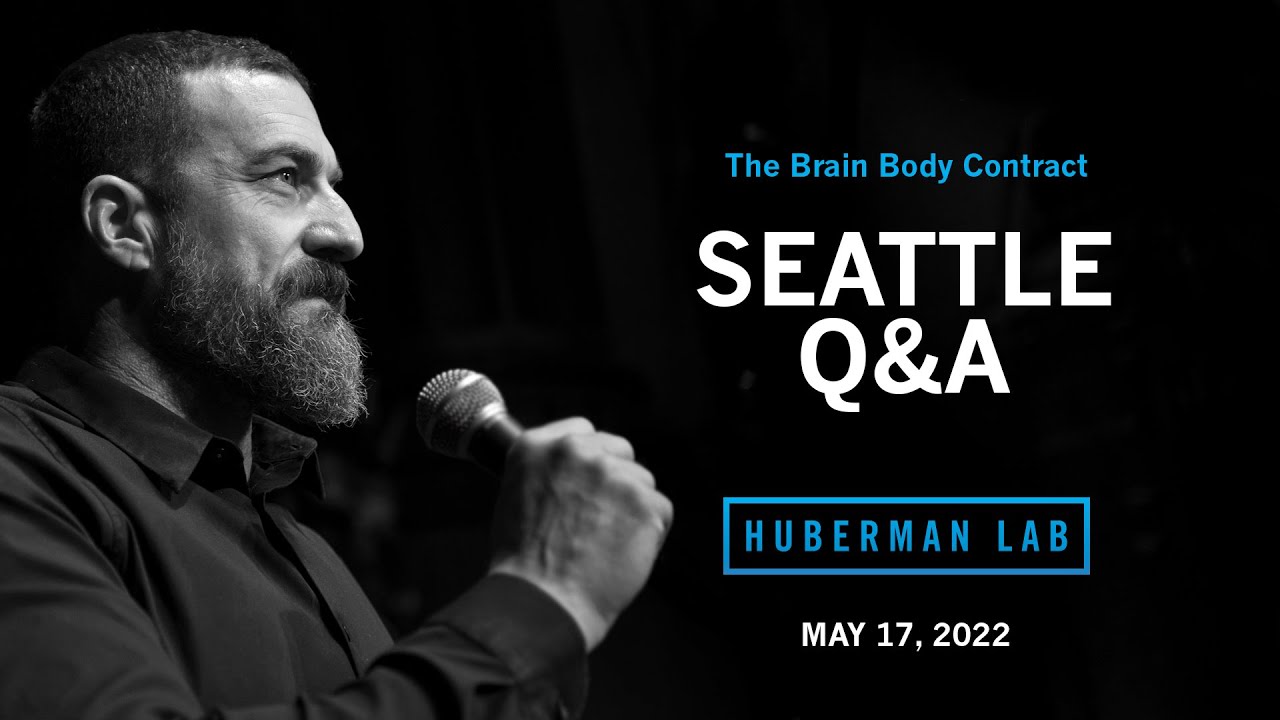
Andrew Huberman: Professor of Neurobiology and Ophthalmology at Stanford School of Medicine and host of the Huberman Lab Podcast, known for translating neuroscience into actionable everyday tools.
What this episode covers
This is the audience question-and-answer portion of Huberman's 'The Brain Body Contract' live event in Seattle. He answers attendee questions about his most-used protocols, sleep cycles, books that shaped him, the future of mental-health treatment, creativity, memory, social-media addiction, supplements, and ADHD. He shares personal stories about late mentors, his bulldog Costello, and his nervousness on stage. The session blends practical neuroscience tools with candid personal reflection.
Recommended on this episode
On the Move
Oliver Sacks
“Oliver Sack's autobiography, "On the Move," had a profound impact on me. You know, people hated him?”— Andrew Huberman
The Four Hour Chef
Tim Ferriss
“I learned how to make a decent steak and a few other simple recipes, not well, from Tim Ferris's book, "The Four Hour Chef"”— Andrew Huberman
Mastery
Robert Greene
“I like Robert Greene's book, "Mastery," because I've had amazing mentors and that book is all about finding mentors”— Andrew Huberman
Photo Ark
Joel Sartore
“if you can get a hold of Joel Sartore's Instagram account, the "Photo Ark," he decided to take pictures of every animal on the planet”— Andrew Huberman
Also referenced (named, not recommended)
Ozark
Netflix
“And then you flip on "Ozark" and you're watching "Ozark", and then you really don't know where you are in time. I have one more episode.”— Andrew Huberman
The Wire
HBO
“That show is, when I was a postdoc, I used to recommend, "The Wire," to my competitors.”— Andrew Huberman
Awakenings
Oliver Sacks
“It wasn't until "Awakenings" became a blockbuster movie that suddenly he got appointments at NYU and Columbia.”— Andrew Huberman
Alpha-GPC
“I do take some of the things that we talk about on the podcast to do some focused work, sometimes alpha-GPC”— Andrew Huberman
Vitamin D3
“D3, it seems to be a lot of people deficient in D3, but not everybody. So I think that those are the main ones.”— Andrew Huberman
Big reveals from this episode
- Huberman 'urges a vote for psychedelics' and admits that four years ago he was terrified to even say the word for fear of losing his job.
- Johns Hopkins researcher Matthew Johnson told him to 'macrodose' rather than microdose for guided plasticity, which surprised Huberman.
- Counterintuitive memory claim: spike adrenaline AFTER learning (double espresso or ice bath) rather than before, citing McGaugh and Cahill.
- Calls social media use addiction when 'this isn't even that interesting' yet you keep scrolling, and turns his phone off for hours daily.
- Reveals Lex Fridman put a video online of choking Huberman out in jiu-jitsu, and jokes he wants payback.
- Admits all three of his science mentors (undergrad, grad, postdoc) died young of suicide and cancer, a 'weird curse.'
- Says simply mentioning he eats butter triggered internet backlash, and he once heard rumors he was dead.
Worth remembering
- Huberman does 10-30 minutes of Non-Sleep Deep Rest every single day, his most-used protocol alongside morning sunlight.
- He coined the term NSDR partly because he feared 'Yoga Nidra' would spook people.
- Waking at the end of a 90-minute ultradian cycle can leave you more rested than sleeping longer mid-cycle.
- Giving people a beta blocker after learning emotional information impairs their memory of it.
- His study with David Spiegel found the 'physiological sigh' (double inhale, long exhale) the most effective breathing practice for calming.
- Richard Feynman taught himself to draw late in life and was into flotation tanks and bongo drumming.
- Rusty Gage's Salk lab showed even terminally ill, elderly people still produce new neurons in the hippocampus.
- Huberman cites that roughly 80% of college students use stimulants like Adderall or Modafinil at some point.
- He accesses creative states by staring at unpredictable visual input, like videos of Tokyo aquariums.