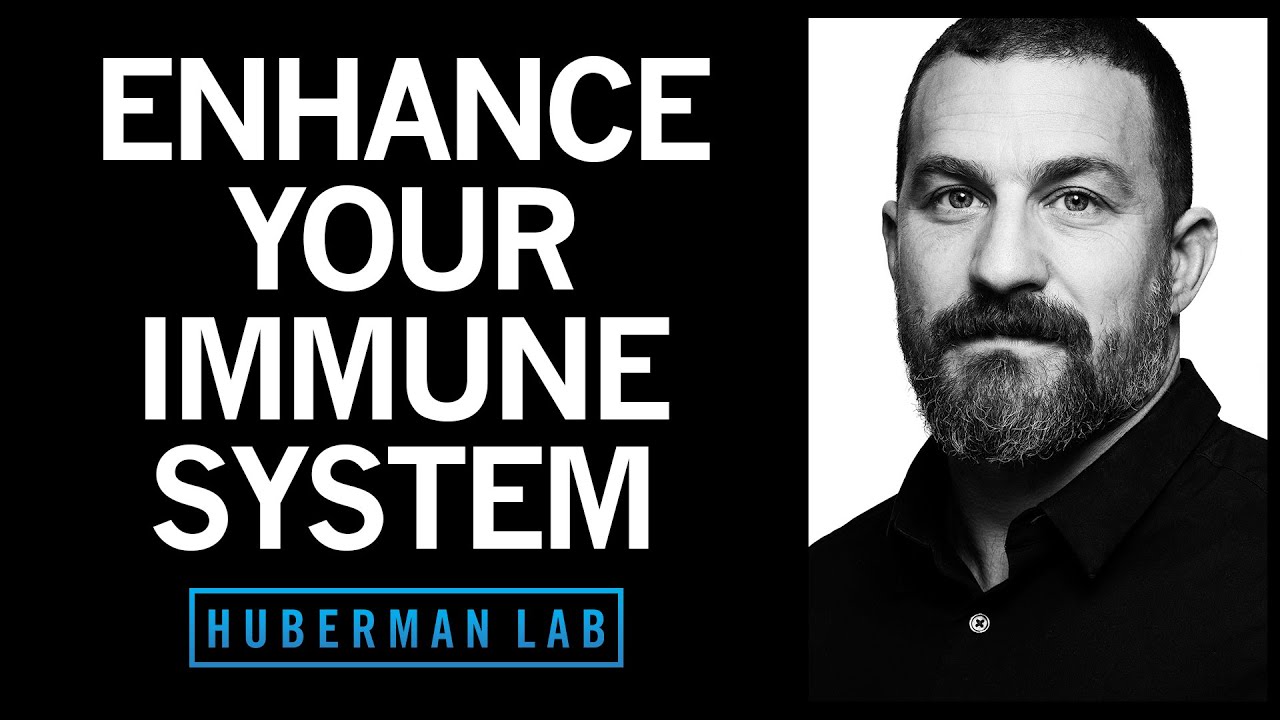
Andrew Huberman: Professor of Neurobiology and Ophthalmology at Stanford School of Medicine and host of the Huberman Lab Podcast, where he translates science into actionable health tools.
What this episode covers
In this solo episode, Huberman delivers an immune system 101 covering the three layers of defense (skin/mucus barriers, the innate immune system, and the adaptive immune system) before bridging into how the nervous system controls immunity. He explains 'sickness behavior' and its overlap with depression via inflammatory cytokines, then pivots to actionable protocols. He details how the vagus nerve and hypothalamus drive fever, photophobia, and lethargy, and how breathing, heat, cold, and mindset can reverse the equation. Tools covered include cyclic hyperventilation (Wim Hof-style breathing), sauna, feet elevation for glymphatic clearance, fermented foods, spirulina for congestion, and dopamine-boosting approaches. He closes by celebrating new mechanistic research validating acupuncture and breathwork.
Recommended on this episode
Jaws: A Hidden Epidemic
Sandra Kahn and Paul Ehrlich
“And there's a terrific book called "Jaws: A Hidden Epidemic," which was written by my colleagues, Sandra Kahn and Paul Ehrlich at Stanford.”— Andrew Huberman
Reverie self-hypnosis app
David Spiegel
“Reverie is a cost-free app for Apple and Android that was developed by my colleague, David Spiegel, and others at the Stanford University School of Medicine.”— Andrew Huberman
Spirulina (Spirulina platensis)
“spirulina can have potent effects in reducing what's called rhinitis, which is a fancy word for congestion of the nose and an inflammation of the nose.”— Andrew Huberman
Pilot V5 pen
Pilot
“maybe, like my PILOT V5s, which I love so much, we could traumatize me to the PILOT V5 if I had some horrible experience happen.”— Andrew Huberman
Also referenced (named, not recommended)
5-HTP supplement
“it's 300 to 500 milligrams taken about 30 to 60 minutes before going to sleep for the night. That's the typical protocol.”— Andrew Huberman
Prozac
Eli Lilly
“This is the basis for things like SSRIs, selective serotonin reuptake inhibitors, like Prozac and Zoloft, and so forth.”— Andrew Huberman
Zoloft
Pfizer
“selective serotonin reuptake inhibitors, like Prozac and Zoloft, and so forth.”— Andrew Huberman
L-Tyrosine supplement
“things like L-tyrosine, taking anywhere from 500 to 750 milligrams can increase dopamine because tyrosine is a dopamine precursor.”— Andrew Huberman
Mucuna pruriens
“Things like Mucuna pruriens, which are L-dopa, the immediate precursor to dopamine.”— Andrew Huberman
Big reveals from this episode
- A new Nature paper from Qiufu Ma's lab at Harvard shows electroacupuncture stimulating fascia triggers a vagal-adrenal pathway that releases potent anti-inflammatory chemicals.
- Sickness behavior is a motivated state, and about 50% of people want to be cared for when sick while the other 50% want to be left alone.
- Huberman calls the popular idea that the vagus nerve calms you down 'a myth' - vagal stimulation usually increases arousal.
- The PNAS study injected human subjects with E. coli; those doing cyclic hyperventilation breathing had reduced inflammation and flu-like symptoms.
- Huberman says don't waste money on alkaline water because you can't shift your body's overall alkalinity.
- Asya Rolls' lab shows activating the dopamine reward pathway can produce highly significant reductions in tumor size in cancers.
- A Science paper (Kataoka) identified a corticolimbic-hypothalamic brain pathway proving you can literally 'worry yourself sick' into a fever.
- Spirulina, an algae, works as well as some prescription drugs for nasal congestion by inhibiting histaminergic mast cells.
Worth remembering
- Within about 30 seconds of meeting someone, most people unconsciously wipe that person's chemicals onto their own face or body.
- The crust in your eyes when you wake up is actually dead bacteria you successfully battled during the night.
- Fever has a functional, adaptive role - heat helps kill invaders, so lowering it with drugs can undercut your body's defense.
- The glymphatic system washes debris out of the brain and is most active during deep sleep.
- Elevating your heels about 12 degrees while sleeping can increase glymphatic clearance.
- A single 15-minute Finnish sauna session increased white blood cell profiles and adjusted cortisol levels.
- People often get sick right after a stressful period ends because adrenaline had been propping up their immune response.
- The cyclic hyperventilation protocol is essentially Wim Hof breathing, similar to historical Tummo breathing.
- Both major depression and acute illness involve robust increases in IL-6 and tumor necrosis factor alpha.
- Eating two to four servings a day of low-sugar fermented foods reduces inflammatory cytokines via the gut microbiome.