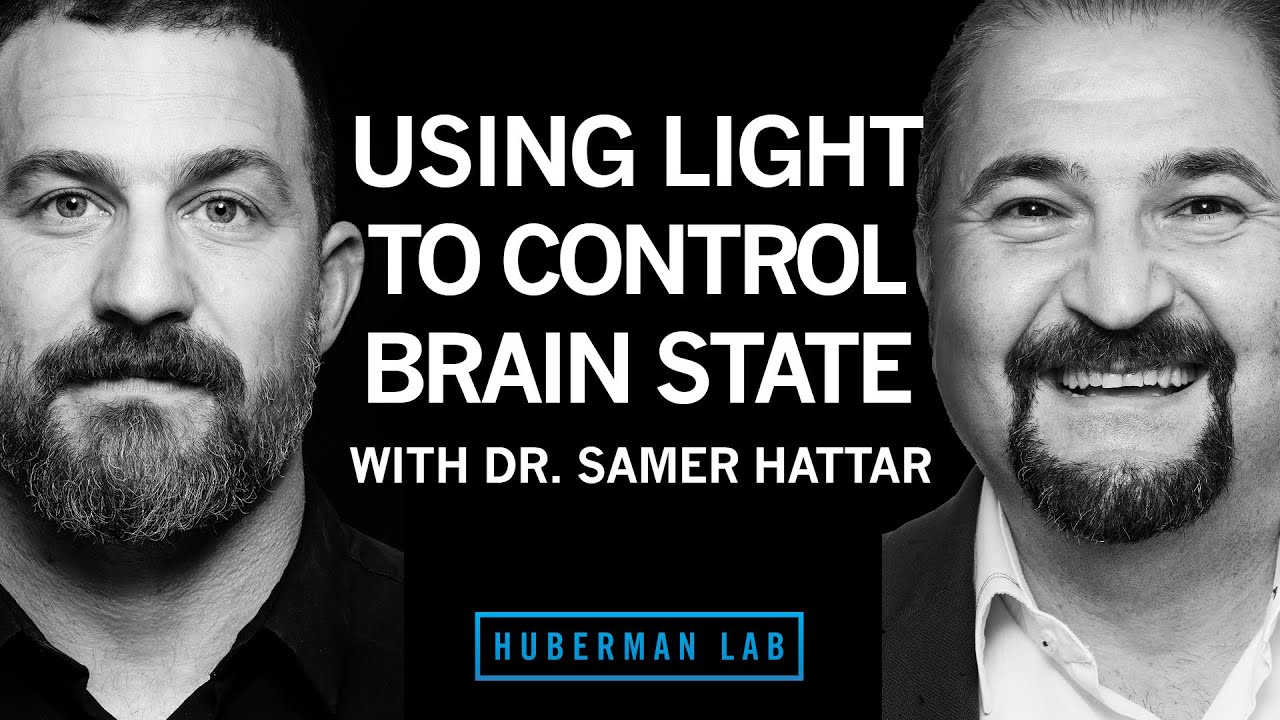
Dr. Samer Hattar: Chief of the Section on Light and Circadian Rhythms at the National Institute of Mental Health. He was among the scientists who discovered the light-sensing retinal cells (ipRGCs) that set the body's circadian clock.
What this episode covers
Andrew Huberman interviews circadian biologist Dr. Samer Hattar about how light, far beyond vision, subconsciously sets the body's clock and directly shapes mood, learning, hunger, and metabolism. Hattar walks through practical rules for viewing bright light in the morning and throughout the day while minimizing light at night, and explains how to gauge true light intensity rather than trusting the eye. He introduces his 'tripartite model,' arguing that the circadian clock, the homeostatic sleep drive, and direct environmental light input must all be aligned, alongside regular meal and exercise timing. He shares how applying these principles helped him lose roughly 56 pounds, and gives concrete protocols for beating jet lag, daylight saving disruption, and seasonal mood shifts.
Recommended on this episode
The Circadian Code
Satchin Panda
“we're referring to Satchin Panda's work, he wrote a beautiful book called "The Circadian Code."”— Andrew Huberman
Also referenced (named, not recommended)
Light Meter app
“there are apps, free apps like Light Meter, where you can walk around and hold the button down and see how many lux are in the environment.”— Andrew Huberman
Oura Ring
Oura
“Do you think that's going to come from using better trackers, like Oura rings, WHOOP straps, these kinds of things?”— Andrew Huberman
WHOOP strap
WHOOP
“Do you think that's going to come from using better trackers, like Oura rings, WHOOP straps, these kinds of things?”— Andrew Huberman
Big reveals from this episode
- Hattar's Nature paper showed light at the wrong time damages mood and learning even without disrupting the circadian clock or causing sleep deprivation.
- Mood effects of light run through a different brain region (the perihabenular nucleus) than circadian setting, projecting to the prefrontal cortex.
- Hattar introduces his 'tripartite model': circadian clock, homeostatic sleep drive, and direct light/environment input must all be aligned.
- Killing the light-entrainment cells unexpectedly destroyed the animals' ability to entrain to food, opposite of what the lab predicted.
- Hattar reveals he lost about 56 pounds (from 275 to 219) by aligning light, meal timing, and exercise to his circadian cycle.
- Hattar argues light is the strongest time-giver and must be regulated first before food, exercise, and sleep fall into place.
- Hattar admits a six-day conference of late-night partying takes him two full weeks of jet-lag-like recovery afterward.
- Hattar makes the case to abolish daylight saving time entirely, calling the one-hour shifts biologically harmful.
Worth remembering
- The human circadian clock runs about 24.2 hours, drifting roughly 0.2 hours per day without sunlight to reset it.
- Even a cloudy day is far brighter than indoor lighting, so outdoor light still sets the clock through clouds.
- About 15 minutes of daily morning light is enough; the system is 'photon counting' and tracks light continuously.
- Hattar dislikes blue-blocker glasses because filtering one wavelength distorts vision; dimming full-spectrum light is better.
- Bright light at night disrupts the clock even with blue blocked, since the cells also respond to a wide spectrum.
- Both totally dark rooms and complete darkness induce anxiety; even nocturnal animals get depressed in constant dark.
- Regular meal timing acts as a second time-giver, so hunger can spike sharply right at your usual eating time.
- Light early in the evening delays your clock; light after your temperature low (early morning) advances it.
- Spring may carry higher suicide risk because returning light gives deeply depressed people the energy to act.
- People with lighter-colored eyes likely need less light because a lighter pupil blocks fewer photons.