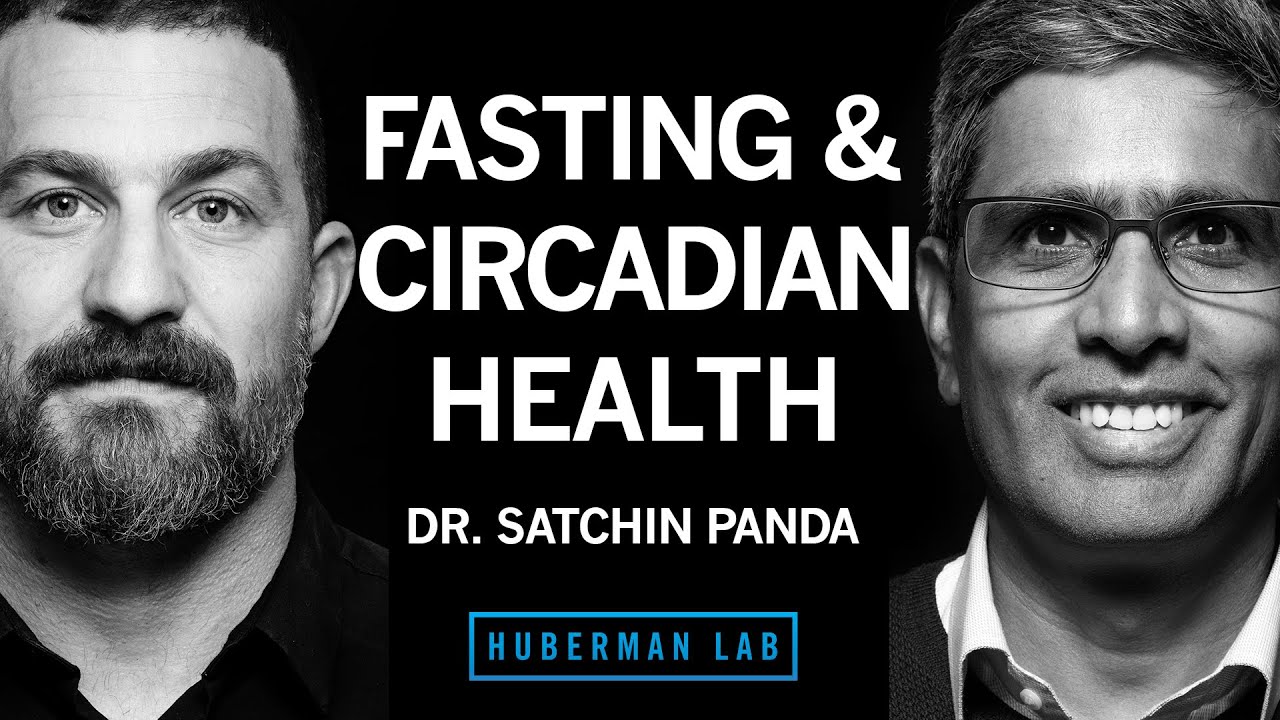
Sachin Panda: Professor and director of the regulatory biology laboratory at the Salk Institute. A pioneer of circadian rhythm and time-restricted feeding research, and author of The Circadian Code and The Circadian Diabetes Code.
What this episode covers
Andrew Huberman and Dr. Sachin Panda dig into the science of intermittent fasting (time-restricted feeding) and circadian biology. They distinguish caloric restriction from meal timing, citing mouse studies showing lifespan extensions of 10-35% depending on when calories are eaten. The conversation covers what 'breaks a fast,' optimal eating windows (8-12 hours), the risks of overly short windows (RED-S, lost menstrual cycles, bone loss), and how light, caffeine, fire, and evening socialization shaped human eating and sleep. Panda details his firefighter time-restricted-eating trial showing improved blood pressure, blood sugar, and reduced alcohol intake, and argues that roughly half of adults effectively live like shift workers.
The guest's own work
The Circadian Code
Sachin Panda
“those books include the Circadian code and a more recent book the Circadian diabetes code both of which we've provided links to in the show note captions”— Andrew Huberman
The Circadian Diabetes Code
Sachin Panda
“those books include the Circadian code and a more recent book the Circadian diabetes code both of which we've provided links to in the show note captions”— Andrew Huberman
myCircadianClock app
Sachin Panda
“they used our my security and clock app this is a research app we developed just to this is mostly used in time restricted eating studies”— Sachin Panda
Also referenced (named, not recommended)
Actiwatch
Philips Respironics
“it was this active watch which is kind of a modern activity tracker um but it's a little bit more refined because it also collects light information”— Sachin Panda
Berberine
“berberine is kind of the Poor Man's metformin it's a tree bark extract that also dramatically lowers blood glucose”— Andrew Huberman
Metformin
“two very popular drug like molecules or drugs that people think will increase longevity or metformin which many people agree”— Sachin Panda
Big reveals from this episode
- Mice on calorie restriction lived 10% longer, but timing the same calories to the active phase pushed lifespan extension to 35%.
- Researcher Joe Takahashi found that no known biomarker (A1c, glucose, cholesterol) predicted the longevity benefit of caloric restriction.
- Panda reframes obesity: instead of asking why 60% of Americans are overweight, ask why 40% stay at a healthy weight.
- Coffee's strong acid reflux is what created the culture of breakfast in Turkey, so coffee led to breakfast, not the other way around.
- Ken Wright's camping studies showed self-described night owls all went to bed by 9-10:30pm once removed from artificial light.
- In the firefighter trial, 10-hour time-restricted eating lowered blood pressure to a degree one physician compared to an antihypertensive drug.
- Time-restricted firefighters significantly reduced their alcohol intake, unlike the Mediterranean-diet-only group.
- Panda raises an open question: long-term low-carb diets may leave pancreatic islet cells under-engaged, like unused muscles atrophying.
Worth remembering
- Walter Longo's periodic fasting (4-5 days every 1-3 months) and 5:2 and alternate-day fasting all fall under the intermittent fasting umbrella.
- Daylight saving time's spring forward correlates with a sharp rise in heart attacks and car accidents due to disrupted anticipatory rhythms.
- Nearly 40% of athletes experience RED-S (relative energy deficit in sport), often without knowing it.
- Argentine Toba people without electricity consistently go to bed about 3-3.5 hours after sunset, with very tight sleep-onset variability.
- About one in five working adults is a card-carrying shift worker, but roughly half the adult population effectively lives like one.
- Five nights of shift-worker-like sleep loss can push a perfectly healthy person's blood glucose into the pre-diabetic range.
- Panda's app study found people eat a median of seven times per day, with the top 10% eating 12 times daily.
- Nearly 50% of adults eat across a window of about 15 hours or longer; only ~10% eat within a conventional 12-hour, three-meal pattern.
- A Scripps study found metformin's glucose-lowering ability varies dramatically depending on the time of day it is taken.
- Huberman notes data showing health deficits begin beyond just zero to two alcoholic drinks per week.