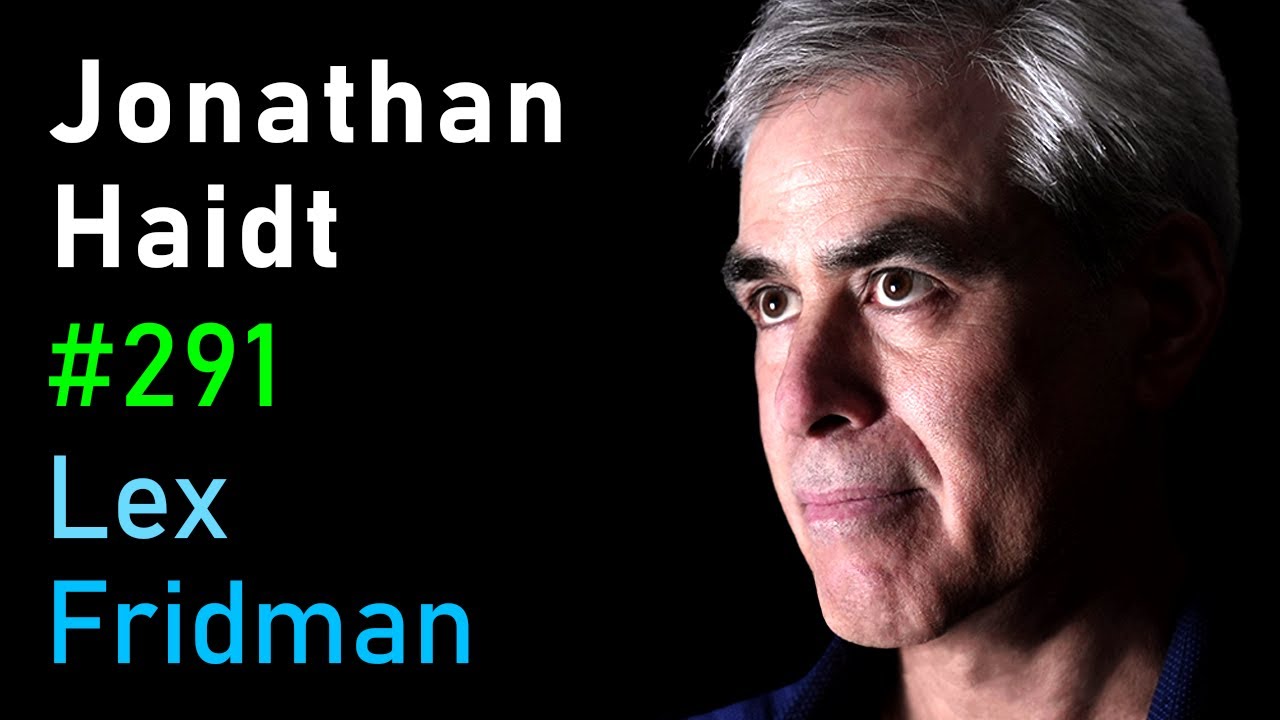
Jonathan Haidt: Social psychologist at NYU's Stern School of Business and author of The Righteous Mind and The Coddling of the American Mind. He studies moral psychology, polarization, and the effects of social media on teens and democracy.
What this episode covers
Haidt joins Lex Fridman to deliver a hard-hitting rebuttal to Mark Zuckerberg's claims that Instagram is good for teens and that social media isn't a major driver of polarization. He lays out evidence that teen mental health, especially for pre-teen girls, fell off a cliff around 2012-2013, coinciding with the rise of like/retweet virality and smartphone adoption. He frames the harm not as a 'dose' problem but as a rewiring of childhood, advocating raising the minimum social-media age to 16 with enforcement and restoring free play. On democracy he uses the Tower of Babel as a metaphor for fragmentation, arguing the real fix is user authentication and changing platform dynamics rather than content moderation. The two debate Elon Musk's Twitter purchase, CEO authenticity versus fiduciary duty, and design ideas for incentivizing constructive behavior online.
Recommended on this episode
Free Range Kids
Lenore Skenazy
“i'm a big fan of leonardo skinnezy who wrote the book free range kids if there are any parents listening to this please buy lenora's book”— guest
The Great Experiment
Yascha Mounk
“there's a wonderful book by yasha monk called the great experiment that talks about the difficulty of diversity in democracy”— guest
The Revolt of the Public
Martin Gurri
“martin guri he was a former cia analyst wrote this brilliant book uh called the revolt of the public”— guest
The guest's own work
The Coddling of the American Mind
Jonathan Haidt and Greg Lukianoff
“he has brilliantly discussed these topics in his writing including in his book the coddling of the american mind”— Lex Fridman
The Happiness Hypothesis
Jonathan Haidt
“you wrote the happiness hypothesis the righteous mind the coddling of the american mind and today you're thinking”— Lex Fridman
The Righteous Mind
Jonathan Haidt
“you wrote the happiness hypothesis the righteous mind the coddling of the american mind and today you're thinking”— Lex Fridman
Also referenced (named, not recommended)
iGen
Jean Twenge
“this has worked with gene twenge uh who wrote the book igen is um because i was challenged”— guest
How to Win Friends and Influence People
Dale Carnegie
“i could say go read dale carnegie how to win friends and influence people but take charge of your life and your development”— guest
Big reveals from this episode
- Haidt says teen mental health 'fell off a cliff' around 2012-2013 with depression, self-harm and suicide rising 50-150% suddenly across multiple countries.
- He debunks the famous 'social media is no worse than eating potatoes' claim, showing that study lumped in all screen use and the real correlation for girls is much higher.
- His core thesis: social media isn't a dose-response problem like sugar, it's a complete rewiring of childhood that began with the loss of free play in the 1990s.
- Bold policy stance that kids should be barred from these platforms until 16, with enforcement, because there's no way to make them safe for pre-teens.
- He reframes the whole crisis through the Tower of Babel metaphor: God confusing language and scattering people maps onto modern fragmentation.
- Sharp criticism of Elon Musk declaring himself Republican, calling it 'throwing fuel on a fire' and a violation of a CEO's fiduciary duty.
- Haidt argues content moderation barely matters; 'all the action is in the dynamics, the architecture, the virality' and user authentication.
- Lex admits he worries social media could help trigger world war, while Haidt says he fears 'civil war two' as the more likely prospect.
Worth remembering
- Suicide for pre-teen girls roughly doubled between 2010 and 2015, and the crisis hit pre-teen girls hardest.
- Around 2010-2012 girls flocked to visual platforms like Instagram and Tumblr while boys went to YouTube and video games, which seem far less harmful.
- Public-health correlations are almost never above 0.2; childhood lead exposure and adult IQ is only 0.09, yet girls' social-media harm runs around 0.15-0.22.
- Haidt organizes his entire research literature in collaborative Google Docs so critics with opposite biases can add and challenge studies.
- He recounts his first paintball game at 29 feeling like 'we'd opened a room in our hearts,' illustrating humans' evolved appetite for tribal conflict.
- A small number of users adept at social media can act as catalysts who start a viral wave of mob destruction, usually over a single word, not ideas.
- Haidt floats rating users 1-5 for hostility, defaulting accounts to never see the worst offenders, disincentivizing hostility without censorship.
- The Turner Diaries, a 1978 novel that spread replacement theory, was on Timothy McVeigh when he was captured after the 1995 Oklahoma City bombing.
- Haidt's NYU course 'Work, Wisdom and Happiness' boils success down to becoming stronger, smarter and more sociable.
- He invokes Chief Justice John Roberts' middle-school graduation speech wishing students unfairness, betrayal and loneliness to build character.