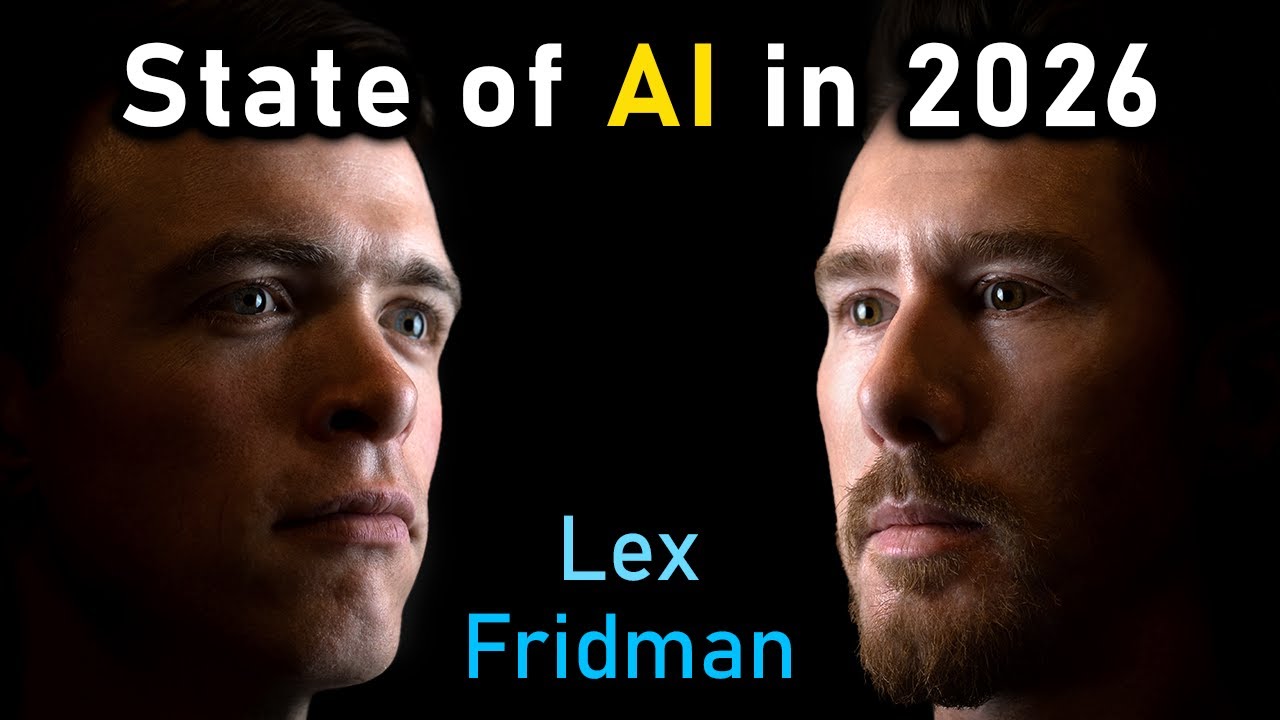
Sebastian Raschka and Nathan Lambert: Sebastian Raschka is a machine learning researcher and author of 'Build a Large Language Model from Scratch' and 'Build a Reasoning Model from Scratch.' Nathan Lambert is the post-training lead at the Allen Institute for AI (Ai2) and author of a definitive book on Reinforcement Learning from Human Feedback.
What this episode covers
In this multi-guest roundtable, Lex Fridman talks with researchers Sebastian Raschka and Nathan Lambert about the state of AI roughly a year after the 'DeepSeek moment.' They debate who is winning between US and Chinese labs, dissect the explosion of open-weight models, and explain the technical lineage from GPT-2 to today's architectures (Mixture of Experts, attention variants, KV cache). A large portion covers training stages, scaling laws, and the rise of reinforcement learning with verifiable rewards (RLVR) and inference-time scaling. They also discuss education and learning, careers in AI, tool use, continual learning, robotics, timelines to AGI/ASI, the business and consolidation landscape, NVIDIA's moat, and Nathan's ADAM Project to build American open models.
Recommended on this episode
Build a Large Language Model from Scratch
Sebastian Raschka
“Sebastian is the author of two books I highly recommend for beginners and experts alike. First is Build a Large Language Model from Scratch”— Lex Fridman
Build a Reasoning Model from Scratch
Sebastian Raschka
“two books I highly recommend for beginners and experts alike. First is Build a Large Language Model from Scratch and Build a Reasoning Model from Scratch”— Lex Fridman
Season of the Witch
David Talbot
“It's a great book, Season of the Witch. I recommend it. A bunch of my SF friends who get out recommended it to me.”— Nathan Lambert
Claude Code
Anthropic
“You can select the same models on all of them and ask questions, and it's very interesting. Claude Code is way better in that domain. It's remarkable.”— Lex Fridman
Cursor Composer
Anysphere
“I should say I use Composer a lot because one of the benefits it has is that it's fast.”— Lex Fridman
The guest's own work
Reinforcement Learning from Human Feedback
Nathan Lambert
“Nathan is the post-training lead at the Allen Institute for AI, author of the definitive book on Reinforcement Learning from Human Feedback”— Lex Fridman
Also referenced (named, not recommended)
Apple in China
Patrick McGee
“The book Apple in China by Patrick McGee, he talked about how hard the Apple engineers worked to set up the supply chains in China”— Nathan Lambert
Cursor
Anysphere
“I use basically half-and-half Cursor and Claude Code, because they're fundamentally different experiences and both are useful.”— Lex Fridman
Claude Opus 4.5
Anthropic
“for code and any sort of philosophical discussion, I use Claude Opus 4.5. Also always with extended thinking.”— Nathan Lambert
ChatGPT
OpenAI
“for my personal usage, most of the time when I look something up, I use ChatGPT to ask a quick question, get the information I wanted fast.”— Sebastian Raschka
Gemini
“I use Gemini for fast things or stuff that I could sometimes Google, which is it's good at explaining things and the Gemini app has gotten a lot better”— Nathan Lambert
GPT-5.2 Pro
OpenAI
“I will only use GPT-5.2 Thinking or Pro when I'm finding any sort of information query for work, whether that's a paper or some code reference”— Nathan Lambert
Codeium
Codeium
“I use the Codeium plugin for VS Code. You know, it's very convenient. It's just like a plugin, and then it's a chat interface that has access to your repository.”— Sebastian Raschka
Codex
OpenAI
“Codex can often be as good from OpenAI, but it just feel a little bit rough around the edges. Whereas Claude Code makes it fun to build things from scratch”— Nathan Lambert
Perplexity
Perplexity AI
“I should say, going to Perplexity here, Sebastian Raschka is a machine learning researcher and author known for several influential books.”— Lex Fridman
The Legend of Zelda
Nintendo
“Sometimes for pastime I play video games, like I like video games with puzzles, like Zelda and Metroid.”— Nathan Lambert
Metroid
Nintendo
“Sometimes for pastime I play video games, like I like video games with puzzles, like Zelda and Metroid.”— Nathan Lambert
Big reveals from this episode
- Raschka argues there will be no winner-take-all in AI because researchers rotate between labs, so ideas are not proprietary; the differentiating factor will be budget and hardware, not technology access.
- DeepSeek is described as losing its crown as China's preeminent open model maker as Z.ai (GLM), MiniMax, and Kimi Moonshot rise, with DeepSeek having kicked off a broad Chinese open-weight movement.
- Despite rapid AI progress, the autoregressive transformer derived from GPT-2 remains essentially the same architecture; advances come from data, systems, and training stages rather than fundamental architecture changes.
- Lambert reveals he was on the Ai2 team (Tulu 3 work) that coined the term RLVR before DeepSeek, while DeepSeek did the actual breakthrough of scaling reinforcement learning.
- Unlike RLVR and inference-time scaling, RLHF has no clean scaling law where log-increasing compute yields linear performance gains; the seminal RLHF scaling paper is about reward model over-optimization.
- Lambert details the ADAM Project (American Truly Open Models) to build and host high-quality US open-weight models to compete with China's open-source ecosystem, noting Ai2 received a $100M NSF grant over four years.
- Cursor reportedly updates its Composer model weights every 90 minutes based on real-world user feedback, described as the closest thing to real-world RL happening on a deployed model.
- Anthropic lost a court case in 2025 and owed $1.5 billion to authors, tied to torrenting books, even though buying and scanning books was cleared as legal.
Worth remembering
- DeepSeek's pre-training reportedly cost about $5 million at cloud market rates, and OLMo 3 cost roughly $2 million to rent the cluster, while serving millions of users costs billions in compute.
- Leaders cite scaling laws holding for about 13 orders of magnitude of compute as a reason it is unlikely to stop soon.
- Pre-training dataset sizes are measured in trillions of tokens; researcher models use 5-10 trillion, Qwen is documented up to 50 trillion, and closed labs are rumored to reach 100 trillion tokens.
- A survey of about 791 professional developers found both junior and senior devs ship AI-generated code, with senior developers more likely to ship code that is over 50% AI-generated, and about 80% finding work more enjoyable with AI.
- The guests note a brief roughly 10-year window where exams could be digital yet uncheatable; after AI, education is reverting to blue books and oral exams.
- The '996' work culture (9am to 9pm, six days a week, about 72 hours) originated in China and has been adopted in Silicon Valley AI companies.
- OpenAI's average employee compensation is cited as over a million dollars in stock per year.
- Manus.ai, a Singapore-based company, was founded about eight months prior and had a roughly $2 billion exit; Groq (~$20B) and Scale AI (~$30B) are cited as consolidation deals.
- In the DeepSeek R1 paper, the longer the model trains, the longer its responses grow, and the 'aha moment' is when the model self-corrects and recognizes its own mistakes.
- NVIDIA's real moat is described as the CUDA ecosystem built over roughly two decades, not the GPU chip itself, though LLMs may make replicating something like CUDA easier.