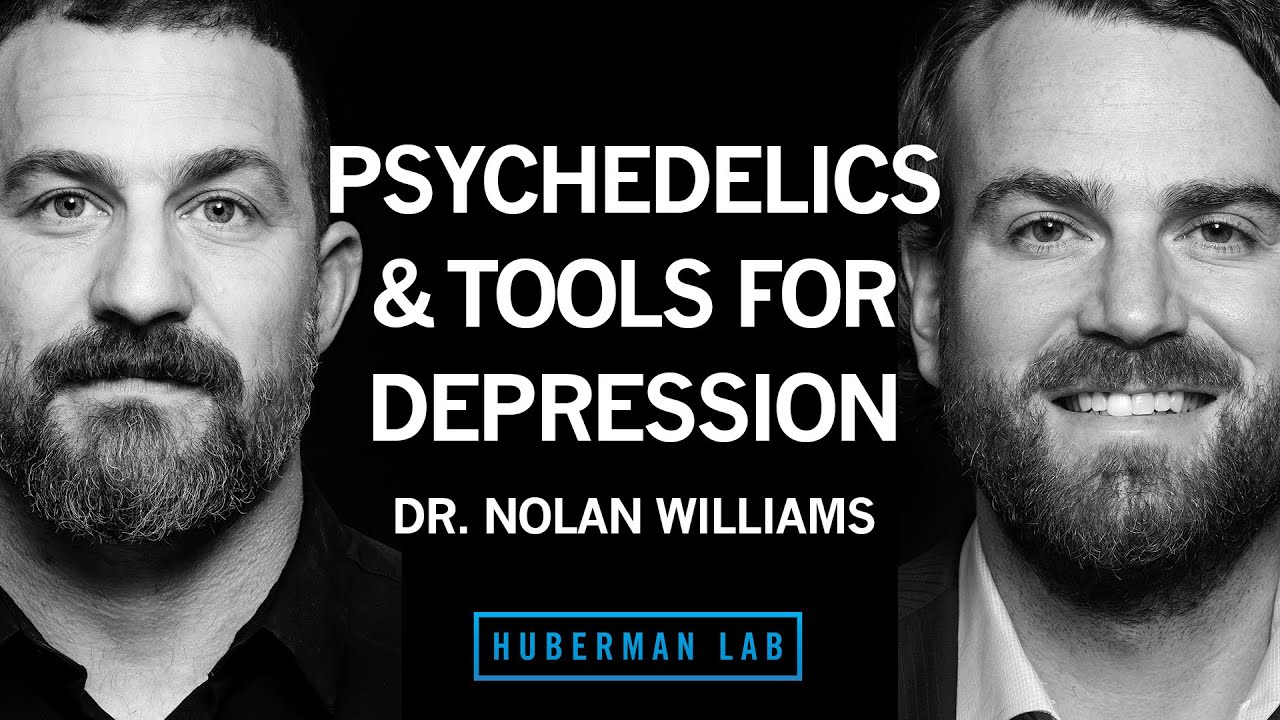
Dr. Nolan Williams: Medical doctor and Stanford professor of psychiatry and behavioral sciences who directs the Brain Stimulation Laboratory. He pioneers transcranial magnetic stimulation (TMS) combined with psychedelics to treat severe, treatment-resistant depression and PTSD.
What this episode covers
Andrew Huberman and Dr. Nolan Williams explore the neural circuitry of depression, focusing on the left dorsolateral prefrontal cortex and its connections to the cingulate, vagus nerve, and heart. Williams describes how TMS can re-time the brain's governance circuits to remit depression in one to five days, and how his lab combines stimulation with cutting-edge compounds. They examine the mechanisms, safety, and clinical status of ketamine, psilocybin, MDMA, ibogaine, 5-MeO-DMT, ayahuasca, and cannabis, challenging the serotonin 'chemical imbalance' theory and the assumption that the psychedelic experience itself drives recovery. The conversation closes with sleep-deprivation triple therapy, the relative risks of drugs, and the SAINT/SNT accelerated TMS protocol now FDA-cleared via Magnus Medical.
Also referenced (named, not recommended)
Breaking Open the Head
Daniel Pinchbeck
“If you're interested in this, there's a book called "Breaking Open the Head" by Daniel Pinchbeck that goes through and talks about this whole process”— Nolan Williams
Minority Report
Steven Spielberg
“have you ever seen "Minority Report," you know, the movie with Tom Cruise, I think 15 or 20 years ago or something?”— Nolan Williams
One Flew Over the Cuckoo's Nest
Milos Forman
“the counterculture of the '60s and '70s, some of which took place, like "One Flew Over the Cuckoo's Nest" I think is actually based on the Menlo Park VA”— Andrew Huberman
Charlotte's Web (CBD cannabis strain)
Charlotte's Web
“This strain of cannabis that's THC free, there's no THC at all, and it's all CBD, and it's called Charlotte's Web”— Nolan Williams
GW Pharmaceuticals CBD (Epidiolex)
GW Pharmaceuticals
“there's a company called GW Pharmaceuticals... they have a lot of clinical trials for something called Dravet Syndrome, which is a seizure disorder”— Nolan Williams
Magnus Medical (SAINT/SNT TMS device)
Magnus Medical
“some of my students went over to a company called Magnus Medical, and they've been working on this, they've got an FDA clearance now”— Nolan Williams
Big reveals from this episode
- A naltrexone study showed blocking opioid receptors eliminated ketamine's antidepressant effect while leaving dissociation unchanged, debunking the idea the 'trip' alone is what works.
- Williams says the serotonin 'chemical imbalance' theory of depression is wrong and that TMS works without giving anyone any serotonin.
- He frames a 'psychiatry 3.0' where depression is a correctable, recalibrate-able circuit rather than something permanently missing or broken.
- A famous Science paper claiming MDMA was neurotoxic actually injected monkeys with methamphetamine, not MDMA, and was never formally retracted.
- Ibogaine is described as '10 years of psychotherapy in a night,' letting Navy SEALs re-experience and forgive traumatic moral injuries.
- Studies of children given small ayahuasca doses as sacrament found no neurocognitive effects, and a Brazilian prison study lowered recidivism.
- On David Nutt's combined personal-plus-societal risk ranking, alcohol is the single most dangerous drug, with psilocybin at the safe extreme.
- The SAINT protocol compresses six weeks of TMS into five days using spaced-learning theory, achieving 60-90% remission in severe depression.
Worth remembering
- The American Heart Association added depression as the fourth major risk factor for coronary artery disease, alongside hypertension, high cholesterol, and diabetes.
- In psychiatry, as a patient's acuity rises from depressed to suicidal, the number of available treatments actually goes down on average, the opposite of cardiology.
- Stimulating the left dorsolateral prefrontal cortex decelerates the heart by about 10 beats per minute, time-locked to each two-second stimulation train.
- Brain lesions causing depression map to the left dorsolateral prefrontal cortex, while lesions causing mania map to the right, showing hemispheric mood balancing.
- Patients with depression require triple the oral opioid dose by day four after a total knee replacement, suggesting opioids treat emotional as well as physical pain.
- Roughly two-thirds of PTSD patients in MDMA trials had a clinically significant improvement, with effects lasting into the years range for some.
- Psilocybin decreases overall brain activity while increasing global connectivity, and degates the thalamus, possibly explaining synesthesia.
- With 10,000 to 20,000 Amazonian plant species, someone discovered the precise ayahuasca combination where a MAO inhibitor lets oral DMT cross the blood-brain barrier.
- Cannabis has been selectively bred to maximize THC and breed out CBD, even though CBD is antiepileptic and antipsychotic.
- A 2005 Neuron paper showed TMS mimicking hippocampal rhythms can change cortical excitability for an hour with just three minutes of stimulation.