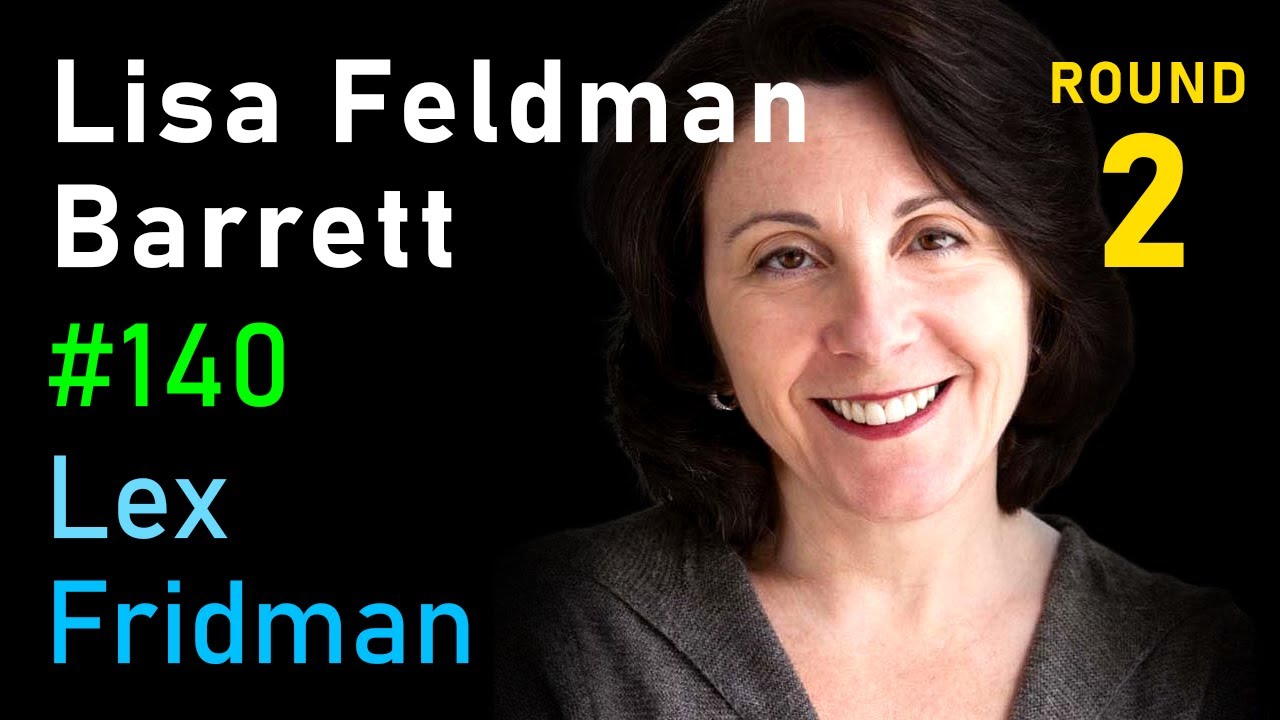
Lisa Feldman Barrett: A neuroscientist at Northeastern University and one of the most cited psychologists in the world, known for her theory of constructed emotion. She is the author of How Emotions Are Made and Seven and a Half Lessons About the Brain.
What this episode covers
Lisa Feldman Barrett returns to the podcast for a wide-ranging, often playful conversation that opens with the romantic story of how she met her husband Dan through a 1992 internet personals ad. The discussion moves into the neuroscience of love, why she rejects 'love at first sight,' and how the brain is fundamentally a predictive organ that budgets the body. She dismantles the myth of the 'triune brain' and the idea that brains evolved in a progressive upward scale toward human rationality, arguing instead that brains emerged under the selection pressure of hunting. They explore the nature of evil, complexity versus single-cause thinking, the lack of a single 'self,' and end with reflections on consciousness and a stack of book recommendations.
Recommended on this episode
At Large and at Small
Anne Fadiman
“after reading a a a small set of essays by an fatan um called at large and at small which I just loved these little essays”— Lisa Feldman Barrett
The Triple Helix
Richard Lewontin
“the things I would recommend are the triple helix um by uh Richard lanon it's a little book published um in 2000 which is um I think a really good introduction to complexity”— Lisa Feldman Barrett
Biology as Ideology
Richard Lewontin
“He has another book too which is it's more I think scientists would find it I don't know I've loved it it's called biology as ideology”— Lisa Feldman Barrett
Naming the Mind
Kurt Danziger
“there's a wonderful book A little it's a fairly small book called naming the Mind by Kurt danziger who's a historian of psychology everybody in my lab reads both of these books”— Lisa Feldman Barrett
On Writing
Stephen King
“Stephen King has a great book writing on writing and um you know where he gives tips um interlaced with his own personal history”— Lisa Feldman Barrett
The Beak of the Finch
Jonathan Weiner
“if I were to pick one book that I think is a really good example of good science writing it would be the beak of the finch which is one of it won a pullit Sur prise”— Lisa Feldman Barrett
The Evolution of Beauty
Richard Prum
“there's also the evolution of beauty which is yeah which is also a great book”— Lisa Feldman Barrett
Major Pettigrew's Last Stand
Helen Simonson
“some of my favorite uh love stories are major pedigree Last Stand by Helen Simonson it's a love story about people who you wouldn't expect to fall in love”— Lisa Feldman Barrett
The Storied Life of A.J. Fikry
Gabrielle Zevin
“another book like that is um the storyed life of AJ FY um which is also a love story but in this case it's a love story between a little girl and her adopted dad”— Lisa Feldman Barrett
The guest's own work
Seven and a Half Lessons About the Brain
Lisa Feldman Barrett
“her new book called 7 and a half lessons about the brain is out now as of a couple of days ago so you should definitely support Lisa by buying it”— Lisa Feldman Barrett
How Emotions Are Made
Lisa Feldman Barrett
“you also have the author of another book is we talked about how emotions are made so it's interesting to talk about the process of writing”— Lisa Feldman Barrett
Also referenced (named, not recommended)
The Fountainhead
Ayn Rand
“he made an analogy between me and uh character in The Fountain Head um the woman who's who's raped in the Fountain Head”— Lisa Feldman Barrett
Borat Subsequent Moviefilm
Sacha Baron Cohen
“I just watched Borat the new Borat movie and the thing that I came away with but you know the thing I came away with was look at how like generous people were”— Lisa Feldman Barrett
The War of the Worlds
“using uh you know those movies like The War of the Worlds or or um Pacific Rim you know where like aliens come down from outer space”— Lisa Feldman Barrett
Pacific Rim
Guillermo del Toro
“using uh you know those movies like The War of the Worlds or or um Pacific Rim you know where like aliens come down from outer space”— Lisa Feldman Barrett
Cast Away
Robert Zemeckis
“I'm thinking now of um Tom Hanks um and um the movie um cway yeah you know with Wilson yeah”— Lisa Feldman Barrett
Doctor Zhivago
David Lean
“but you know like Dr shivago like or The English Patient oh my goodness like why oh it's just yeah”— Lisa Feldman Barrett
The English Patient
Anthony Minghella
“but you know like Dr shivago like or The English Patient oh my goodness like why oh it's just yeah”— Lisa Feldman Barrett
The Art of War
Sun Tzu
“let me leave you some words from sunzoo and the Art of War there are not more than five musical notes yet the combination of these five give rise to more Melodies”— Lex Fridman
Big reveals from this episode
- Barrett recounts meeting her husband Dan via a 1992 anonymous internet personals ad, exchanging 100 text-only emails before ever seeing a photo.
- She names a six-way power plug her husband gave her for Valentine's Day as the most romantic gift she ever received, because it showed he truly understood her.
- She argues the layered 'lizard brain / limbic / neocortex' triune model is a myth traceable to ancient Greek morality stories, not biology.
- Brains evolved under the selection pressure of hunting in the Cambrian period, not as a progressive march toward intelligence.
- Barrett claims almost anyone is capable of doing very bad things, and the environment is partly responsible for creating evil like Hitler.
- She argues you can fall in love through words alone and that a sustaining relationship with an inanimate object is an open empirical question.
- Every special human trait exists in some other animal; what is unique is having all of them combined in one souped-up brain.
- She says consciousness will not be solved under science's current incentive structure, assumptions, and budget.
Worth remembering
- If you think a book will take a year to write, it will take three; good storytelling is mostly knowing what to leave out.
- The amphioxus (lancelet) is essentially 'a little stomach on a stick' with no eyes, ears, nose, or brain.
- Theory of mind may have evolved under predation pressure because inferring others' inner states makes you a better predator.
- The human cerebral cortex is exactly the size you'd expect for a brain of our size, not specially enlarged.
- Crows and other animals can do nearly everything 'special' humans do; we just combine all the abilities in one brain.
- Words have power over biology: a text saying 'I love you' can change a distant friend's heart rate, breathing, and metabolism.
- In controlled studies only 20 to 40 percent of people exposed to a virus actually develop illness; a virus is a necessary but not sufficient cause.
- Humans have no water receptors on the skin; the feeling of wetness is computed in the brain from temperature and touch.
- Barrett read 50 to 60 popular science books before writing How Emotions Are Made to learn the craft.
- 'Be yourself' is a very Western idea because there is no single self; you have multiple selves drawn out by context.