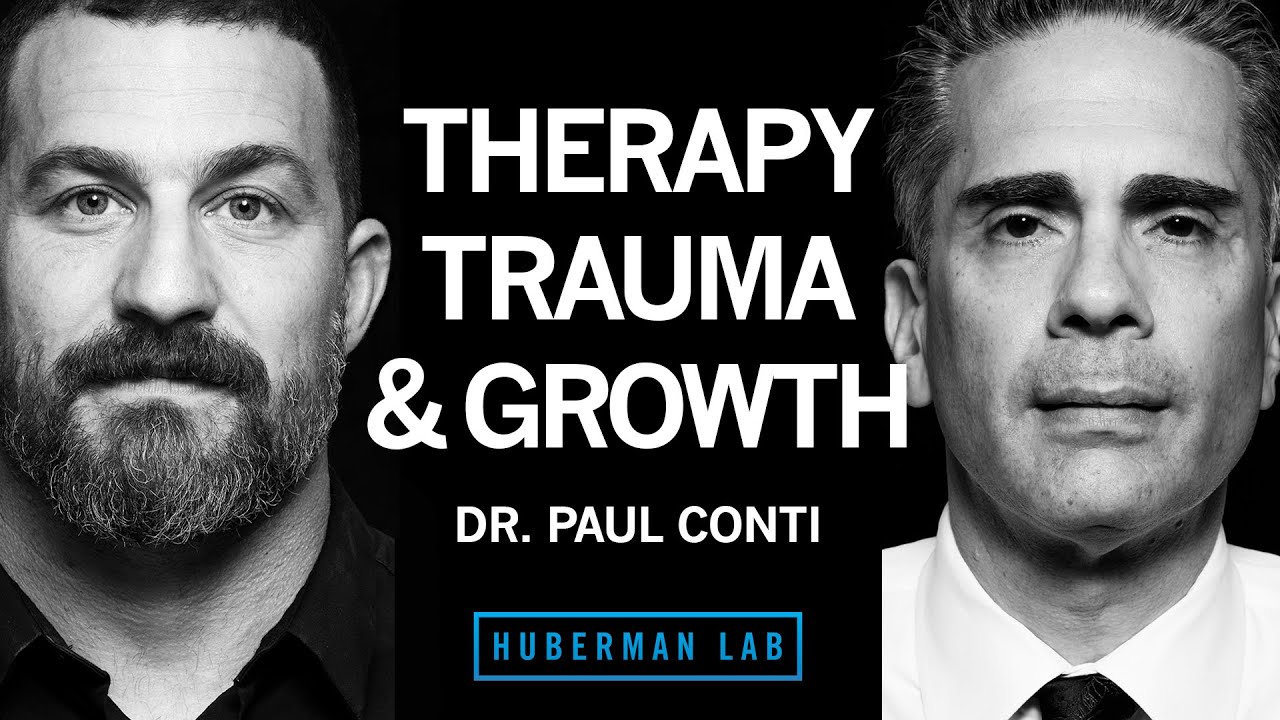
Dr. Paul Conti: A psychiatrist trained at Stanford and chief resident at Harvard who runs the Pacific Premier Group treating complex trauma, addiction, and psychiatric disorders. He is the author of 'Trauma: The Invisible Epidemic.'
What this episode covers
Andrew Huberman interviews psychiatrist Dr. Paul Conti about what trauma actually is, how to recognize it, and how it changes brain function. Conti argues real trauma overwhelms coping skills and reflexively triggers guilt and shame, leading people to bury it and unconsciously repeat harmful patterns. They discuss how to confront trauma through talking, journaling, and therapy, how to find a good therapist (rapport above all), and the role of medication. The conversation also explores stimulants, cannabis, alcohol, and the therapeutic potential of psychedelics like psilocybin, LSD, and MDMA, plus the foundations of self-care.
Recommended on this episode
Why We Sleep
Matthew Walker
“one of the books that I read and found very valuable is Matt Walker, professor at UC Berkeley's book, "Why We Sleep,"”— Andrew Huberman
The 4-Hour Body
Tim Ferriss
“Other books that I've read before... are things like Tim Ferris's "The 4-Hour Body" or Tim Ferris's The 4-Hour Chef book, both of which are excellent”— Andrew Huberman
The 4-Hour Chef
Tim Ferriss
“Tim Ferris's "The 4-Hour Body" or Tim Ferris's The 4-Hour Chef book, both of which are excellent”— Andrew Huberman
The guest's own work
Trauma: The Invisible Epidemic, How Trauma Works and How We Can Heal From It
Paul Conti
“Dr. Conti is also the author of an exceptional book, entitled "Trauma: The Invisible Epidemic, How trauma works and how we can heal from it."”— Andrew Huberman
Also referenced (named, not recommended)
The Black Swan
Nassim Nicholas Taleb
“or Nassim Taleb's "The Black Swan" and there are many other titles as well.”— Andrew Huberman
Listening to Prozac
Peter D. Kramer
“I'm old enough to remember the book, "Listening to Prozac." I remember when Prozac and its and things like it first started showing up”— Andrew Huberman
Dry
Augusten Burroughs
“I think it was an Augusten Burroughs book, "Dry" where he was an alcoholic. He said that the first drink he had, it felt like this magic elixir”— Andrew Huberman
Adderall
Adderall
“people... who are interested or taking Ritalin, Adderall, Modafinil or Armodafinil or Vyvanse, because they seem to struggle focusing without it.”— Andrew Huberman
Ritalin
Novartis
“people... who are interested or taking Ritalin, Adderall, Modafinil or Armodafinil or Vyvanse, because they seem to struggle focusing without it.”— Andrew Huberman
Modafinil
Modafinil
“people... who are interested or taking Ritalin, Adderall, Modafinil or Armodafinil or Vyvanse, because they seem to struggle focusing without it.”— Andrew Huberman
Vyvanse
Takeda
“people... who are interested or taking Ritalin, Adderall, Modafinil or Armodafinil or Vyvanse, because they seem to struggle focusing without it.”— Andrew Huberman
Prozac
Eli Lilly
“So you think about when Prozac and those kinds of medicines came out, they were safer medicines, they're billed as antidepressants”— guest
Big reveals from this episode
- Conti reveals his own brother died by suicide in Conti's early twenties, and the resulting guilt and shame went unacknowledged for years.
- Conti argues the limbic system always trumps logic, and because it ignores the clock and calendar, people try to fix the past by repeating it.
- Huberman discloses he channeled negative arousal into overwork, and was inspired to change by the promise he could be far more effective without it.
- Conti claims Americans use roughly five times as much psychiatric medication as the Dutch, largely for systemic throughput reasons.
- Conti contends psychedelics work by quieting the survival-focused outer cortex and seating consciousness in deeper brain regions where 'true humanness' lives.
- Huberman reveals he is a participant in an MDMA clinical trial and describes two profoundly different dosing experiences.
- Conti admits he personally functions on poor self-care because he fears losing his 'edge,' and is still working on it himself.
Worth remembering
- Trauma is defined not as anything negative but as something that overwhelms coping skills and changes brain function going forward.
- Conti says he has literally written patients prescriptions that say 'no more news' because vicarious media exposure can traumatize the brain.
- Patients claiming seven different abusive relationships usually had one relationship repeated seven times.
- Negative fantasies and self-punishment make us feel better in the moment but don't make anything better, much like opioids.
- Guilt and shame block grief; crying is described as one of the best coping mechanisms we have.
- The single most important factor in choosing a therapist is rapport, far above any specific therapeutic modality.
- Intensive therapy gives exponential rather than linear gains; 30 clinical hours in a week can equal a year of weekly sessions.
- Not all attention deficit is ADHD; anxiety, depression, poor sleep, diet, and trauma can all impair attention.
- Conti says the number of times alcohol was a good idea for coping 'approaches zero.'
- MDMA amplifies both dopamine and serotonin at once, a rare brain state that funnels focus inward and is highly suggestible.