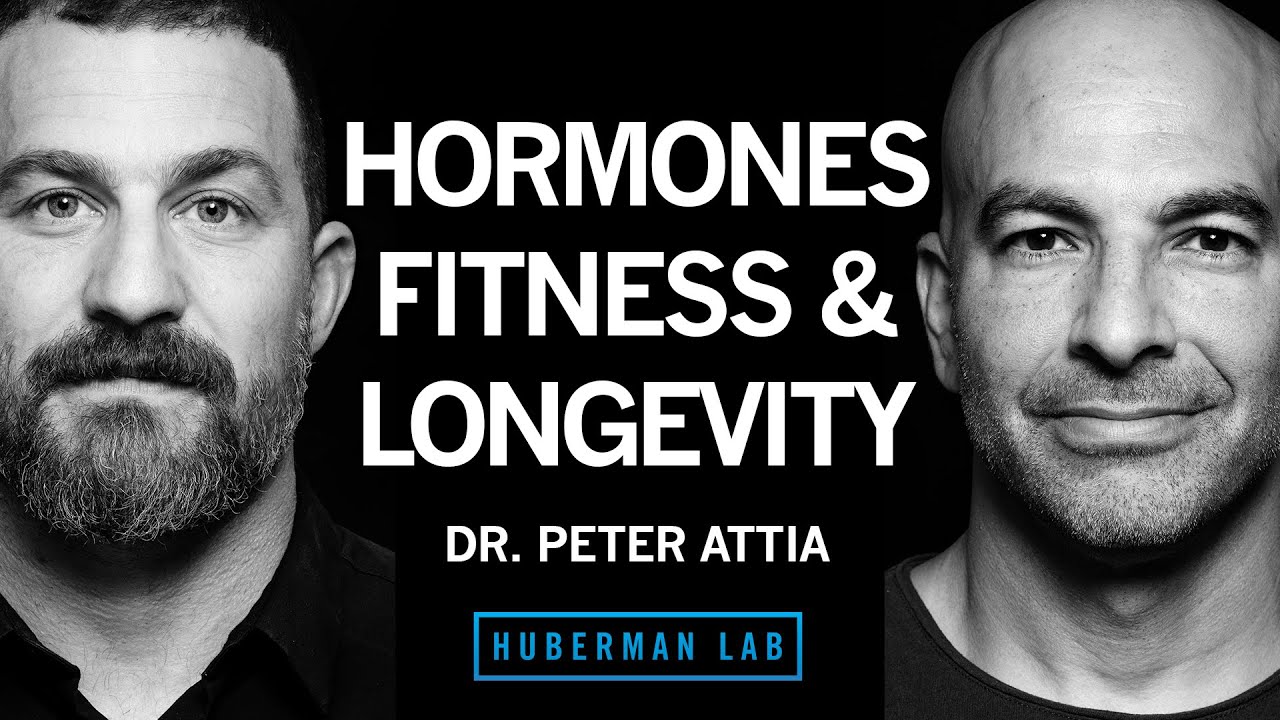
Dr. Peter Attia: Stanford-trained physician (MD) and Johns Hopkins-trained surgeon focused on longevity, who runs a clinical practice optimizing lifespan and health span and hosts the podcast The Drive.
What this episode covers
Andrew Huberman interviews Dr. Peter Attia on how to assess and extend lifespan and health span. They cover what blood work and DEXA scans actually reveal, why strength training and VO2 max are the strongest modifiable predictors of mortality, and Attia's 'marginal decade' back-casting framework for planning health. The conversation goes deep on hormone replacement therapy for women (and the flawed Women's Health Initiative study) and men (free testosterone, SHBG, Clomid, HCG, anastrozole). It closes on cholesterol biology, ApoB as the causative driver of atherosclerosis, statins and PCSK9 inhibitors, plus skeptical takes on peptides, stem cells, PRP, and GLP-1 drugs.
Recommended on this episode
Alpha-GPC
“I take 300 milligrams of Alpha-GPC now and again, before some cognitive work, sometimes before workouts, and I do subjectively feel that it narrows my focus”— Andrew Huberman
Rapamycin
“let's use rapamycin as an example, right? I'm a huge proponent of rapamycin.”— Peter Attia
The Drive (podcast)
Peter Attia
“I highly recommend people check out Dr. Attia's podcast, "The Drive" is excellent, as you can imagine, based on today's conversation”— Andrew Huberman
The guest's own work
Outlive (Peter Attia's book, then in progress)
Peter Attia
“there's a whole chapter in my book I'm working on that really gets to this problem of, why aren't we looking at atherosclerosis in terms of treating the causative agent?”— Peter Attia
Also referenced (named, not recommended)
Nicorette
Nicorette
“one of those three individuals chews an excessive amount of Nicorette. Used to be a smoker and I asked him why”— Andrew Huberman
Modafinil / Armodafinil
“Armodafinil, modafinil which are slightly different, of course, but, so non-clinical use, not prescribed for ADHD, but just, it's rampant.”— Andrew Huberman
Vivelle-Dot
Novartis
“it's an FDA product called the Vivelle-Dot. So it's a patch that you just put on, and it's estradiol, but it's bioidentical estradiol.”— Peter Attia
Anavar (oxandrolone)
“we would use a micro dose of Anavar to lower SHBG in a person who had normal testosterone, but low free testosterone.”— Peter Attia
Tongkat Ali
“I love input from experts like you on the use of Tongkat Ali for reducing SHBG. In my experience, it does free up some testosterone.”— Andrew Huberman
Clomid (clomiphene)
“We used to use a lot of Clomid in our practice. And have you talked about Clomid on the pod?”— Peter Attia
Anastrozole (Arimidex)
“You can lower estradiol a bit with an aromatase inhibitor, and that can bring down SHBG.”— Peter Attia
Testosterone cypionate
“TRT is ultimately, you know, giving testosterone cypionate is usually what we use.”— Peter Attia
Xyosted
Antares Pharma
“if they're real needle-phobes we use Xyosted, which is a preloaded pen.”— Peter Attia
HCG (human chorionic gonadotropin)
“we then switched to HCG, which we used to use sometimes instead of Clomid, but it's more cumbersome to work with.”— Peter Attia
Fadogia agrestis
“one supplement I've talked a lot about publicly is Fadogia agrestis, which is this weird Nigerian shrub”— Andrew Huberman
Ezetimibe
“that guy has a drug called ezetimibe that just mechanically blocks it.”— Peter Attia
Bempedoic acid
“This other drug called bempedoic acid does it only in the liver. So it has a very similar mechanism to statins... way fewer side effects.”— Peter Attia
BPC-157
“what do you know about studies on things like BPC-157, this gastric peptide that anecdotally, again, anecdotally, people report getting injections”— Andrew Huberman
Semaglutide (GLP-1 agonist)
“if you're looking at semaglutide, the dose that was studied, so did a one-year trial... took about 16 weeks to get the patients comfortably up to 2.4 milligrams weekly”— Peter Attia
Mosaic
NCSA
“I mean, I was in college when Mosaic launched in the early '90s.”— Peter Attia
Annie Duke's book (on back casting)
Annie Duke
“in Annie Duke's book, she wrote about this exact thing and called it back casting, and I was like, I like the term back casting better.”— Peter Attia
Big reveals from this episode
- Attia argues blood biomarkers predict lifespan well but have huge blind spots for cancer and the emotional domain of health span.
- Surprising to Attia: power lifting, not running, is the single best activity for building bone mineral density.
- Comparing the bottom 25% to the top 2.5% for VO2 max shows a 5x (400%) difference in all-cause mortality, the strongest modifiable association he's seen.
- Attia calls the mishandling of female HRT 'hands down the biggest screw up of the entire medical field in the last 25 years.'
- The infamous HRT-breast-cancer scare was a relative 25% increase but an absolute risk of just one extra case per thousand.
- A 200mg-every-two-weeks TRT clinic dose equals 50mg twice weekly, a physiologic dose that avoids the side effects clinics cause.
- Attia says he doesn't care about HDL/LDL ratio at all: ApoB is the causative agent of atherosclerosis and the only number he treats.
- Roughly 80% of Attia's patients over 45 are on a statin or related lipid-lowering drug.
Worth remembering
- If you're 65 or older, fall, and break your hip, there's a 30-40% chance you're dead within a year.
- Lp(a), a genetic atherosclerosis driver affecting 8-20% of people, only needs checking once in a lifetime yet is rarely tested.
- Converted to the same units, women have more testosterone in their bodies than estrogen.
- Going from sedentary to ~15 MET-hours/week (three brisk one-hour walks) can cut dementia risk by roughly 50%.
- A man's free testosterone should be about 2% of his total; high SHBG can drop it below 1%.
- Dietary cholesterol is esterified and largely can't be absorbed; Ancel Keys acknowledged it barely affects serum cholesterol in the 1960s.
- In 2006, Helen Hobbs found people with hypofunctioning PCSK9 had LDL of 10-20 and were essentially immune to heart disease.
- In 2019, 18.6 million people died of heart disease versus 10 million from cancer, with no other cause close.
- One cigarette delivers ~1mg of nicotine, but a single lozenge can deliver 4-8mg in one bolus.
- GLP-1 drugs are catabolic across the board, so patients lose muscle along with fat, and most of semaglutide's effect is central.