Book · recommended on 2 episodes
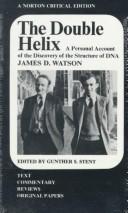
The Double Helix
James D. Watson ISBN 9789654485623
Find it on AmazonAffiliate link — we may earn a commission at no extra cost to you.
James D. Watson ISBN 9789654485623
Find it on AmazonAffiliate link — we may earn a commission at no extra cost to you.
This book by James D. Watson has come up 2 times across 2 different shows: Andrew Huberman, Lex Fridman. 2 of those mentions were genuine on-air recommendations, not just passing references. The people who brought it up: Bernardo Huberman, Eric Weinstein. The earliest mention we indexed is from 2019-03-20 and the most recent from 2024-12-16. Every occurrence below links to the episode page and to the exact second it was said on YouTube.
By identifying the structure of DNA, the molecule of life, Francis Crick and James Watson revolutionized biochemistry and won themselves a Nobel Prize. At the time, Watson was only 24, a young scientist hungry to make his mark. His uncompromisingly honest account of the heady days of their thrilling sprint against other world-class researchers to solve one of science's greatest mysteries gives a dazzlingly clear picture of a world of brilliant scientists with great gifts, very human ambitions, and bitter rivalries.
“I read the famous book by Watson you know the double helix and I I couldn't sleep I mean I read it one night... amazing book amazing book yes”— Bernardo Huberman
The guest here is Dr. Bernardo Huberman: Andrew Huberman's father and a theoretical/applied physicist, VP of Next-Gen Systems at CableLabs, former director of HP's Social Computing Lab and a researcher at Xerox PARC. Known for foundational work in chaos theory, the economics of computation/attention, and now quantum networking. Andrew Huberman interviews his father, physicist Bernardo Huberman, on a life of curiosity spanning relativity, chaos, quantum internet, and the art of a joyful, grounded life.
“You ever read The Double Helix? Oh, you have to read this book”— Eric Weinstein
The guest here is Eric Weinstein: Mathematician, economist, and managing director of Thiel Capital who coined the term Intellectual Dark Web. Eric Weinstein on artificial life, the dangers of self-replicating software, the collapse of theoretical physics, academia, and saving capitalism.
 26× recommended
Tom O'Neill
 17× recommended
Steven Pressfield
 17× recommended
S.C. Gwynne
 16× recommended
Marcus Aurelius
 16× recommended
Viktor Frankl
 15× recommended
Brian Muraresku