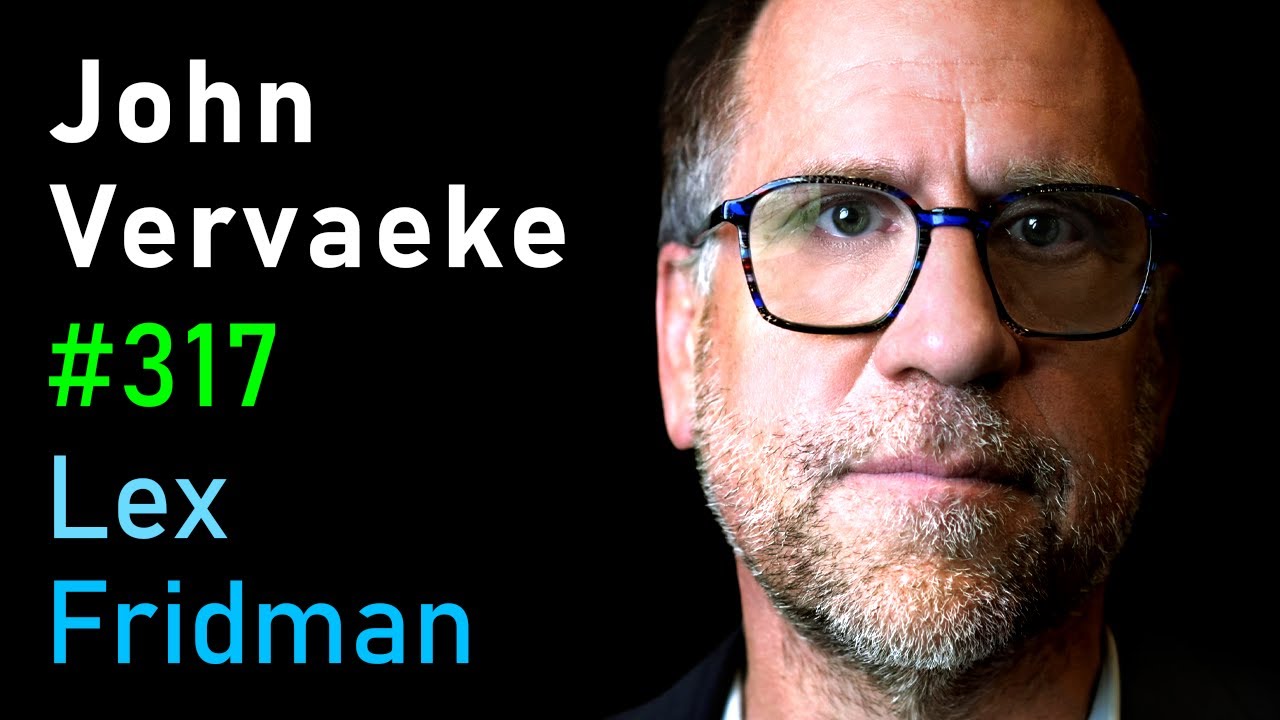
John Vervaeke: A psychologist and cognitive scientist at the University of Toronto, known for his 50-part lecture series 'Awakening from the Meaning Crisis.' He works in 4E cognitive science on relevance realization, wisdom, mindfulness, and the meaning crisis.
What this episode covers
Lex Fridman and John Vervaeke explore what makes life meaningful, framing meaning not as a property of the self or the universe but as a 'transjective' relationship between them. Vervaeke unpacks his core ideas, relevance realization, multiple ways of knowing, wisdom as overcoming self-deception, and flow as optimized non-propositional connectedness. The conversation ranges across mortality, consciousness, AGI, atheism versus non-theism, psychedelics, mindfulness practices, and the religion-as-psychotechnology thesis. It closes with the rise and danger of pseudo-religious ideologies like Marxism and Nazism, the nature of evil and sin, and Vervaeke's own dark passage out of fundamentalist Christianity.
The guest's own work
The Oxford Handbook of Spontaneous Thought
Kalina Christoff and Kieran C. R. Fox
“the article we published in the hand the Oxford handbook spontaneous thought with Aryan Hera Bennett and Leo Ferraro”— John Vervaeke
Also referenced (named, not recommended)
The Denial of Death
Ernest Becker
“you know Ernest Becker talked about the in his book denial of death about the fear of death and being an important motivator in our life”— Lex Fridman
Educating Intuition
Robin Hogarth
“this is hogarth's proposal in educating intuition intuition is actually the result of implicit learning”— John Vervaeke
Siddhartha
Hermann Hesse
“let me leave you with some words from Herman Hesse and Siddhartha I've always believed and I still believe that whatever good or bad fortune may come our way”— Lex Fridman
The Matrix
The Wachowskis
“either the illusion is one that I cannot discover sort of you know the The Matrix on steroids or something”— John Vervaeke
The Simpsons
Matt Groening
“there's a episode from the classic Simpsons not the modern Simpsons the classic symptoms where the there's the aliens and they're running for office”— John Vervaeke
Animal Farm
George Orwell
“it's like at the end of Animal Farm you look at pigs and humans and you look at robots and humans you can't tell the difference”— Lex Fridman
Grand Theft Auto
Rockstar Games
“in the Video Game World you can do all kinds of wild things Grand Theft Auto you can shoot people up you can do whatever the heck you want”— Lex Fridman
Tetris
Alexey Pajitnov
“you can get that right sense of being in the game with something like Tetris which has Isn't like it doesn't look like the real world”— John Vervaeke
Big reveals from this episode
- Vervaeke reframes mortality as a present-tense state, not a future event, the universe's indifference is always with us.
- States plainly that mind and life go away completely when we die, and that this finitude matters morally.
- Declares himself a 'non-theist,' rejecting the shared presuppositions of both theists and atheists.
- Warns that video-game flow can hijack real-world flow and is linked by the WHO to disorder and depression.
- Reclaims 'sin' as a failure to love wisely, a deeper category than individual immorality.
- Reveals his own years-long 'black burning', a dark, self-destructive period after leaving fundamentalist Christianity.
- Claims people who have mystical/higher states of consciousness show measurable, lasting increases in openness and well-being.
Worth remembering
- In surveys people rank public speaking above death as their greatest fear, because loss of status feels like a kind of death.
- Terror-management word-priming makes people rigid in third person, but more cognitively flexible when imagining dying in first person.
- The fastest-growing religious demographic is the 'nones', mostly 'spiritual but not religious,' not atheist.
- On the Wason selection task only ~10% of individuals succeed, but groups of four reach an 80% success rate.
- Psychedelics may work like neural-network 'dropout', reducing constraints and preventing overfitting so the brain generalizes better.
- Flow requires clear information, tightly coupled feedback, and consequences where failure matters, the same conditions as a scientific experiment.
- Vervaeke distinguishes four kinds of knowing: propositional, procedural, perspectival, and participatory.
- Meditation means stepping back to look AT your mental frame; contemplation means looking THROUGH it, mindfulness is both.
- He frames Marxism and Nazism as pseudo-religious ideologies fueled by a 'Promethean spirit' that licenses any means.