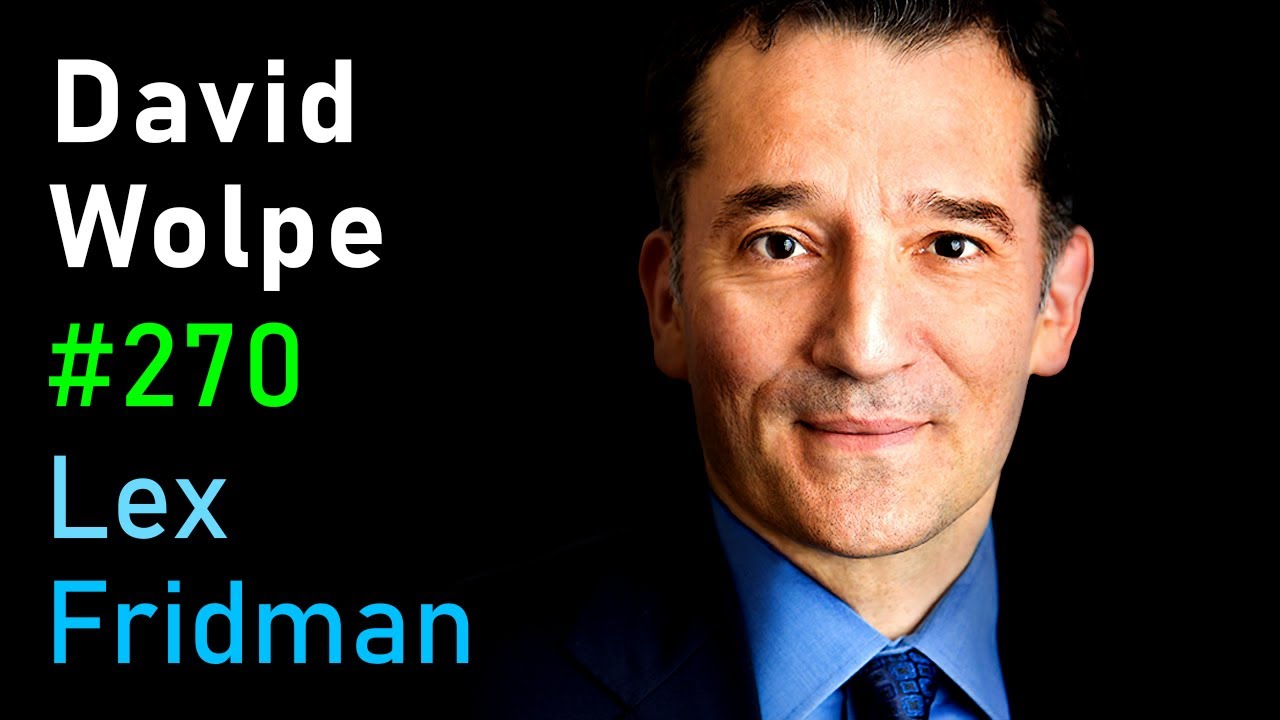
David Wolpe: A prominent American rabbi (longtime leader of Sinai Temple in Los Angeles), author, and public intellectual known for debating atheists like Christopher Hitchens and Sam Harris.
What this episode covers
Rabbi David Wolpe joins Lex Fridman for a wide-ranging conversation on the nature of God in Judaism, the limits of human comprehension, and how religion shapes meaning and morality. Wolpe reflects on his friendships and debates with Christopher Hitchens, Sam Harris, and Eric Weinstein, and on his own journey from teenage atheism to faith. He recounts the controversies that defined his career, from performing same-sex marriages to questioning the historicity of the Exodus to an unmasked Super Bowl photo. The talk moves through free will, consciousness, suffering, anti-semitism, Israel-Palestine, and AI, returning repeatedly to his core belief that every human being bears the image of God. He closes that the meaning of life is to grow the soul through love.
Recommended on this episode
Hitch-22
Christopher Hitchens
“his autobiography hitch 22 is a great read and i just want to say like what you discover there”— Lex Fridman
The Denial of Death
Ernest Becker
“i read ernest becker's denial of death which i found and still find to be one of the most profound works i've ever come across”— David Wolpe
Middlemarch
George Eliot
“my favorite novel is middle march so much middle march”— David Wolpe
Herzog
Saul Bellow
“i also love i love soul bello especially herzog but but it's a very different kind of uh of thinking person's novel”— David Wolpe
Man's Search for Meaning
Viktor Frankl
“you mentioned one of them which is viktor frankl's man's search for meaning um and i also really really love heschel's the sabbath”— David Wolpe
The Sabbath
Abraham Joshua Heschel
“i also really really love heschel's the sabbath i think it's a beautiful book very sh it's very short book”— David Wolpe
The guest's own work
Why Faith Matters
David Wolpe
“you wrote in your book why faith matters quote walt whitman wrote that in order for there to be a great books there must be great readers”— Lex Fridman
Also referenced (named, not recommended)
god is not Great: How Religion Poisons Everything
Christopher Hitchens
“the idea that you would call a book that religion poisons everything um i think he did that deliberately provocatively”— David Wolpe
Exodus
Richard Elliott Friedman
“i think richard elliott friedman may have gotten this right in his book exodus it may have been the levites who left”— David Wolpe
Letters from the Earth
Mark Twain
“mark twain has i think in letters from earth he says we're going to lie on green fields and listen to harp music”— David Wolpe
The Brothers Karamazov
Fyodor Dostoevsky
“your guests said the two greatest novels of the 19th century were uh were brothers karamazov and uh what was the other one”— David Wolpe
March of the Penguins
Luc Jacquet
“there's that movie march of the penguins and they're all huddling together in the cold yeah this is this is fundamentally human”— Lex Fridman
Big reveals from this episode
- Wolpe admits Hitchens convinced him that the claim 'religion makes people better' is far more complicated than he wished it to be.
- Wolpe says Hitchens was less a passionate arguer against religion than someone who got carried away by his own eloquence once he picked a target.
- He states the Torah is a human product written over hundreds of years, 'from heaven but not from Sinai,' inspired by God rather than literally dictated.
- He recounts the explosive controversy over performing same-sex marriages, front-page news in the NY and LA Times, driven by his heart not scholarship.
- He tells the story of his unmasked Super Bowl photo backlash and the sermon he wrote in response about brokenness and giving people space.
- He reaffirms his 21-year-old controversial sermon that the Exodus likely didn't happen as described, arguing faith is deeper than fact.
- He calls denying the reality of consciousness, by people who are fully conscious, baffling and intellectually arrogant.
- He reveals Christopher Hitchens discovered in his 30s that his mother was Jewish, so 'remarkably enough he actually was Jewish.'
Worth remembering
- In Jewish tradition God is both 'as close as your mouth is to your ear' yet unfathomably distant, an enormous tension between immanence and transcendence.
- Wolpe argues traditions that make hard, counter-cultural demands survive; easy ones like Thanksgiving turkey persist but demanding ones fall apart without faith.
- He describes anti-semitism's unique feature: Jews are cast as both superhuman (controlling the world) and subhuman (vermin) at the same time.
- Islam and Judaism are religions of law born in the lawless desert, while Christianity grew up under Roman law and thus separated church and state.
- Judaism has an 'ideal book' while Christianity has an 'ideal life'; Jewish holidays mark events in the life of the people, not the life of God.
- Wolpe argues a thoroughgoing materialist cannot have free will, only randomness, so belief in free will requires a spiritual component.
- He frames theodicy starkly: God either grants free will to all, even Nazis, or to none; you cannot exempt only the worst people.
- As a teen atheist devoted to Bertrand Russell, a rabbi told him 'I'd rather you grow out of him than grow into him.'
- A child survivor's father lit Hanukkah candles with the margarine ration in Auschwitz: 'you can't live for three minutes without hope.'
- Wolpe's answer to the meaning of life: humans are here to grow in soul and return it more burnished than they received it, chiefly through love.