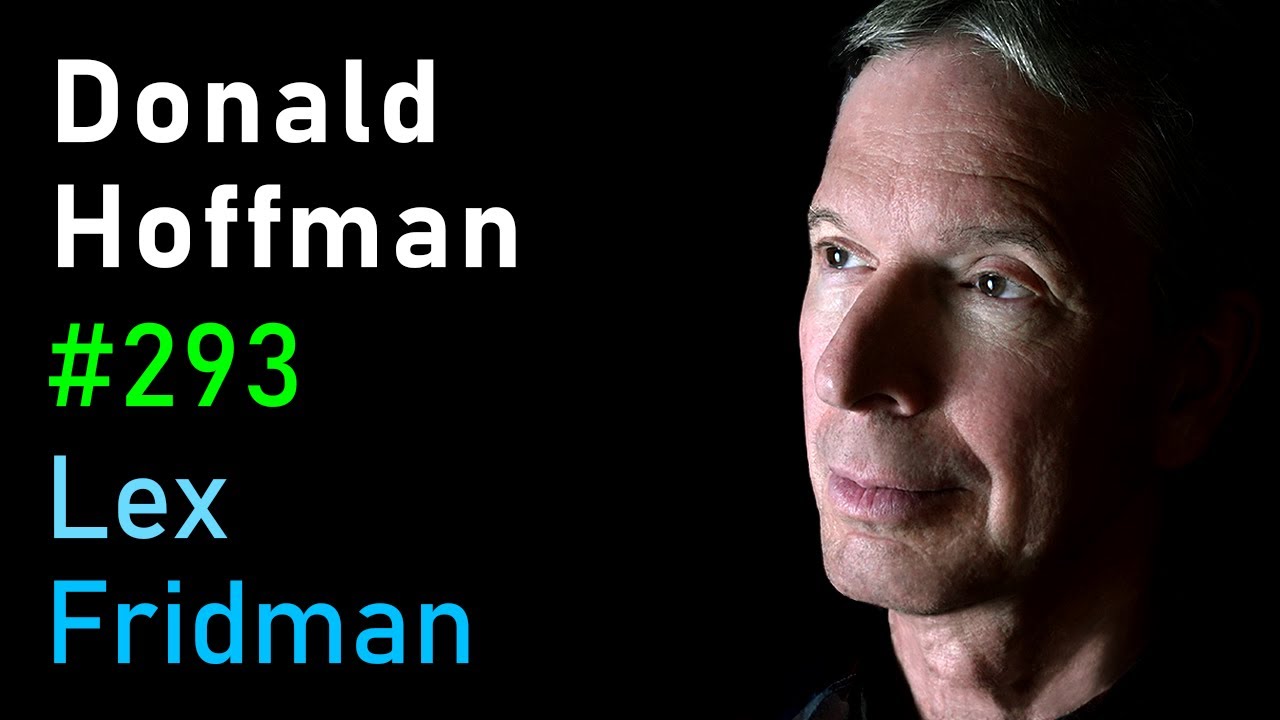
Donald Hoffman: Professor of cognitive sciences at UC Irvine researching evolutionary psychology, visual perception, and consciousness. Author of 'The Case Against Reality' and over 120 scientific papers.
What this episode covers
Donald Hoffman makes the case that what we perceive is not objective reality but an 'adaptive fiction' shaped by natural selection to maximize fitness, not truth. He argues that spacetime itself is 'doomed' as a fundamental concept, echoing physicists like Nima Arkani-Hamed who find deeper structures (the amplituhedron, cosmological polytopes) beyond it. Hoffman proposes a mathematical theory of 'conscious agents' in which consciousness is fundamental and spacetime, brains, and objects are data structures it creates. The conversation ranges across evolutionary game theory, the hard problem of consciousness, Godel's incompleteness, psychedelics, and spiritual traditions. It turns deeply personal as Hoffman discusses nearly dying a year earlier and how his theories collide with his emotional attachment to life.
The guest's own work
The Case Against Reality: Why Evolution Hid the Truth from Our Eyes
Donald Hoffman
“he's the author of over 120 scientific papers on these topics and his most recent book titled the case against reality why Evolution hid the truth from our eyes”— Lex Fridman
Also referenced (named, not recommended)
Vision
David Marr
“well David Mah again my visor at MIT in his book Vision suggested that the more primitive sensory systems were less realistic less veritical”— guest
Monadology
Gottfried Wilhelm Leibniz
“there's a lot of ingenious arguments in Barkley liet liet in his monadology understood very clearly that the hard problem was not solvable”— guest
Little Drop of Poison
Tom Waits
“I like that Tom W song I like my town with a little Drop of Poison how much poison do you allow yourself to have”— Lex Fridman
Big reveals from this episode
- Hoffman claims the probability that natural selection shapes senses to perceive objective reality is precisely zero.
- He aligns his view with physicists declaring 'spacetime is doomed' as a fundamental concept.
- Hoffman reframes the hard problem in reverse: not how brains create consciousness, but how consciousness creates brains.
- He states 'right now I have no neurons' - neurons are a data structure you create on the fly when you look.
- Hoffman admits his default mode is still physicalist and his emotions rebel against his own theory.
- He reveals he nearly died last year from COVID attacking his heart and texted a goodbye to his wife from the ER.
- The 'nothing behind you' experiment: with eyes closed, attention backward reveals an absence of qualia, suggesting we live in a partial-render simulation.
Worth remembering
- Hoffman compares perception to a computer desktop interface that hides the 'truth' of voltages and circuits to be usable.
- Physicists found the amplituhedron turns billions of computation terms into a single term by abandoning spacetime.
- The 1986 Park-Taylor formula reduced gluon scattering from hundreds of pages to one term.
- In color-naming games, dichromats (colorblind men, ~7%) had an outsized influence on how language carves up color.
- Some women called tetrachromats have four color receptors and a dimension of color experience no man can imagine.
- A stationary (timeless) Markov dynamics, when projected, produces increasing entropy - so time emerges as an artifact of projection.
- Hoffman calls having children the one known 'technology' for creating new portals into consciousness.
- Quantum theory shows the act of observation is an act of fact creation - values do not exist before measurement.
- Hoffman invokes Godel's incompleteness theorem to argue science can never reach a final theory of everything.