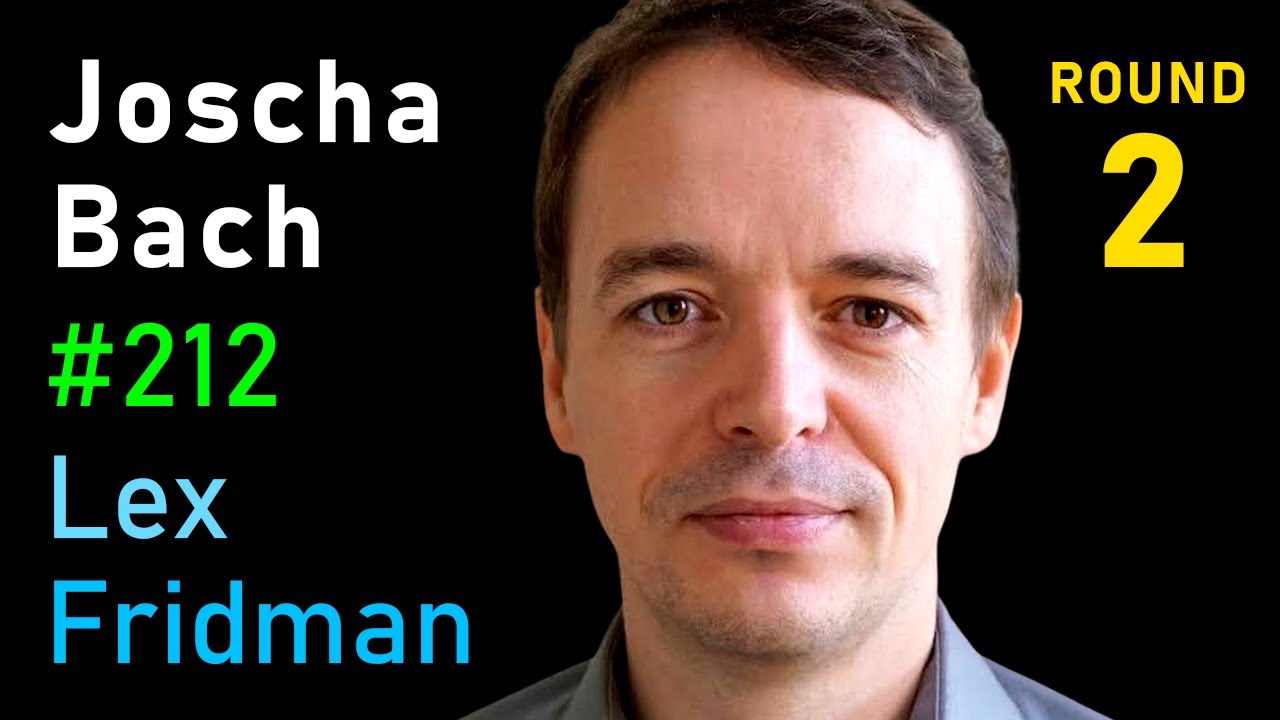
Joscha Bach: Cognitive scientist and AI researcher known for his work on artificial general intelligence, computational models of the mind, and theories of consciousness. A widely-followed thinker on intelligence, cognition, and the nature of reality.
What this episode covers
In his second appearance on the podcast, Joscha Bach explores consciousness as a control model for attention, framing the self as a story the brain tells itself to inform behavior. He argues we live inside a 'dream world' game engine generated by our brains rather than in physical reality, and that consciousness exists only inside this simulation. The conversation ranges across free will, life and agency, infinity in mathematics, psychedelics as data augmentation, GPT-3 and the future of language models, AI ethics and automation, and the dangers of postmodernism as ideology. It closes on love as the discovery of shared purpose, the line between good and evil, and a meditation on meaning, integrity, and the meaning of life.
Recommended on this episode
Princess Mononoke
Hayao Miyazaki
“when i watch the miyazaki movies that there is nobody who captures my spirituality as well as he does”— Joscha Bach
Also referenced (named, not recommended)
Westworld
HBO
“this notion of a person is a fiction similar as it is in westworld where the robots realize that their memories and desires are just stuff”— Joscha Bach
The Elder Scrolls V: Skyrim
Bethesda
“every time you start thinking about skyrim and elder scrolls and walking around in beautiful nature and swinging a sword”— Lex Fridman
The Road to Reality
Roger Penrose
“when I read for instance the section that he writes in the introduction to and wrote to infinity the thing that he specifically refers to”— Joscha Bach
GPT-3
OpenAI
“what are your thoughts about gpt3 and language models trained with self-supervised learning”— Lex Fridman
Wolfram Mathematica
Wolfram Research
“it was able to learn how to do differentiation integration in race that according to the authors mathematica could not”— Joscha Bach
GitHub Copilot
GitHub
“if you look at github open pilot which is based on openai's codex it's the system that's able to generate code”— Lex Fridman
OpenAI Codex
OpenAI
“if you look at github open pilot which is based on openai's codex i don't know if you got a chance to look at it”— Lex Fridman
Heidi, Girl of the Alps
Hayao Miyazaki
“it's this little girl that is basically heidi and i suspect that happened because he when he did field work for working on the heidi movies”— Joscha Bach
Big reveals from this episode
- Bach reframes depression by reminding himself he is 'not a person' but software running on a random ape's brain.
- Bach insists free will is not an illusion but a 'model', a story the system tells itself about being in control.
- He defines suffering as a chronic, escalating pain signal that cannot be resolved, and the trigger for higher consciousness.
- Bach shares his fear that insects could be conscious, making the amount of suffering on Earth unthinkable.
- He claims heavy psychedelic users tend toward 'overfitting', models richly detailed about the past but no longer predictive.
- Bach warns that German fascism was driven by love, 'just a very selective love.'
- He names Miyazaki 'the most relevant protestant philosopher today.'
- On the meaning of life, Bach concludes nothing makes sense unless the mind projects a purpose onto it.
Worth remembering
- Bach describes consciousness as a monkey riding an elephant, the attentional system steering a vast perceptual-motivational system.
- He proposes the simplest definition: 'life is cells,' a modular DNA read-write principle maintaining disequilibrium.
- He distinguishes res extensa and res cogitans as both being mental representations inside a brain-generated game engine.
- Bach says waves crashing on your feet aren't real, there are only water molecules; the wave is data compression.
- He argues no real Turing machine can exist because it requires an infinite tape; we always have finite tape.
- Consciousness is described as the 'index in the memory database' of what attention was paid to.
- Bach notes anecdotally that a single LSD dose has cured severe migraines by resetting the serotonergic system.
- He explains the transformer was invented in NLP, not vision, because language topology is non-local.
- He cites the US healthcare system as the leading cause of personal bankruptcy and partly an administrative job program.
- Bach notes the out-of-Africa bottleneck left humans with less genetic diversity than neighboring Kalahari tribes.