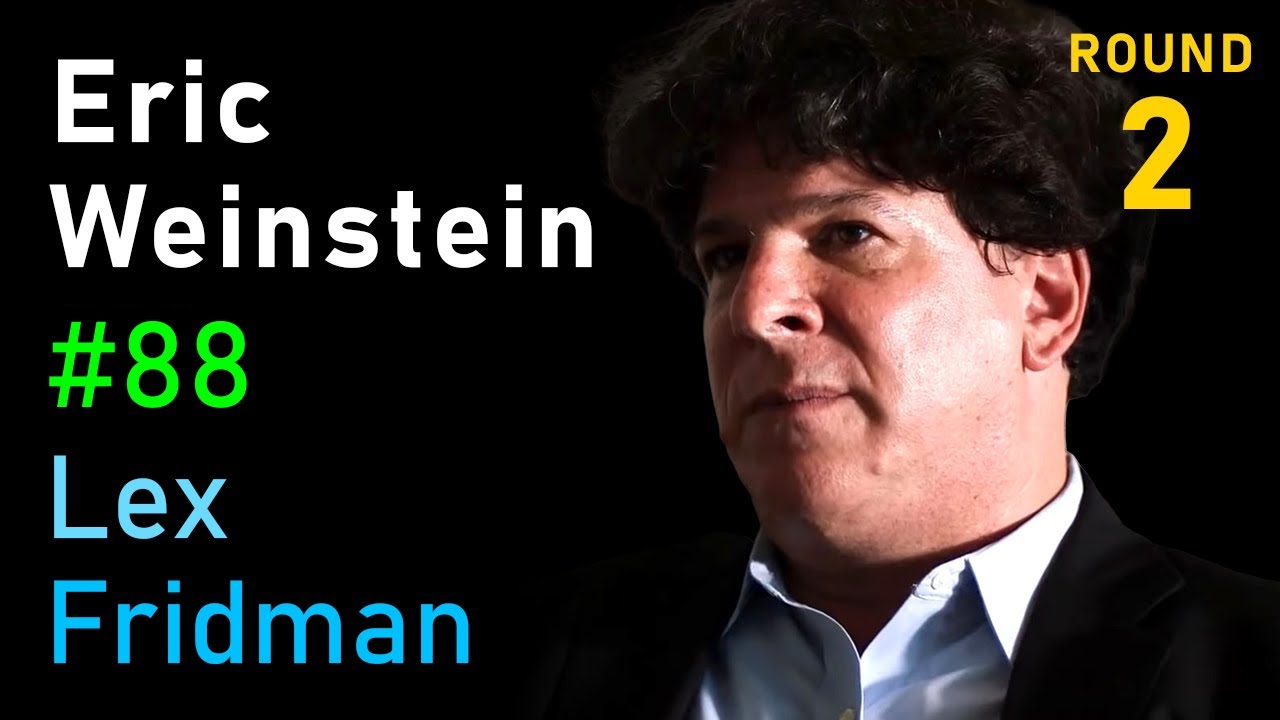
Eric Weinstein: Mathematician, managing director of Thiel Capital, and host of The Portal podcast, known for his contrarian critiques of academia and his decades-long pursuit of a theory of everything called Geometric Unity.
What this episode covers
Recorded during the early COVID-19 pandemic, Lex Fridman's second conversation with Eric Weinstein opens on the crisis as the end of what Weinstein calls 'the great nap' - 75 years without realized global tragedy. Weinstein indicts failing leadership and institutions, calling for younger, riskier mutants to take over universities like MIT. The bulk of the talk explores his Geometric Unity theory of everything, which replaces space-time with a higher-dimensional 'observerse' and tries to make the canvas generate its own paint. He shares the personal toll of working outside academia, an institutional-betrayal framework rooted in past trauma, and the story of a 'secret seminar' at Harvard that revealed academia's hidden parallel structure.
The guest's own work
Geometric Unity (2013 Oxford lecture)
Eric Weinstein
“you recently published the video of a lecture he gave at Oxford presenting some aspects of a theory theory of everything called geometric unity”— Lex Fridman
Also referenced (named, not recommended)
The Plague
Albert Camus
“I keep connecting to historical events and making sense of them through that way or reading the plague by Camus”— Lex Fridman
Harrison Bergeron
Kurt Vonnegut
“just imagine like you're in the story of Harrison Bergeron by Vonnegut and our smartest people were all subjected to distracting noises”— guest
Men in Black
Columbia Pictures
“it's like you know you work with the men in black group right and it's the last suit that you'll ever need”— guest
The Road to Reality
Roger Penrose
“that wall needs an owner's manual which Roger Penrose has written called the road to reality let's call that the tome”— guest
Big reveals from this episode
- Weinstein calls the last 75 years 'the great nap' and challenges Steven Pinker's optimism by arguing destructive potential has skyrocketed even as realized violence dropped.
- He calls for the heads of the CDC, the Surgeon General, Trump, Pelosi, and de Blasio to all resign, framing both US parties as one 'looting party' (kleptocracy).
- He reveals he carried the secret number 14 for years - four dimensions of space-time plus ten extra dimensions of 'rulers and protractors'.
- He frames Geometric Unity as a possible 'Skynet moment' where we, as the AGI, may be trying to wake up by learning our own source code.
- He claims his theory makes falsifiable predictions and produces a third 'imposter' generation of particles never discussed in regular physics.
- He argues Elon Musk isn't taking enough risk and is using Mars as a narrative 'to make the moon jealous' and reawaken our need for space.
- He recounts discovering a 'secret seminar' his Harvard advisor was running on his exact topic, revealing a hidden parallel structure in academia.
- He obliquely discusses childhood abuse by a therapist and being forced back for a second appointment, seeding his theory of institutional betrayal.
Worth remembering
- Weinstein notes positive breakthroughs like HIV becoming survivable lack a 'Wednesday effect' - they don't happen on one dramatic day, so they fail to capture attention.
- He cites Dirac's 1963 claim that beauty in equations matters more than agreement with experiment, since disagreement is often just fine-tuning.
- He frames adding extra dimensions as taking on 'technical debt' borrowed from software engineering.
- He explains spinors require 720 degrees of rotation to return to normal, illustrated by the 'Philippine wine glass dance'.
- He pushes the 'graph-wall-tome project': Witten's paragraph, Jim Simons' equation wall at Stony Brook, and Penrose's Road to Reality as an on-ramp to physics.
- Witten's single key paragraph encodes humanity's deepest knowledge via three equations: Einstein field, Dirac, and Yang-Mills-Maxwell.
- Weinstein describes a 'distributed idea suppression complex' that filters out exceptional people like Musk from the pipeline.
- His theory of 'pervasive institutional betrayal' holds that schools, hospitals, drug companies, and journalists were all built on growth that has now ended.
- He compares universities' tactics to orcas drowning minke whales by covering their blowholes - interference competition for needed resources.
- He cites Douglas Prasher, who pioneered green fluorescent protein research that won a Nobel, ending up driving a shuttle bus for $35,000 a year.