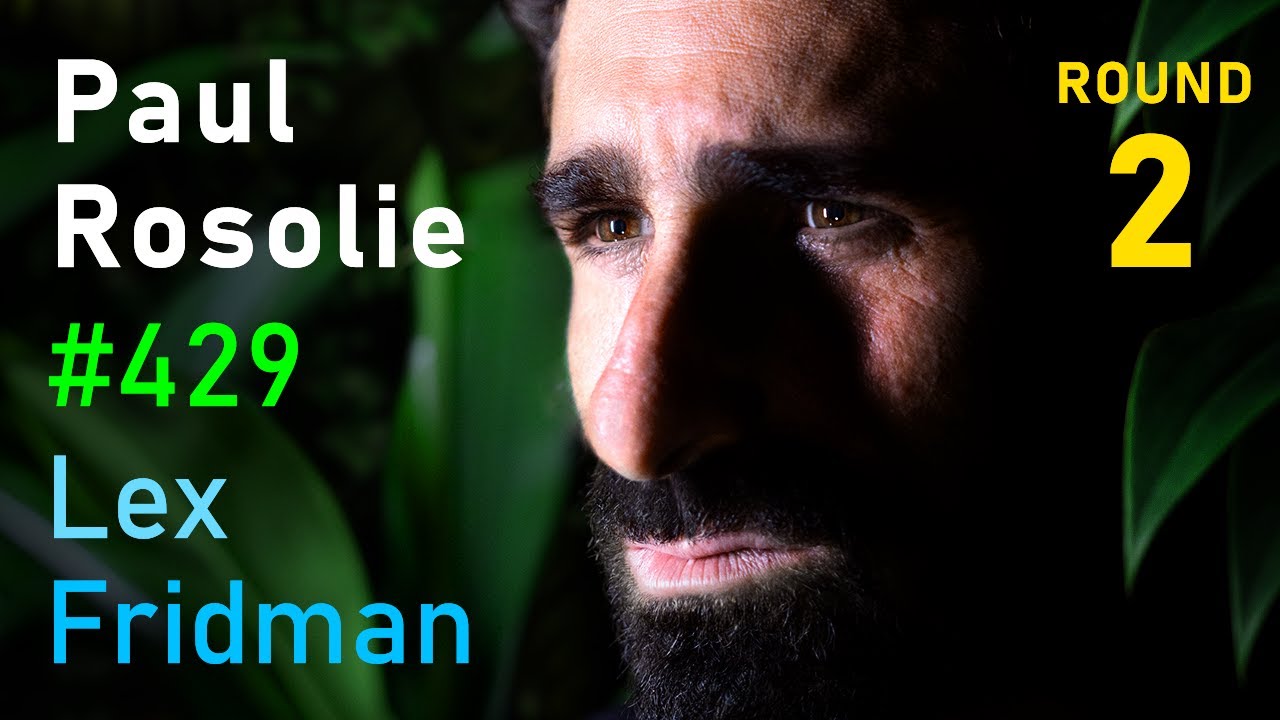
Paul Rosolie: Naturalist, explorer, author, and conservationist who has spent nearly 20 years in the Western Amazon. He founded Junglekeepers, an Indigenous-led organization protecting rainforest along Peru's Las Piedras River.
What this episode covers
Lex Fridman travels to a remote part of the Peruvian Amazon to record with Paul Rosolie in the field, surrounded by jungle, after an expedition that included getting lost in unexplored wilderness and taking high-dose ayahuasca. The conversation covers apex predators like black caiman and anacondas, snake behavior, the intelligence and ethics of elephants and other animals, and the staggering biodiversity and undescribed species of the rainforest. They debate aliens, the origin of life, the simulation hypothesis, exploration history (Fawcett, Roosevelt, Schultes), and survival lessons from the show 'Alone.' Throughout, Rosolie makes the case for Junglekeepers' fight against logging, gold mining, and the human trafficking that accompanies them, and shares his views on uncontacted tribes, mortality, and God as a creative force he equates with love and nature.
Recommended on this episode
The River of Doubt: Theodore Roosevelt's Darkest Journey
Candice Millard
“So I started reading the "River of Doubt" book you recommended to me on Teddy Roosevelt.”— Paul Rosolie
Postcard from Earth
Darren Aronofsky
“Saw it at The Sphere, "The Postcard From Earth". I mean, it's a celebration of Earth in all forms”— Lex Fridman
The Fountain
Darren Aronofsky
“And the epiphany at the end, God, I love that movie. God, I love that.”— Paul Rosolie
The guest's own work
Mother of God
Paul Rosolie
“In "Mother of God", I write about the first one that me and JJ caught together, which was probably a little bigger than this table.”— Paul Rosolie
Also referenced (named, not recommended)
Are We Smart Enough to Know How Smart Animals Are?
Frans de Waal
“You go back to that Frans de Waal book, "Are We Smart Enough to Know How Smart Animals Are?" There's so many incredible examples of controlled studies”— Paul Rosolie
One River: Explorations and Discoveries in the Amazon Rain Forest
Wade Davis
“I know about him from reading Wade Davis' book "One River", which is this big, hefty, you know, five or 600 page tome about the Amazon.”— Paul Rosolie
Plants of the Gods: Their Sacred, Healing and Hallucinogenic Powers
Richard Evans Schultes
“Yeah, he wrote the "Plants of the Gods: Their Sacred, Healing and Hallucinogenic Powers".”— Lex Fridman
Into the Wild
Jon Krakauer
“And you know what the kid from "Into the Wild" learned right before he died in that bus? That if you don't have somebody to share it with, it doesn't matter.”— Paul Rosolie
The Lord of the Rings
J.R.R. Tolkien
“and having "Lord of the Rings" be one of the things I grew up on, I just chose to come to the Amazon.”— Paul Rosolie
Birds of Peru
Thomas S. Schulenberg
“This is just here, this is birds of Peru. Dude, pages on pages of toucans and aracaris and hummingbirds and ant birds”— Paul Rosolie
Alone
The History Channel
“We talked about "Alone," this show a bit. Rock House, Roland Welker from season seven. He built a rock house.”— Lex Fridman
Game of Thrones
HBO
“And I've never seen anything like this except for in like "Game of Thrones", this croc head comes flying out of the water.”— Paul Rosolie
Happy People: A Year in the Taiga
Werner Herzog
“One of the things is he spent all of his 20s in, living in Siberia with the tribes out there. Herzog, "Happy People".”— Lex Fridman
GoPro
GoPro
“He killed a muskox with bow and arrow and then finished it with a knife. And had the GoPro mount to, you know? To document it.”— Paul Rosolie
Big reveals from this episode
- Rosolie describes grabbing the tail of an 11-foot bushmaster viper, which turned and made clear that if he wanted 'to meet God,' it could arrange the meeting, so he let it go.
- He recounts a wild river otter seemingly inviting him to follow it to a lake, where a pack of otters was harassing a 16-foot black caiman with a head half the size of a table.
- He found a 16-foot anaconda that had grabbed a peccary by the jaw, swiped its legs, bent it in half, and crushed its ribs, illustrating how anacondas kill with a three-point constriction system.
- Rosolie argues elephants deserve representation in governments because they engineer landscapes, have emotions, families, and burial rituals, and should be seen as a separate society sharing Earth with humans.
- On ayahuasca, Rosolie says he became a jungle creature with no name, witnessed all the animals discussing a fire-driven threat, then experienced years of crushing vacuum silence in space.
- He reveals that after Lex Fridman sent him a DM and published their first conversation, listeners donated 'in droves,' transforming Junglekeepers from minor-league efforts into protecting thousands more acres.
- A contacted Indigenous man who tried to give uncontacted tribespeople a boat full of plantains was shot with three seven-foot arrows, one hitting his skull and requiring helicopter evacuation.
- Asked how he might die, Rosolie predicts loggers or gold miners will likely kill him, and says he has already told friends to make the documentary 'Junglekeepers: The Heartbeats' if that happens.
Worth remembering
- An anaconda's stomach acid can digest an entire crocodile, bones and skull included, with nothing coming out the other side; a chemist suggested a mucus lining protects the snake from its own acid.
- There are roughly 4,000 species of butterflies in the Amazon, and for the white witch moth, one of the world's largest by wingspan, scientists still don't know what its caterpillar looks like.
- Pumas range from Alaska down through Argentina, living across deserts and high mountains, making them an extremely successful and widely distributed species.
- The Amazon contains roughly 400 billion trees and 70,000 to 80,000 species of plants, with new species described every year.
- Leafcutter ants digest roughly 17 percent of the total biomass of the forest, constantly regenerating the ecosystem.
- Female Indian elephants kick males out of the herd and lead matriarchally; elephants once surrounded and touched the stomach of a pregnant girl because they could smell she was pregnant.
- The statistical odds of discovering ayahuasca by trial and error, combining a specific vine and root among 80,000 plant species, are astronomical, which Indigenous people attribute to the gods revealing it.
- Jane Goodall travels roughly 300 days a year educating people about conservation and broke scientific convention by naming her chimpanzee study subjects.
- On 'Alone' season seven, Roland Welker built a stone shelter that cost about 500 calories an hour to construct, and still lost 44 pounds, about 20 percent of his body weight.
- An estimated 1,200 girls aged 12 to 17 are forcibly drafted into prostitution around the Amazon gold-mining camps, with at least a third of camp prostitutes being underage.
- During the rubber boom, uncontacted tribes refused enslavement by rubber barons, retreated deeper into the forest with six-foot longbows and seven-foot arrows, and have remained violently isolated for roughly a century.