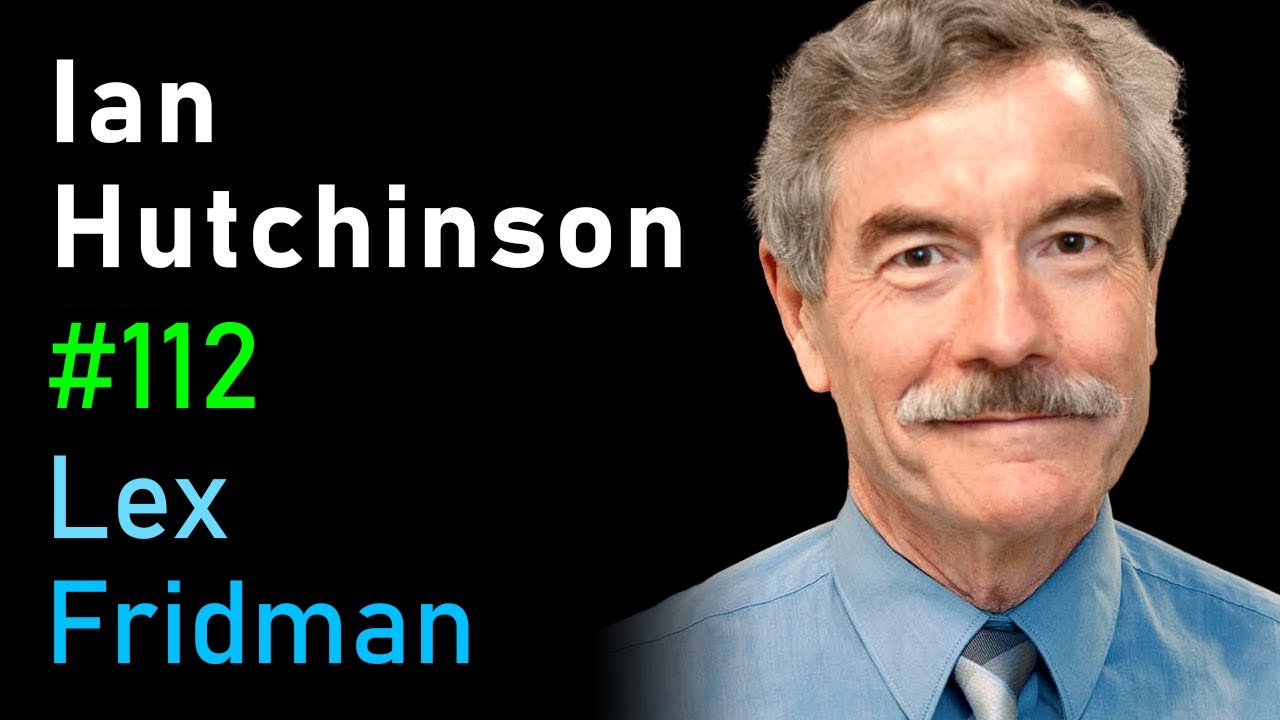
Ian Hutchinson: Nuclear engineer and plasma physicist at MIT specializing in magnetic confinement fusion. He also writes on the philosophy of science and Christianity, critiquing 'scientism' in books like Monopolizing Knowledge.
What this episode covers
Ian Hutchinson walks Lex Fridman through the physics of nuclear fusion and fission, explaining tokamaks, the ITER experiment, and why fusion is so hard to ignite on Earth. He gives a measured assessment of nuclear energy's safety record and argues there is no technological magic bullet for energy, population, or climate. The conversation then turns to his Christian faith, his critique of scientism, and the limits of science as a way of knowing. They explore suffering, morality, consciousness, transhumanism, the simulation hypothesis, and the meaning of life, landing on love and loyalty.
Recommended on this episode
Can a Scientist Believe in Miracles
Ian Hutchinson
“i recommend two of his books his new one can a scientist believe in miracles where he answers more than 200 questions on all aspects of god and science”— Lex Fridman
Monopolizing Knowledge
Ian Hutchinson
“and his earlier book on scientism called monopolizing knowledge”— Lex Fridman
Also referenced (named, not recommended)
Solaris
Stanislaw Lem
“what stanislav in his book solaris called our own labyrinth of dark passages and secret chambers”— Lex Fridman
Chernobyl
HBO
“there's a very popular hbo show and just came out on chernobyl uh there's the three mile island there's fukushima”— Lex Fridman
Paradise Lost
John Milton
“you're gonna have to read paradise last to get your answer to that beautifully put”— guest
Big reveals from this episode
- Hutchinson admits a personal disappointment of his career: a burning fusion reaction likely won't be achieved until well after his retirement, possibly not in his lifetime.
- He argues most public complaints about fission energy are 'ill-informed' and that Fukushima 'came out looking pretty good' since the reactors themselves killed essentially no one.
- He says overpopulation worries him more than COVID deaths, calling people not dying 'ultimately more of a problem' than people dying.
- He flatly states there is no technological solution to society's biggest challenges, which are human and sociological, not scientific.
- He calls the aspirations of transhumanism 'horrific' and a 'nightmare,' rejecting mind-uploading.
- He argues quantum mechanics is likely essential in the brain, making the mind inseparable from the body's hardware.
- He reveals he was not raised Christian but converted as a Cambridge undergraduate, persuaded partly by the historical evidence for the resurrection.
Worth remembering
- Both fusion and fission release roughly a million times more energy per unit mass than chemical reactions like burning coal.
- Magnetic-confinement fusion plasma density is about a million times less than the density of air in a room.
- The word 'tokamak' is a Russian acronym meaning toroidal magnetic chamber, shaped like a donut.
- The ITER experiment in southern France is designed to produce about 500 megawatts of fusion power for hundreds of seconds.
- Known uranium reserves could support fission energy worldwide for thousands of years, but maybe not millions.
- Reaching a sustainable, equitable energy world would require cutting Western CO2 emissions to about 1 percent of current levels.
- Radioactivity from fusion reactions is at least a hundred times less than from fission reactions.
- The word 'compassion' literally means to suffer alongside someone.
- Hutchinson was a competitive chess player as a kid and stopped playing seriously once computers could beat him.