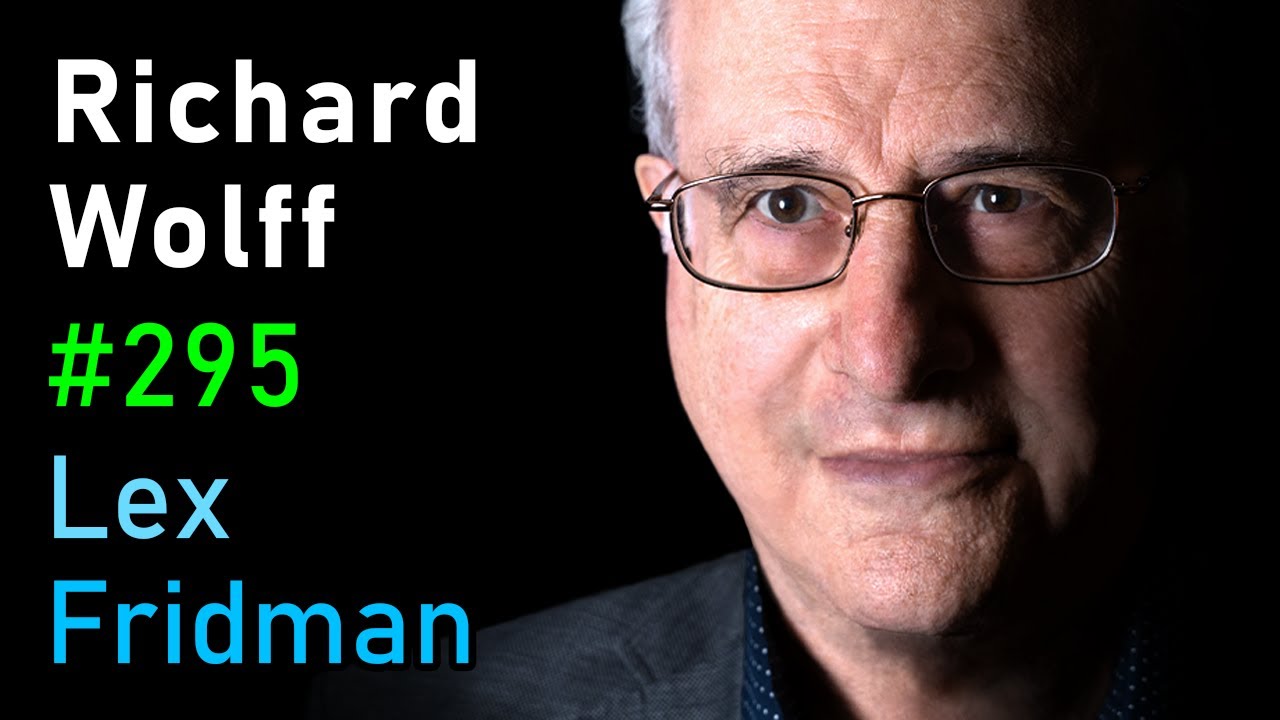
Richard Wolff: One of the world's leading Marxist economists, a professor (Harvard, Stanford, Yale-trained) who taught economics for decades and now reaches huge online audiences explaining socialism and critiques of capitalism.
What this episode covers
Lex Fridman interviews Marxist economist Richard Wolff about the origins and meaning of Marxism, distinguishing Marx's actual ideas from later state-centric Soviet interpretations. Wolff argues Marx focused on exploitation in the workplace, where workers produce a surplus appropriated by employers, and that true communism means workers democratically controlling that surplus via worker co-ops. They debate human nature, risk, competition, monopoly, innovation, government versus corporate accountability, and why Stalinism turned bloody. Wolff also covers the U.S. taboo on Marxism during the Cold War, the rise of Bernie Sanders and AOC, cultural Marxism, and his personal life.
The guest's own work
Contending Economic Theories: Neoclassical, Keynesian, and Marxian
Richard Wolff (and Stephen Resnick)
“the textbook I wrote in economics in case you're ever interested was also published by the MIT press and the title of contending economic theories neoclassical Keynesian and marxian”— Richard Wolff
book on the rise and fall of the Soviet Union
Richard Wolff (and Stephen Resnick)
“I spent 10 years of my life uh with another Economist writing a book uh about that to try to explain from a Marxist position the rise and fall of the Soviet Union”— Richard Wolff
Also referenced (named, not recommended)
Capital (Das Kapital)
Karl Marx
“if you read Marx's Capital the great work of his maturity three volumes there's almost nothing in there the state”— Richard Wolff
The Development of Capitalism in Russia
Vladimir Lenin
“one of Lennon's greatest books is called the economic history of Russia and he goes back centuries it's a huge book 3 or 4 inches thick”— Richard Wolff
Big reveals from this episode
- Wolff says Stalin redefined socialism as simply capturing the state, which Wolff calls a fundamental betrayal of what Marx meant.
- As a Marxist, Wolff flatly states the Soviet, Chinese, Cuban and other 20th-century attempts did not succeed.
- Wolff reveals that in 20 semesters across Harvard, Stanford and Yale, 19 never mentioned Marxism at all.
- Core thesis: a revolution that just swaps a private exploiter for a government official misses the entire point of Marxism.
- Wolff's concrete alternative to capitalism: workers collectively appropriate their own surplus and decide democratically what to do with it (worker co-ops).
- He warns that doing to the U.S. working class what was done to 1920s German workers risks producing an American Hitler.
- Wolff argues Hitler used 'socialist' purely as a populist stepping stone and that Nazis first jailed and killed Communists and socialists.
- Wolff says demand for his work exploded in the last 10 years, from one interview every few months to three or four every day.
Worth remembering
- Eugene Debs ran for U.S. president from jail and did remarkably well, and Wolff calls him the inspiration for Bernie Sanders.
- Wolff explains 'surplus' is a mistranslation of Marx's German 'mehr' (more); Marx meant a simple equation, output minus the producer's consumption.
- Median U.S. childcare worker pay is about $11.22/hour, less than parking-lot attendants, which Wolff attributes to gender.
- Both Plato and Aristotle hated markets for destroying community; Plato wanted them banned, Aristotle wanted them regulated.
- The U.S. federal minimum wage was last raised in 2009 to $7.25 and has not moved despite years of inflation.
- Wolff argues competition destroys itself: winners absorb losers, so monopoly is the product of competition, not its opposite.
- About 49,000 people died in U.S. auto accidents in a single year, which Wolff uses to argue for mass transit over individual cars.
- Wolff contends corporations are the greatest practitioners of central planning, buying up suppliers to avoid the market they praise.
- He argues Russia today is fundamentally different because it has China, which changes the geopolitical calculus.
- Wolff married his wife, a psychotherapist, at age 23 and is still married to her; both his parents were political refugees.