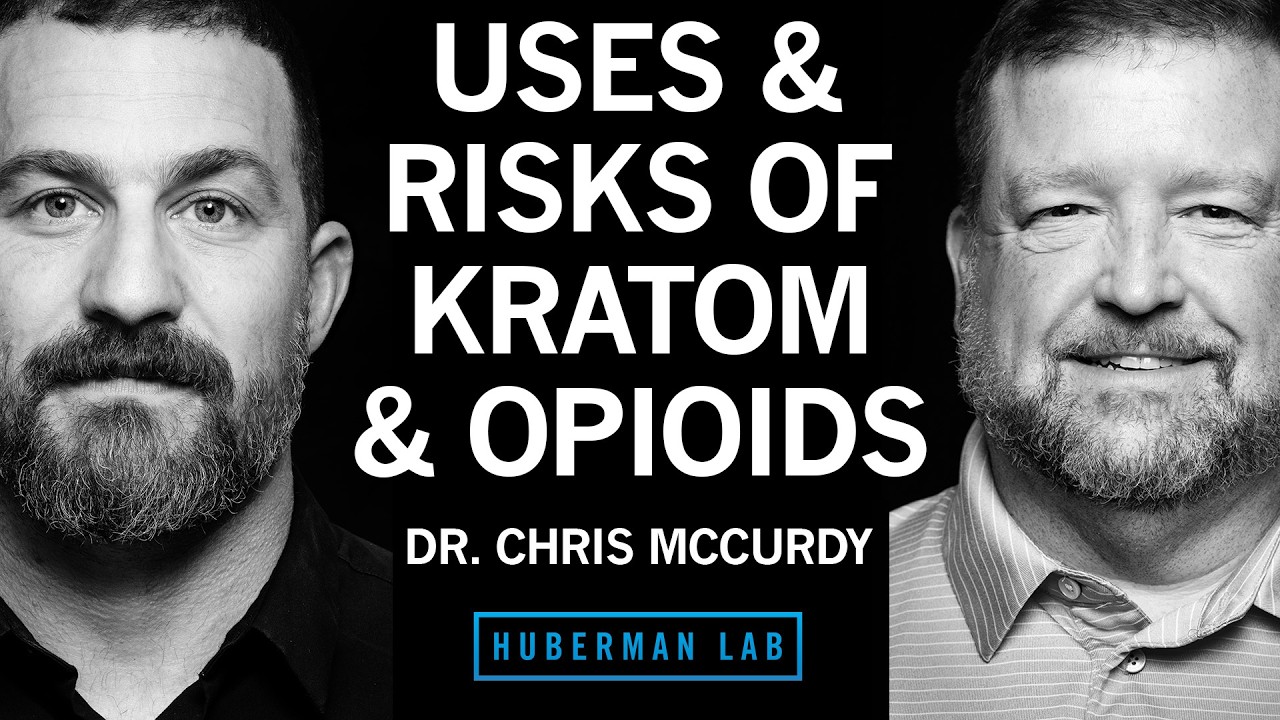
Dr. Chris McCurdy: Professor of medicinal chemistry at the University of Florida who directs research on natural products and their pharmacology. He is the leading academic researcher on kratom, accounting for roughly 10% of all published papers on the plant.
What this episode covers
Andrew Huberman talks with Dr. Chris McCurdy about kratom (Mitragyna speciosa), a plant compound now used by an estimated 20 million Americans daily. McCurdy explains kratom's complex, dose-dependent effects, ranging from a caffeine-like stimulant at low doses to a sedative, opioid-like effect at higher doses, and stresses that US products (concentrates, extracts, and synthetic 7-hydroxymitragynine isolates) are far more potent and risky than the traditional fresh-leaf use in Southeast Asia. They discuss kratom's potential to help people transition off opioids, its addiction and respiratory-depression risks, and how all products get lumped under one name like undifferentiated 'alcohol.' The conversation broadens into how most modern medicines derive from plant alkaloids, and ends with the surprising pharmacologic history of soft drinks like Coca-Cola, 7Up, and Dr. Pepper.
The guest's own work
Protocols: An Operating Manual for the Human Body
Andrew Huberman
“I have a new book coming out. It's my very first book. It's entitled Protocols: An Operating Manual for the Human Body.”— Andrew Huberman
Also referenced (named, not recommended)
5-hour Energy
Living Essentials
“they had uh energy shots right next to the 5-hour energy shots. And so if you were in a hurry you might accidentally grab something that you thought was a five-hour energy shot”— Chris McCurdy
Modafinil (Provigil)
Cephalon
“he took a medaphanil, which is a um drug for actually narcolepsy. A lot of people use modafanil as a stimulant cognitive enhancer.”— Chris McCurdy
Wegovy
Novo Nordisk
“now we have Wiggoi and whatever zones uh out there as blockbuster drugs that are really changing the shape of our society”— Chris McCurdy
Coca-Cola
The Coca-Cola Company
“Coca-Cola um definitely had cocaine in it in in its original setting. Coca-Cola is still the major importer of cocoa leaves into the United States to this day.”— Chris McCurdy
Coke Zero
The Coca-Cola Company
“they got smart and made this product called Coke Zero that has the flavoring agent from the cocoa plant in it.”— Chris McCurdy
7Up
Keurig Dr Pepper
“Seven Up had lithium in it in the past and it was um you know for mind wellness.”— Chris McCurdy
Pepsi
PepsiCo
“Pepsi had pepsinogen which is a digestive peptide in it.”— Chris McCurdy
Dr. Pepper
Keurig Dr Pepper
“Dr. Pepper was developed by Dr. Pepper in Waco, Texas and was a special formula that he had come up with for well-being as well.”— Chris McCurdy
Mountain Dew
PepsiCo
“a bunch of buddies and I would get together on Friday nights and we would drink a case of Mountain Dew.”— Chris McCurdy
Jolt Cola
Jolt Company
“I was just curious what's the best caffeinated beverage... Well, at the time it was Jola, which doesn't exist anymore, right? But Jolt Cola, Mountain Dew was second.”— Chris McCurdy
Vivarin
Meda Consumer Healthcare
“I got Vibrin tablets and I extracted the caffeine out of the Vibrin tablets to quantify how much caffeine was in those.”— Chris McCurdy
Ritalin (methylphenidate)
Novartis
“his master's thesis was making analoges of methylenidate which is rolin... guess what's still on the market today? Methylenadate.”— Chris McCurdy
Suboxone (buprenorphine/naloxone)
Indivior
“they're using bupinorphine or suboxone which is one of our gold standard treatments or even methadone to get individuals off of”— Chris McCurdy
Big reveals from this episode
- McCurdy estimates over 20 million Americans use kratom every single day, far above the often-cited 2 million.
- Surprisingly, the largest survey of users found most take kratom responsibly for energy and mood, not to get high.
- A soon-to-publish paper finds synthetic 7-hydroxymitragynine isolates cause respiratory depression equivalent to opioids in animals.
- The dangerous compound 7-hydroxymitragynine may not even occur naturally in the plant and is now chemically manufactured and sold.
- Huberman admits drinking 600 to 900 mg of caffeine daily, while McCurdy reframes sodas as originally pharmacologic 'soft drinks.'
- Coca-Cola is still the largest importer of coca leaves into the US, processed in New Jersey, with cocaine extracted for pharmaceutical use.
- A 2007 case report: a man had a seizure mixing kratom leaf and modafinil, then quit kratom cold turkey with only a runny nose.
Worth remembering
- Morphine was the very first alkaloid ever isolated; cocaine was the second.
- Kratom acts on three systems at once, opioid, serotonin, and adrenergic, like a 'pharmaceutical shotgun' or symphony orchestra.
- About 75% of FDA-approved drugs were discovered from or modified from natural products.
- GLP-1 weight-loss drugs originated from peptides in the saliva of the Gila monster lizard.
- Kratom's alkaloids likely evolved as antifungal defenses for a tree growing in hot, humid, fungus-prone swamps.
- White, red, and green 'vein' kratom labels are mostly marketing; alkaloid content is nearly identical across colors.
- Cocaine is still the best local anesthetic ever discovered and is used for nasal and eye surgeries.
- 7Up once contained lithium for mood, and Coke syrup was sold in pharmacies to settle nausea, including in pregnant women.
- Smith Kline & French studied mitragynine in the 1960s but shelved it because it was no better than codeine.