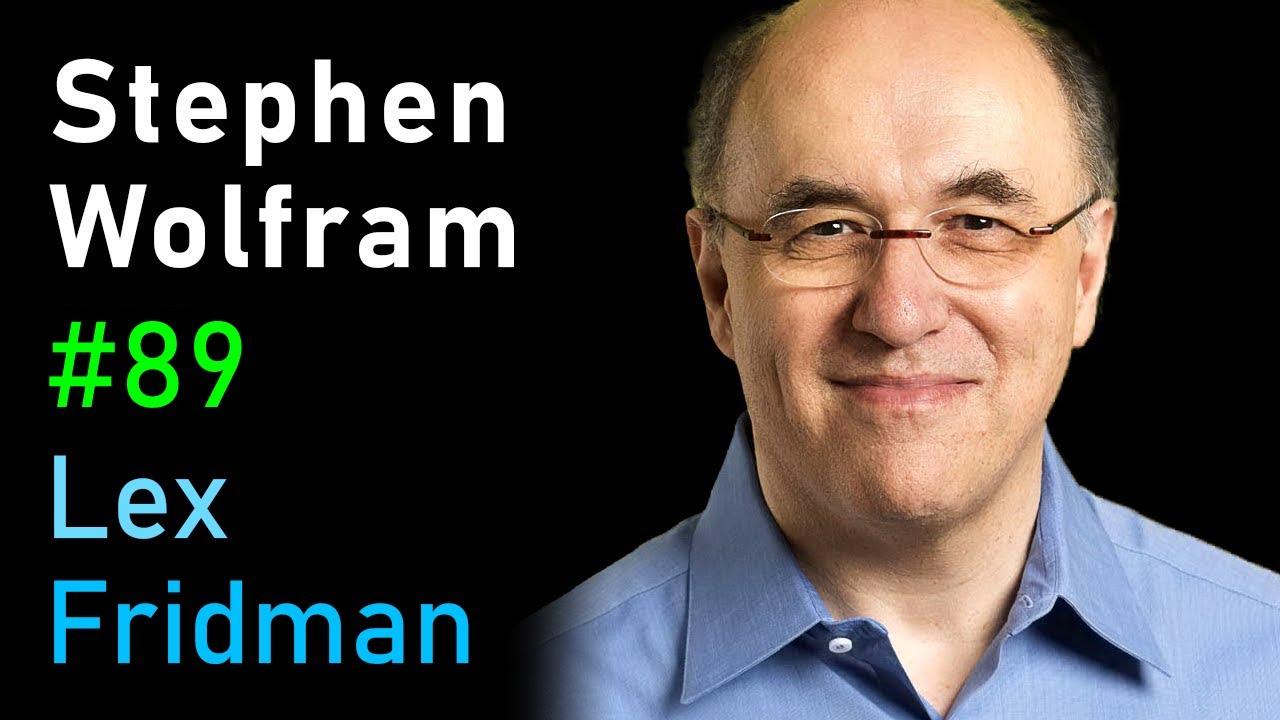
Stephen Wolfram: Computer scientist, mathematician, and theoretical physicist; founder and CEO of Wolfram Research, creator of Mathematica, Wolfram Alpha, and Wolfram Language, and author of A New Kind of Science.
What this episode covers
Lex Fridman talks with Stephen Wolfram about the nature of computation and why even extremely simple rules, like the cellular automaton rule 30, produce immense, irreducible complexity. Wolfram lays out his principle of computational equivalence and the idea of computational irreducibility, arguing there is no bright line between intelligence and mere computation. He details his then-fresh project to find a fundamental theory of physics using hypergraph rewriting, from which space, time, special relativity, and quantum mechanics could emerge. The conversation also covers building Wolfram Language and the Wolfram knowledge base, AI ethics and computational contracts, ego in science, and immortality.
The guest's own work
A New Kind of Science
Stephen Wolfram
“so in 2002 you published a new kind of science to which sort of on a personal level I can credit my love for cellular automata”— Stephen Wolfram
Wolfram Alpha
Wolfram Research
“it wolf now for is a system for answering questions where you ask in question with natural language and it'll try and generate a report”— Stephen Wolfram
Wolfram Language
Wolfram Research
“we have a pretty full scale computational language that sort of talks about the world and that's that's exciting”— Stephen Wolfram
Mathematica
Wolfram Research
“Mathematica first came out 1988 it's this system that is basically a instance of Wolfram language and it's used to do computations”— Stephen Wolfram
Wolfram Engine for Developers
Wolfram Research
“we have this free Wolfram engine for developers which is a free version for developers”— Stephen Wolfram
Also referenced (named, not recommended)
Connection Machine
Thinking Machines Corporation
“using this big parallel computer called a connection machine that that company was making I generated this giant printout of rule 30”— Stephen Wolfram
Arrival
Denis Villeneuve
“you and your son Christopher helped create the alien language in the movie arrival so let me ask maybe a bit of a crazy question”— Lex Fridman
2001: A Space Odyssey
Stanley Kubrick
“what do you make of the monolith in 2001 Space Odyssey in terms of aliens communicating with us”— Lex Fridman
Voyager Golden Record
NASA
“on the Voyager you know golden record thing one of the things that's kind of cute about that is it's a phonograph record”— Stephen Wolfram
BERT
“I think you have some of the state of the art transforms okay have Bert in there I think”— Lex Fridman
Encyclopaedia Britannica
Encyclopaedia Britannica Inc.
“touring trying to work out he's thought about taking encyclopedia britannica and you know making it computational in some way”— Stephen Wolfram
Big reveals from this episode
- Wolfram announces he has just re-energized a public, live-streamed project to find the fundamental theory of physics and is optimistic it will succeed.
- He proposes the universe's deepest structure may be a hypergraph of nodes and edges with rewriting rules, from which space and time emerge.
- He claims the causal-invariance property of these rewrite rules actually implies special relativity rather than assuming it.
- Wolfram says the minimal version of his universe model may be a single line of Wolfram Language code.
- He reveals his team has a 'wonderfully bizarre' new theory linking quantum mechanics to a thread of human consciousness.
- Feynman privately asked how Wolfram knew rule 30 would be complex; Wolfram answered he just enumerated all rules and observed it.
- Wolfram offers $30,000 in prizes ($10,000 each) for solving three open problems about rule 30.
- Wolfram says he would choose immortality and calls effective human immortality the biggest coming discontinuity in human history.
Worth remembering
- Wolfram and his son Christopher helped create the alien language for the movie Arrival.
- The Voyager Golden Record includes instructions to play a phonograph record that most kids today can no longer recognize.
- Rule 30, a cellular automaton with a trivially simple rule, produces behavior that appears random for all practical purposes.
- Computational irreducibility means the only way to know what many systems do is to run every step, with no shortcut.
- Wolfram Language has roughly 6,000 built-in primitive functions covering knowledge from volcanoes to image identification.
- Feynman was secretly best at heavy calculation but presented elegant intuitions afterward, mystifying colleagues.
- When Wolfram showed Wolfram Alpha to Marvin Minsky, Minsky tested random queries and exclaimed it actually works.
- Wolfram argues intelligence is just computation that happens to do things humans care about, with no general bright line.
- He estimates only about 1% to 20% of simple cellular automaton rules reach computational equivalence.
- The term 'computational irreducibility' has entered the U.S. Congressional Record via Wolfram's Senate testimony.