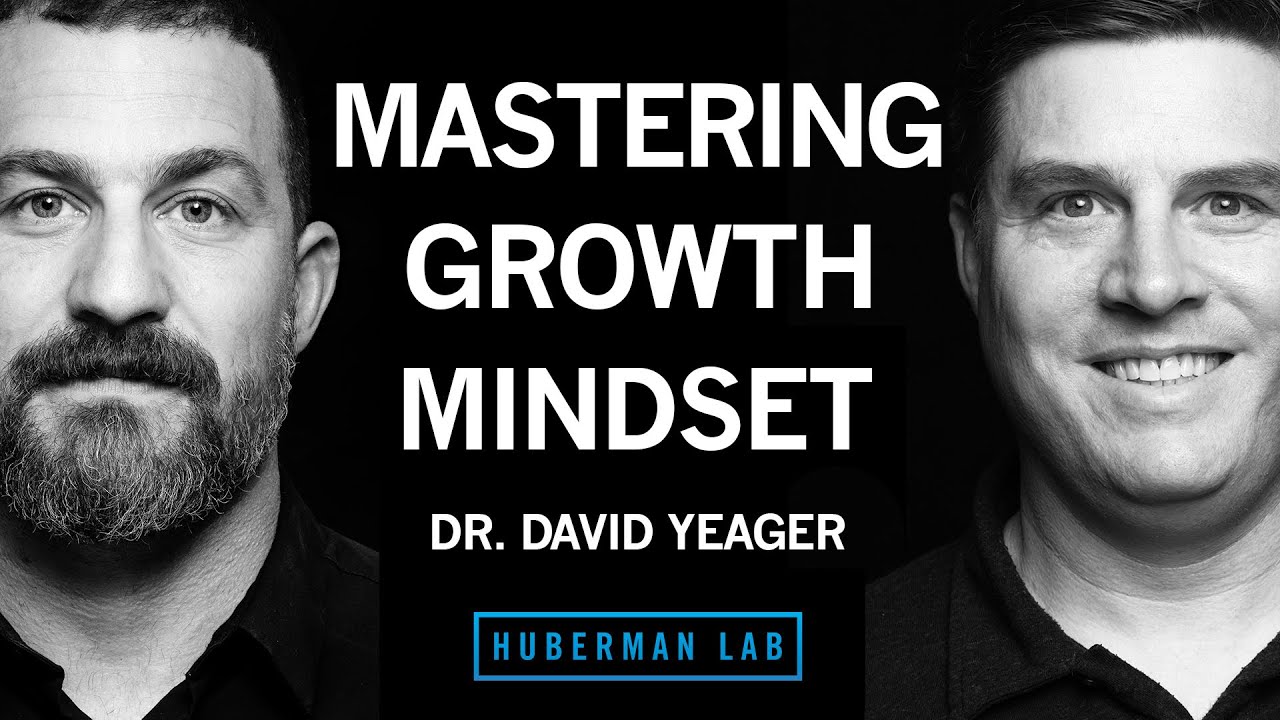
Dr. David Yeager: Professor of psychology at the University of Texas at Austin and one of the world's leading researchers into growth mindset and the stress-can-be-enhancing mindset. Author of the book '10 to 25: The Science of Motivating Young People.'
What this episode covers
Andrew Huberman talks with psychologist David Yeager about what growth mindset actually is and how to apply it. They cover why short, well-designed interventions can change students' trajectories years later, how to reframe physiological stress as a performance-enhancing resource rather than a threat, and the 'mentor mindset' that pairs high standards with high support. The conversation expands into the neuroscience of striving, adolescent status-seeking, and the central role of testosterone and reward circuitry. The most emphasized theme is purpose: attaching effort to a contribution toward others makes the struggle itself rewarding and drives deeper learning, persistence, and better outcomes.
The guest's own work
10 to 25: The Science of Motivating Young People
David Yeager
“Dr joerger is also the author of an important and extremely useful new book entitled 10 to 25 the science of motivating young people”— Andrew Huberman
Also referenced (named, not recommended)
Cultures of Growth
Mary Murphy
“what I find compelling is a beautiful new book by Mary Murphy called cultures of growth... it's getting tons of great press”— David Yeager
The Last Lecture
Randy Pausch
“the late... Randy P for the last lecture... he talked about lessons that were important for life”— Andrew Huberman
Man's Search for Meaning
Viktor Frankl
“it's a classic Victor Frankle argument of man search for meaning... what helps him survive is the debt that he owes to the Future work”— David Yeager
The End of Poverty
Jeffrey Sachs
“I picked up Jeffree Sachs end of poverty which a popular book at the time and just thinking like here's a guy”— David Yeager
Steve Jobs
Walter Isaacson
“we hear the stories of like the Steve Jobs is and I really enjoyed that book by Walter isacon and that story”— Andrew Huberman
War and Peace
Leo Tolstoy
“what's the point of war in peace right war in peace is is really a theory of of great leaders in the war”— David Yeager
Overleaf
Overleaf
“you put up your figures in your paper in over Leaf which is like a wizzywig editor for scientific papers”— David Yeager
Big reveals from this episode
- A two-session, ~25-minute growth mindset intervention raised 9th graders' grades and course-taking, with unpublished effects on college-ready high school graduation four years later.
- Pairing growth mindset with stress-reappraisal actually changes measurable stress physiology, not just attitudes.
- Wearables that detect arousal can't distinguish positive 'challenge' stress from negative 'threat' stress, a key limitation.
- Yeager argues the older 'rational prefrontal tames the emotional brain' model is backwards: affective regions train the prefrontal cortex.
- In experiments, a 'purpose/contribution' framing beat a 'money in the future' framing for deeper learning, persistence, and grades.
- When given a purpose message, teenagers chose boring math over Tetris and videos while being secretly tracked.
- Hypercritical online and workplace behavior is framed as self-protection within a 'culture of genius' that punishes mistakes.
- Vanderbilt's Fisk-Vanderbilt Bridge Program produced the first-ever Black first author on a physics Nature paper by selecting for drive over GRE scores.
Worth remembering
- Growth mindset is simply the belief abilities can change under the right conditions, NOT the idea that trying hard means you can do anything.
- 'Wise interventions' use three elements: new scientific information, stories from relatable peers, and a 'saying-is-believing' writing exercise.
- Misapplied growth mindset that just says 'try harder' can backfire, because effort can be read as a sign of low potential.
- A threat-type stress response keeps blood central to slow bleeding and releases cortisol as an anti-inflammatory for tissue repair.
- Multi-pyramid high schools (many routes to status) show better student adjustment than single-pyramid ones.
- The most bullying comes from kids in the 6th-to-85th popularity percentile, those near but not at the top.
- Testosterone increase predicts reward-circuit reactivity during risk-taking equally in boys and girls, even though boys end higher.
- Kahneman and Tversky's prospect theory shows losses loom larger than equivalent gains, but gains still motivate.
- The brain struggles to be motivated by distant uncertain rewards, which is why 'suffer now for money later' fails with teens.
- Stack ranking (firing the bottom 10%), a Jack Welch GE policy, is cited as fostering mistake-hiding cultures at companies like Boeing.