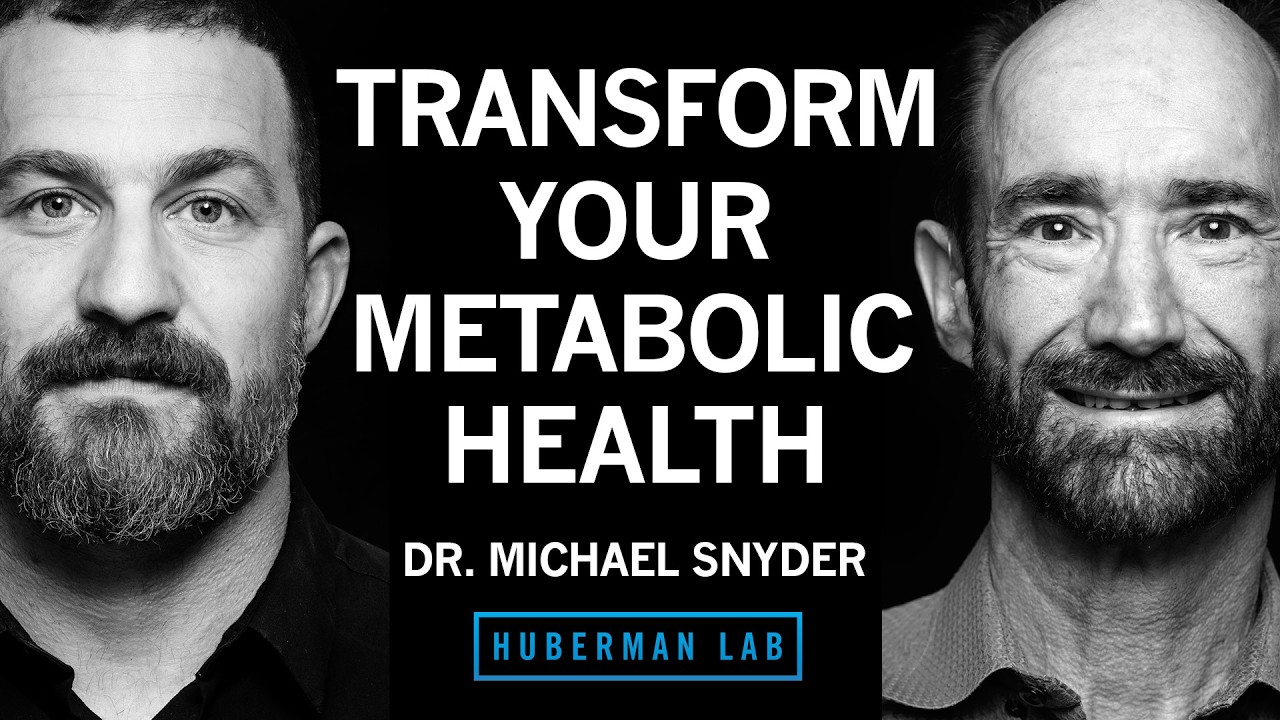
Dr. Michael Snyder: Professor (and former chair) of genetics at Stanford School of Medicine whose lab studies why individuals respond differently to foods, drugs, and interventions. He has spun off multiple health-measurement companies and famously profiles his own biology in extreme detail.
What this episode covers
Andrew Huberman and Dr. Michael Snyder explore individual variability in metabolic health, showing that glycemic index and 'good vs bad' carb advice break down at the personal level. Snyder explains glucose subphenotypes (muscle insulin resistance, beta-cell defects, incretin defects), why continuous glucose monitors and post-meal walks help, and how different fiber types and microbiomes affect different people. They cover GLP-1 drugs for diabetes and possible longevity/cognition benefits, organ-specific aging ('ageotypes'), whole-body MRI baselines, wearables, single-drop-of-blood metabolomics, and air-quality monitoring. The conversation ends with surprisingly positive data on acupuncture and immersive psychological events (Byron Katie, Tony Robbins), framed around Snyder's thesis that medicine must stop being siloed and use big data plus AI.
Recommended on this episode
Prenuvo
Prenuvo
“I've done a Prenuvo scan. They're not a sponsor of the podcast. But I did a Prenuvo scan... I thought it was great”— Andrew Huberman
PCSK9 inhibitors
generic drug class
“I used to have high cholesterol until I went on statins. I'm on PCSK9 inhibitors, and they're amazing”— Michael Snyder
The guest's own work
January AI
January AI
“there are in fact some of these companies that have set up around personalized management of glucose. I'm involved with one called January AI”— Michael Snyder
Q Bio
Q Bio
“we spun off a medical version of this. This is Q Bio that does whole-body MRI”— Michael Snyder
Iollo
Iollo
“You can get these little drops of blood, mail it in, and they'll profile 650 metabolites... It's called Iollo, I-O-L-L-O”— Michael Snyder
Also referenced (named, not recommended)
Fitbit
“So, this is my Fitbit. This is my Apple Watch... they all measure heart rate, heart rate variability, and reasonably accurate”— Michael Snyder
Apple Watch
Apple
“So, this is my Fitbit. This is my Apple Watch... they all measure heart rate, heart rate variability, and reasonably accurate”— Michael Snyder
Circle ring
Circle
“I have a ring. This one happens to be a Circle. I used to wear an Oura Ring”— Michael Snyder
Oura Ring
Oura
“I have a ring. This one happens to be a Circle. I used to wear an Oura Ring”— Michael Snyder
Metamucil
Procter & Gamble
“Arabixylans and psyllium husks and it's associated with Metamucil”— Michael Snyder
Mounjaro
Eli Lilly
“I shifted to Mounjaro, which is a more potent version, and that dropped me down to 5.7. And I did lose weight”— Michael Snyder
Farxiga
AstraZeneca
“I went on a lower dose thing called Farxiga, and that one dropped me down to about the 6.4, 6.5 level”— Michael Snyder
Ozempic
Novo Nordisk
“incretins are these GLPs that everybody's heard about. Ozempic is a mimic of those and Mounjaro and things like that”— Michael Snyder
Metformin
generic
“metformin and then the poor man's version of it is berberine, which is sold as a supplement, they basically do the same thing”— Andrew Huberman
Berberine
generic supplement
“the poor man's version of it is berberine, which is sold as a supplement, they basically do the same thing. They lower blood glucose”— Andrew Huberman
Repaglinide
generic
“I respond to a certain drug repaglinide that actually promotes that release”— Michael Snyder
Ensure
Abbott
“we had 32 people drink this Ensure shake while they were fasted, and they all reacted very differently to it”— Michael Snyder
Nicorette
Nicorette
“he chewed no fewer than, like, six pieces of Nicorette in a 90-minute meeting”— Andrew Huberman
Big reveals from this episode
- Snyder reveals he is himself a type 2 diabetic with a beta-cell defect, despite being thin and very fit.
- Diabetes is far more than type 1 vs type 2, Snyder subdivides it into muscle insulin resistance, beta-cell defects, hepatic and incretin defects.
- GLP-1 drugs are being investigated as potential longevity and cognition-enhancing drugs, not just diabetes/weight drugs.
- On GLP-1s his A1C dropped from 8.4 to 5.7 and his fat 'evaporated' on whole-body MRI, but he backed off Mounjaro because he looked gaunt.
- Only about one-sixth (16%) of lifespan is attributable to genetics for the average person, lifestyle dominates.
- His own diabetes was predicted by his genome and then triggered by an RSV viral infection that methylated ~100 metabolic genes.
- One electroacupuncture session dropped his blood pressure ~25 points the next day, a result he says he can show in his data.
- A ~700-person Tony Robbins study (vs controls) showed significant improvement in anxiety and depression survey scores.
Worth remembering
- Snyder's lab coined 'glucotypes', people fall into normal, moderate, and severe glucose spikers, and some pre-diabetics spike as badly as diabetics without knowing.
- A brisk 15-20 minute walk after eating measurably blunts a glucose spike.
- The soleus muscle is only ~1% of body mass but acts as an outsized 'glucose sponge' (the Houston 'soleus pushup' study).
- You host more microbial cells than human cells, and about 70% of your immune cells are in your gut.
- Native/aboriginal populations have roughly three times the gut-microbe diversity of people in the US (Justin Sonnenburg's work).
- Recommended fiber is ~25g/day for women and ~35g for men, but most people only get 12-15g.
- Arabinoxylan fiber lowered cholesterol ~25% in their study, but had zero effect in some individuals, who instead responded to inulin.
- Snyder's lab identified 'ageotypes', people age along different dominant pathways (cardio, metabolic, immune, kidney, liver).
- Their air sensor found DEET everywhere, even in his Stanford office, and his spring allergies correlate with eucalyptus, not pine.
- In one experiment he sampled a drop of his own blood every hour for seven straight days, finding thousands of biomarker correlations.