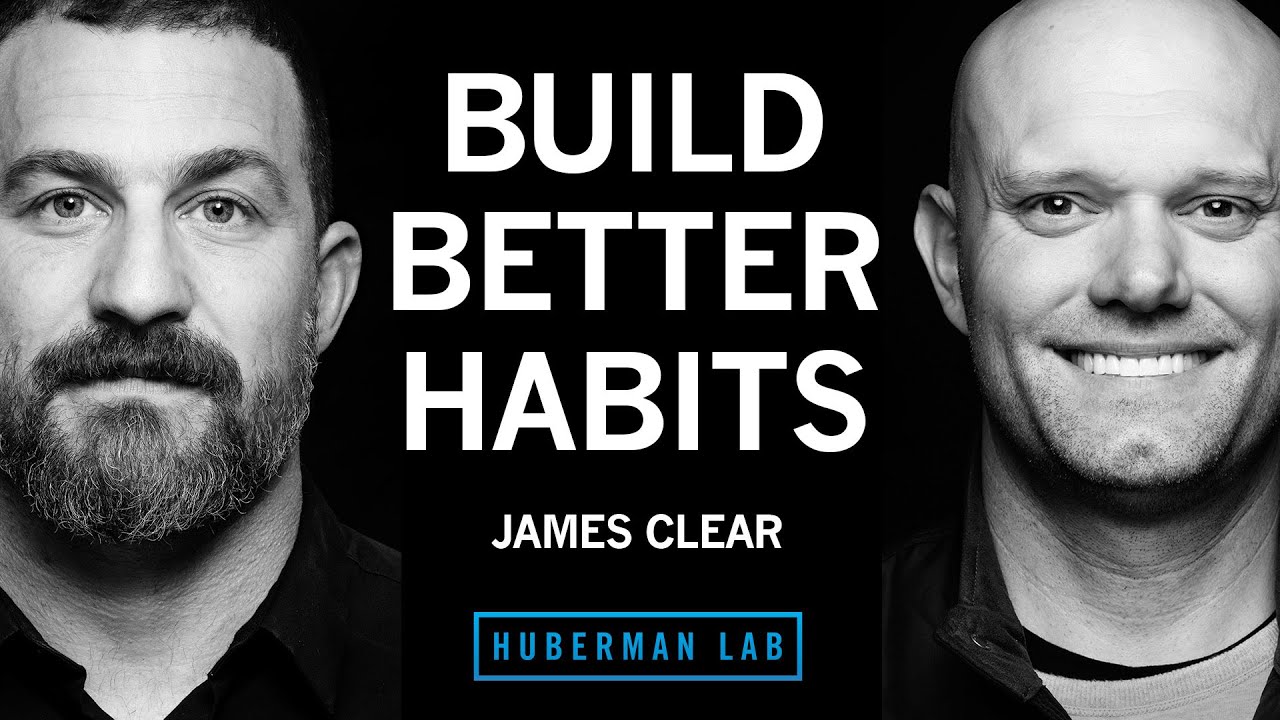
James Clear: Author of the mega-bestseller Atomic Habits (25+ million copies sold) and one of the world's foremost experts on habit formation. A writer and entrepreneur with degrees in biomechanics and business who built his audience through years of twice-weekly online articles.
What this episode covers
James Clear and Andrew Huberman dig into the real-world mechanics of building good habits and breaking bad ones, going beyond cliche acronyms. Clear lays out his four laws of behavior change (make it obvious, attractive, easy, satisfying) and emphasizes that mastering the art of starting and showing up even on bad days matters more than chasing perfect performance. They explore identity-based habits, how consistency raises your performance ceiling, and the power of environment and social groups as forms of 'gravity' that shape behavior. The conversation also covers the danger of clinging too tightly to an identity, managing public failure and fame, the importance of controlling your inputs ('thoughts are downstream of what you consume'), and how to engineer the conditions for success rather than relying on willpower.
The guest's own work
Atomic Habits
James Clear
“There really, there is no one version of Atomic Habits. There are 25 million versions.”— James Clear
Atomic Habits Workbook
James Clear
“I also have an Atomic Habits workbook that we're coming out with, so it just helps you operationalize some of the things.”— James Clear
Also referenced (named, not recommended)
The War of Art
Steven Pressfield
“Steven Pressfield, author of The War of Art, sat in the exact chair you're sitting in right now and he said, "Oh, no, you want kind of an uncomfortable chair."”— Andrew Huberman
Range
David Epstein
“This reminds me a little bit of like David Epstein some of his work on Range and you know, like exploring broadly”— Andrew Huberman
Audible
Amazon
“I was like, "All right, I'm going to be at home more. Let me try to get more reading in." So, I downloaded Audible for audiobooks”— James Clear
Freedom
Freedom
“Doesn't sound like you use any programs like Freedom or any of those to lock you out of the internet. I've I've um uh I have used it.”— James Clear
Self-Control
Self-Control
“Freedom and what's the other one called? Self-Control. Um I've used both of those at various times”— James Clear
DoorDash
DoorDash
“DoorDash is like, just tap your thumb, we'll bring it to your door. Love DoorDash.”— Andrew Huberman
Basquiat
Julian Schnabel
“there's this great moment in the movie Basquiat about Jean-Michel Basquiat, the painter, where he's having a conversation with his friend about fame”— Andrew Huberman
Someone Like You
Adele
“I heard someone told me that Adele, when she uh wrote Someone Like You, she was like, "The best song that I'll ever make is behind me now."”— Andrew Huberman
Big reveals from this episode
- Clear says the single biggest lesson from Atomic Habits readers is the magic and importance of simply getting started.
- Argues the bad days count more than the good days because showing up when you don't feel like it is where you gain separation.
- 'Consistency enlarges ability' - being consistent on imperfect days raises your performance ceiling, a framing Huberman says he'd never heard stated so clearly.
- Identity is a double-edged sword: the tighter you cling to an identity, the harder it becomes to grow beyond it.
- Clear says there's no single version of Atomic Habits - there are 25 million versions, one for each reader, and he has no control over any of them.
- Clear has deleted social media and email from his phone; he must ask his assistant for the social login and re-download email each time he needs it.
- His workout problem wasn't doing the workout - hiring a trainer created the conditions for success, and everything else fell into place.
Worth remembering
- Atomic Habits has sold 25 million copies; at [01:19:00] Clear notes it's one of the top 100 best-selling books ever, after only 7 years.
- Clear wrote two ~2,000-word articles a week for 3 years (about 20 hours each) before landing the book deal.
- Ed Latimore's line that 'the heaviest weight at the gym is the front door' - the hardest step is the first movement.
- Most learning is anti-forgetting; self-testing and reflection are the two things that make material stick.
- Eating most of your calories too close to bedtime impairs sleep; shift-work-style late eating is linked to worse GI health, cancer risk and longevity.
- Clear's daily linchpin habit is his workout - reading and writing come easier afterward, likely from the post-workout cortisol and clarity.
- Huberman notes roughly 3 hours and 11 hours after waking tend to be ideal windows for mental and physical performance.
- Clear frames phone-checking via his four laws: phones are obvious, attractive, easy and satisfying, which is why the habit forms in days.
- Clear cold-emailed about 300 people in his first 6 months as a writer; ~30 responded, and he later hosted author retreats to build his community.
- Clear is from Ohio; his dad played minor-league baseball for the St. Louis Cardinals and his grandpa preached PMA - positive mental attitude.