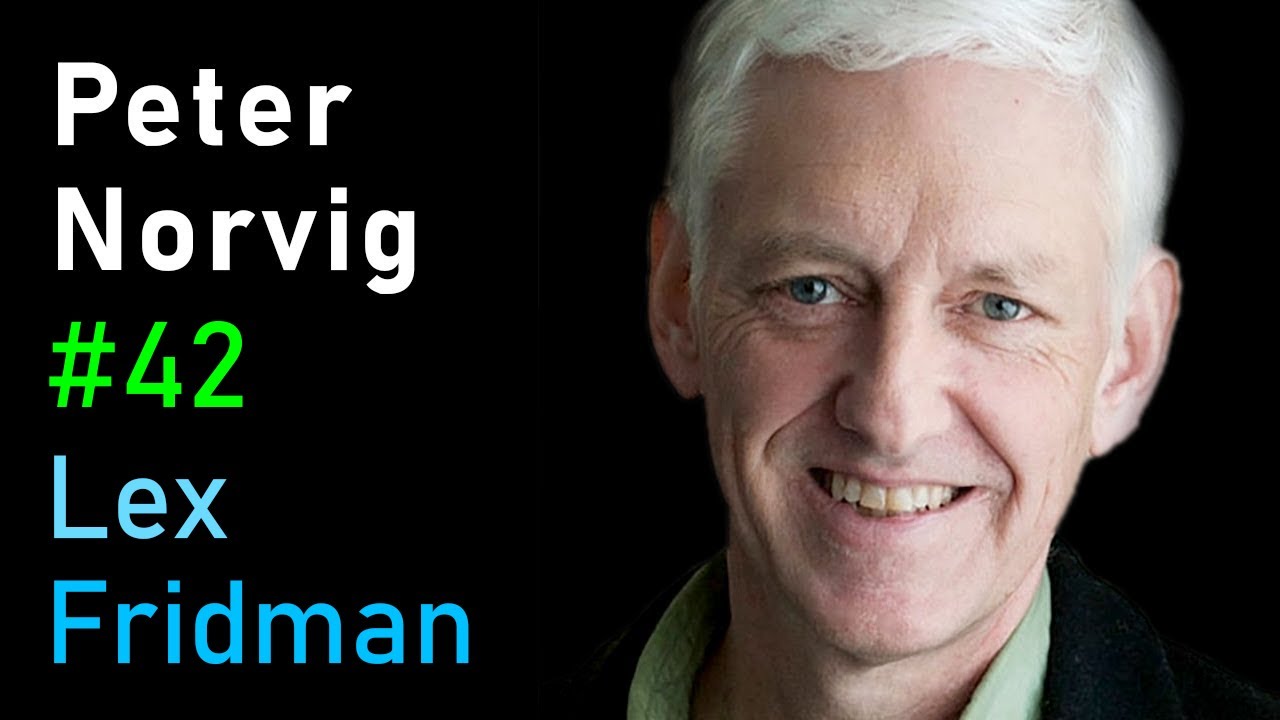
Peter Norvig: Director of Research at Google and co-author, with Stuart Russell, of 'Artificial Intelligence: A Modern Approach,' the textbook that trained a generation of AI researchers. He also taught one of the first massive open online AI courses.
What this episode covers
Lex Fridman interviews Peter Norvig about the evolution of his and Stuart Russell's AI textbook across four editions and how the field shifted from boolean logic and knowledge engineering toward probability and machine learning. Norvig argues the harder problem is no longer optimizing a utility function but deciding what that function should be, raising questions of fairness, bias, and trust. He discusses the brittleness of deep learning and adversarial examples, the value of testing and conversation over simple explanations, and lessons from teaching a 160,000-student MOOC. The conversation closes on programming as problem-solving, the elegance of Lisp, the rise of Python, and his measured view of AI's threats and opportunities.
The guest's own work
Artificial Intelligence: A Modern Approach
Peter Norvig and Stuart Russell
“the co-author with stuart russell of the book artificial intelligence and modern approach that educated and inspired a whole generation of researchers”— Lex Fridman
Paradigms of Artificial Intelligence Programming
Peter Norvig
“i did my list book in the 90s and one of the things i wanted to do was say uh here's how you do an object system”— Peter Norvig
Also referenced (named, not recommended)
Deep Learning
Ian Goodfellow
“we got ian goodfellow to be the guest author for that chapter so he said he could condense his whole deep learning book into one chapter”— Peter Norvig
Her
Spike Jonze
“you've mentioned the movie her as one of your favorite ai movies do you think it's possible for a human being to fall in love with an ai system”— Lex Fridman
Life of Brian
Monty Python
“what other movie do you think her is similar to and my answer was uh life of brian which which is not a science fiction movie”— Peter Norvig
Angry Birds
Rovio
“there's some fuzzier things like you mentioned angry birds yeah do you want do you want to create systems that feed the dopamine enjoyment”— Lex Fridman
Big reveals from this episode
- Norvig says the new edition's key shift is realizing optimization is the easy part while deciding the utility function (what we actually want) is the hard part.
- He explains it is theoretically impossible to satisfy both fairness goals at once in recidivism prediction, forcing an explicit human trade-off.
- Norvig reframes adversarial examples: classification isn't a 2D space mostly covered but a million-dimension space where a cat is a thin string and stepping off leads to nowhere's land.
- He argues much of what we attribute to AI is really driven by communications technology, not AI itself.
- Norvig recounts surveying languages to match his textbook pseudocode and discovering Python was essentially his pseudocode, so he adopted it before he'd even heard of it.
- He dismisses Terminator-style robot apocalypse fears and instead worries about employment disruption and income inequality.
Worth remembering
- Early editions had to assume predicate expressions couldn't fit in memory; hardware growth later made millions or billions of expressions trivially storable.
- The textbook nearly never happened; Norvig and Russell kept talking about it for years at lunch but only committed after meeting again at a conference.
- They deliberately wrote the 1995 first edition from the new probability-and-machine-learning viewpoint while rival books were still old-school.
- Norvig's MOOC signed up about 160,000 students and was one of the first successful massive open online courses.
- Norvig admits he has started about 50 online courses he never finished, and got exactly what he wanted from them anyway.
- Lisp is many AI researchers' favorite language that they never actually use.
- One joke acronym is that LISP stands for 'lots of irritating silly parentheses.'
- Norvig recalls dismissing the commercial internet in 1980, thinking a company could never handle the technology and the dot-com domain would go nowhere.
- He proposes a 'did you mean' for code that predicts the bug fix you'll need tomorrow based on patterns across codebases.