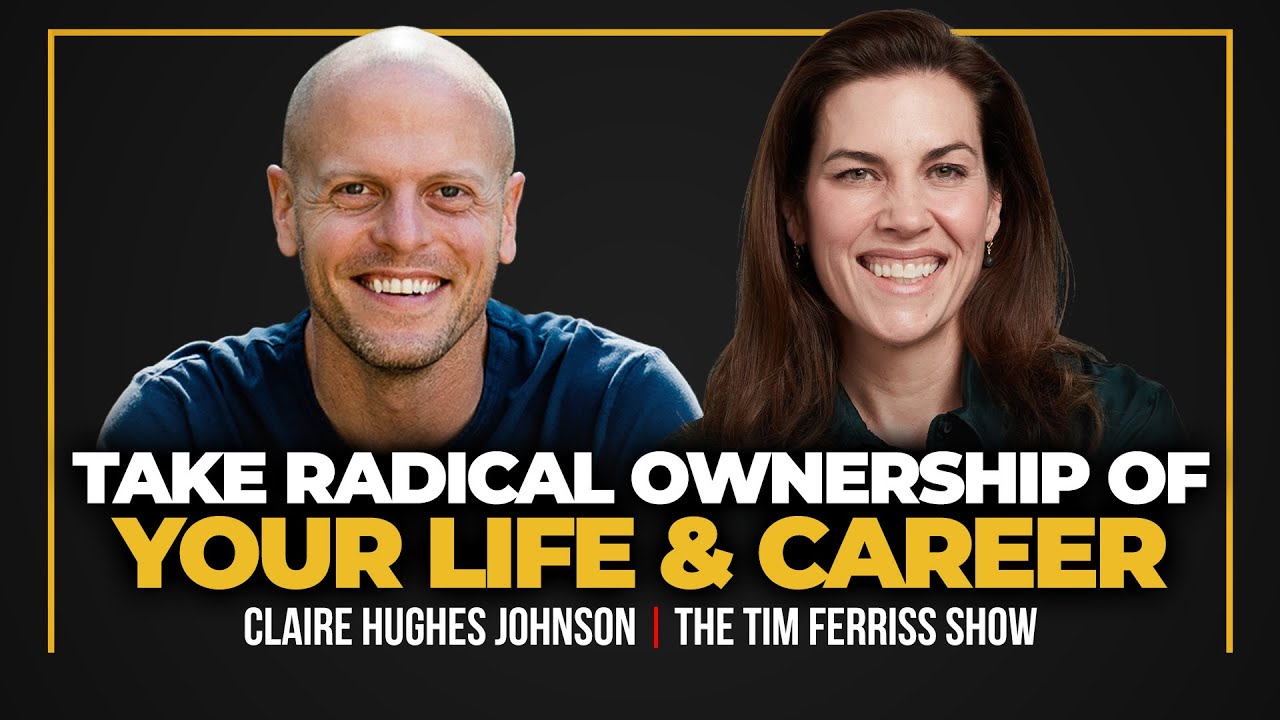
Claire Hughes Johnson: Former COO of Stripe (and prior Google executive); author of Scaling People: Tactics for Management and Company Building.
What this episode covers
Tim Ferriss interviews Claire Hughes Johnson, who spent over a decade at Google before joining Stripe as COO, about the leadership principles she has codified over a 20-plus-year career in tech. The conversation centers on radical ownership: the 'player versus victim' mindset, the discipline of 'saying the thing you think you cannot say,' and making the implicit explicit through tools like a 'working-with-me' user manual. Claire and Tim dig deeply into the art of renegotiating commitments, listening for the 'quiet no,' and protecting time as the most precious resource. They also explore self-awareness as the foundation of leadership, work-style assessments, how to elicit honest hiring references, and how to manage high performers (the 'pushers' and 'pullers') without burning them out. Threaded throughout is a shared love of fiction and great literature as tools for building empathy and emotional intelligence.
Recommended on this episode
Conscious Business
Fred Kofman
“And he wrote this book Conscious Business, which I recommend to, I don't recommend a lot of business books, I'm just going to be perfectly honest Tim”— Claire Hughes Johnson
Awareness
Anthony de Mello
“The book I've probably gifted most to my friends and house guests and so on in the last few years is actually a very short book called Awareness by Anthony de Mello, which is outstanding.”— Tim Ferriss
To the Lighthouse
Virginia Woolf
“Let's talk about a non-business book, and that book is To the Lighthouse by Virginia Woolf. What is your history with this book and why do you recommend it?”— Tim Ferriss
Little, Big
John Crowley
“the one that blew my mind, and nine out of 10 people hate this book... it's Little, Big by John Crowley... It is so unbelievably good.”— Tim Ferriss
Exhalation
Ted Chiang
“I'll usually steer them to, say, Ted Chiang short stories like Exhalation is his second collection.”— Tim Ferriss
One Hundred Years of Solitude
Gabriel García Márquez
“If you said to me, what's the other To the Lighthouse, I would say One Hundred Years of Solitude, Gabriel García Márquez, and my introduction to magical realism.”— Claire Hughes Johnson
An Irish Goodbye
“I watched it last night called An Irish Goodbye... It is hilarious and profound and outstanding... one of the better short films I've ever seen.”— Tim Ferriss
Insights Discovery
The Insights Group
“I would say there's one that's called, I think if you just Google, it's Insights Discovery, which is to me more effective than Myers-Briggs.”— Claire Hughes Johnson
The guest's own work
The 4-Hour Workweek
Tim Ferriss
“I think it's in 4-Hour Workweek, you have some good models of pushing people on not just being busy, but being productive.”— Claire Hughes Johnson
Scaling People: Tactics for Management and Company Building
Claire Hughes Johnson
“The book, Scaling People: Tactics for Management and Company Building.”— Tim Ferriss
Also referenced (named, not recommended)
A Room of One's Own
Virginia Woolf
“But if you read A Room of One's Own, it's basically one of the earliest feminist manifestos that exist.”— Claire Hughes Johnson
Mrs. Dalloway
Virginia Woolf
“I actually decided to write it on Mrs. Dalloway, which is another one of her novels because I love the parallels from Mrs. Dalloway”— Claire Hughes Johnson
The Passion
Jeanette Winterson
“the parallels from Mrs. Dalloway with a book called The Passion by Jeanette Winterson”— Claire Hughes Johnson
Oranges Are Not the Only Fruit
Jeanette Winterson
“who had broken through with a memoir called Oranges Are Not the Only Fruit”— Claire Hughes Johnson
Sexing the Cherry
Jeanette Winterson
“And then had published this book, The Passion, and then a book called Sexing the Cherry, and she's published now several books”— Claire Hughes Johnson
John Wick
“It's like John Wick in some sense. I'm kidding. I'm kidding.”— Tim Ferriss
The Neverending Story
Michael Ende
“So as a kid there were books like The Neverending Story, and then later Dune, for instance.”— Tim Ferriss
Dune
Frank Herbert
“So as a kid there were books like The Neverending Story, and then later Dune, for instance. Science fiction.”— Tim Ferriss
Stranger in a Strange Land
Robert A. Heinlein
“Stranger in a Strange Land by Heinlein, which were also very condensed thought experiments.”— Tim Ferriss
High Growth Handbook
Elad Gil
“My working-with-me document was published in Elad Gil's book, High Growth Handbook, and it went a little bit viral.”— Claire Hughes Johnson
Pulp Fiction
“They send The Wolf from Pulp Fiction. They send it out to do the dirty work.”— Tim Ferriss
Myers-Briggs Type Indicator
The Myers-Briggs Company
“Myers-Briggs, DiSC, Enneagram. I mean there's Discovery Insights, there's the Hogan Assessment”— Claire Hughes Johnson
DiSC assessment
“Myers-Briggs, DiSC, Enneagram. I mean there's Discovery Insights, there's the Hogan Assessment — that's 170 questions.”— Claire Hughes Johnson
Hogan Assessment
Hogan Assessment Systems
“there's the Hogan Assessment — that's 170 questions. There's the Big Five personality test.”— Claire Hughes Johnson
Big Five personality test
“the Big Five personality test is very simple. It's available for free online... the research supports that they're pretty indicative of certain human behaviors.”— Claire Hughes Johnson
CliftonStrengths (StrengthsFinder)
Gallup
“There's a lot of them. StrengthsFinder. It goes on and on. (Claire: StrengthsFinder, good one.)”— Tim Ferriss
Big reveals from this episode
- Claire's second operating principle, learned from leadership coach Fred Kofman, is 'Say the thing you think you cannot say', a leadership skill of naming an unspoken tension in the room, ideally framed as a question or hypothesis to invite validation rather than issuing a judgment.
- Fred Kofman's 'victim versus player' framework: a player owns the miss ('Completely my fault, can we renegotiate?') while a victim deflects ('Lucy owes me her notes'). Later-career people who operate as victims become 'empire builders' who only take responsibility for what they directly control.
- The 'working-with-me' document (a personal user manual): Claire wrote hers around 2009 inspired by Google's Urs Holzle, calling it 'The Unauthorized Guide,' and it reduces team anxiety by making communication channels, decision style, and quirks explicit. It was published in Elad Gil's High Growth Handbook and went mildly viral.
- Claire's billboard / core philosophy is 'Make the implicit explicit', she insists her book is really about getting results, not just being humanistic, because clarity on outcome, process, and measurement gets teams to the finish faster.
- The 'quiet no': a spiritually-minded friend taught her to listen for it and never respond to a request immediately, buy time ('When do you need to know?') so you don't default to yes against your real priorities.
- The most quoted line in her book (which she credits to adaptive-leadership authors Ron Heifetz/Marty Linsky): 'Leadership is disappointing people at a rate that they can absorb.'
- The Stripe 24/7 global support story: Patrick Collison pushed Claire to publicly commit to building it; she missed the first-year deadline but renegotiated by ranking priorities, predicting support would 'implode within six months' (it exploded at four), and earning followership through honesty and visible progress.
- Claire's self-invented 'top talent' framework splits high performers into 'pushers' (grab for more, high-impact but high-friction) and 'pullers' (quietly reliable, never say no, will implode/explode), each needs different coaching to avoid burnout.
Worth remembering
- Claire joined Google in May 2004 at roughly 1,800 employees and left in 2014 when it was nearly 60,000, the company was doubling roughly every year early on.
- Fred Kofman's firm Axialent was hired by Sheryl Sandberg to run management boot camps at Google, including 360 assessments and exercises to 'detoxify the left-hand column' (the unspoken inner monologue).
- Claire's favorite Virginia Woolf novel is To the Lighthouse, but she wrote her college thesis on Mrs. Dalloway, comparing it to Jeanette Winterson's The Passion.
- Claire's working-with-me document has barely changed since 2009; an early note from her Irish assistant Maeve added a section acknowledging she likes 'good craic' (humor) in meetings.
- Claire's mother chose a history PhD over a math career at Radcliffe/Harvard, realizing at age 19-20 that academia offered more control over her time, the money-versus-time trade-off.
- The framework of 'time, treasure, talent' is expanded in the episode to include a fourth: 'testimony' (endorsements, intros, public quotes).
- At peak Claire had 23 to 27 direct reports at Stripe, a former Google colleague she was recruiting was horrified, asking 'What happened to the Claire Johnson that I know?'
- Her hiring-reference trick: ask 'Is this person in the top 20% you've worked with?' then 'Top 10? Top 5?' because people dislike lying about specific rankings; also ask 'What's the most important thing I could do to help them?'
- Claire prefers Insights Discovery over Myers-Briggs; Patrick Collison, initially skeptical that assessments were 'horoscopes,' researched and landed on the Big Five personality test.
- Sheryl Sandberg is cited as a paragon of efficient, decisive 'no'; Claire criticizes leaders who say yes to everything and rely on an assistant 'cleanup crew' (likened to The Wolf from Pulp Fiction).