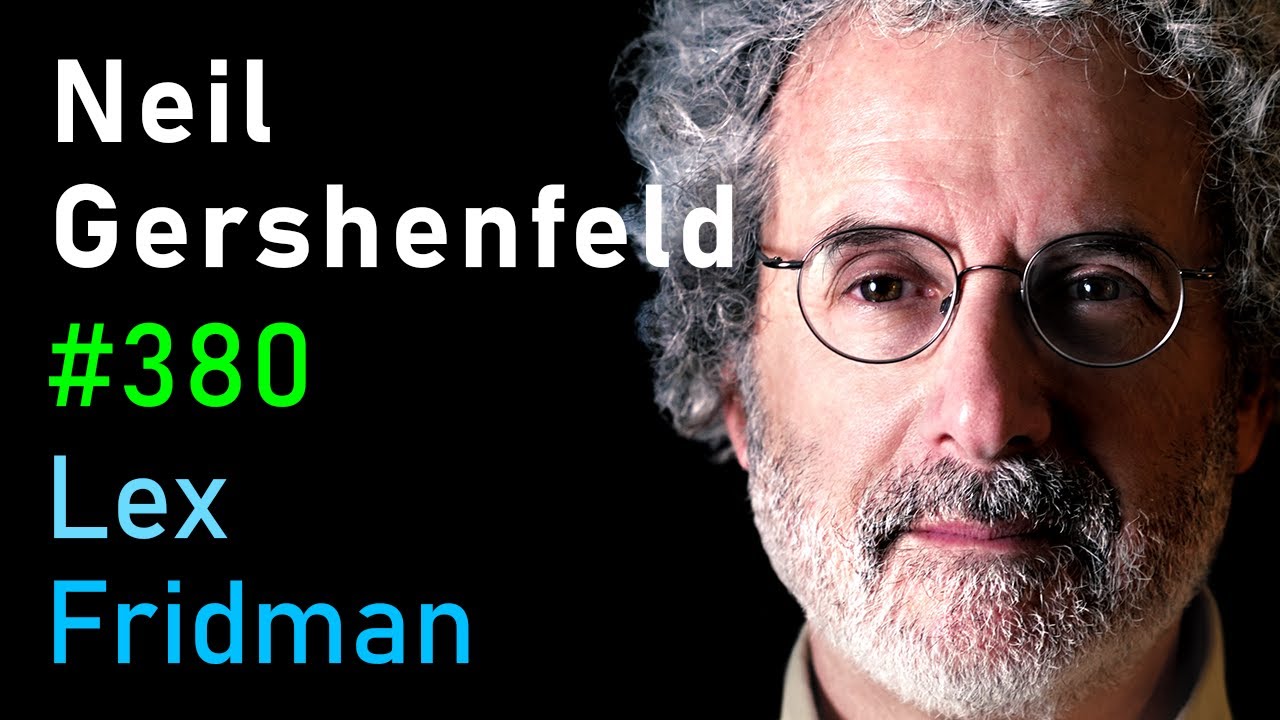
Neil Gershenfeld: Director of MIT's Center for Bits and Atoms, a pioneer of digital fabrication who started the global Fab Lab network and the 'How to Make Almost Anything' course. His work spans self-replicating robots, quantum computing, and synthetic life.
What this episode covers
Gershenfeld argues that Turing and Von Neumann made a foundational physics mistake by separating the computer's 'head' from its 'tape,' divorcing software from hardware. He lays out a vision of digital fabrication where, like the ribosome, a code does not describe a thing but becomes the thing, with error-correcting assembler robots that build copies of themselves from a small set of about 20 building blocks. He traces this through his lab's work on ultralight aerospace materials, microfluidic bubble logic, early NMR quantum computing, and the 2,500-lab global Fab Lab network. The conversation ranges across Maxwell's demon and the thermodynamics of computation, the limits and hype of AI and quantum computing, and a physics in which information and computation are the fundamental resources of the universe. It closes on the social and existential implications: distributed local production, the untapped global 'density of bright inventive people,' and the meaning of life as the propagation of life up a recursive hierarchy.
Also referenced (named, not recommended)
Metropolis
Fritz Lang
“see if you're familiar with the movie The Metropolis uh people would Frolic upstairs in the gardens and down in the basement people would move levers”— Neil Gershenfeld
The Martian
Ridley Scott
“there was a fun thing for the movie The Martian where I did a program with Bill Nye and a few others on how to actually build a civilization on Mars”— Neil Gershenfeld
The Endless Frontier
Vannevar Bush
“I had mentioned veniver Bush and uh he wrote a really influential thing called the endless Frontier so uh science won World War II”— Neil Gershenfeld
Gingery (build-your-own-machine-shop book series)
David J. Gingery
“there's a wonderful series of books by gingery book one is how to make a charcoal furnace and at the end of book Seven you have a machine shop”— Neil Gershenfeld
Big reveals from this episode
- Claims Turing and Von Neumann made a fundamental physics mistake by separating the head from the tape, i.e. software from hardware.
- Notes both Turing and Von Neumann ended their lives studying how software becomes hardware (morphogenesis and self-reproducing automata).
- Reveals an accident in sensing Yo-Yo Ma's cello led to a $100M/year auto airbag-safety sensor business.
- Argues the real birth of digital manufacturing was four billion years ago with the ribosome, not 1952.
- Says his students published a Nature Communications paper showing a robot that can be built from the parts it is itself making.
- States a Fab Lab can make a bio lab and that home-brewed biological threats are something he genuinely worries about.
- Predicts we are nearing the end of the current AI boom and that the next frontier is embodied 'molecular intelligence.'
- Contends the equations of physics are not fundamental but a pencil-and-paper-era representation, and that information and computation are the real root.
Worth remembering
- A ribosome makes only about one molecule per second, but trillions of them building ribosomes can assemble an elephant.
- CBA's tools range from zeptojoule electronics to 10-million-RPM diamond bearings to robots for 100-meter space structures.
- Mixing chemicals has an error rate of ~1 in 100; protein elongation is ~1 in 10,000; DNA replication is ~1 in 100 million.
- A 100-petaflop supercomputer and the human brain both run at about 10^17 operations per second.
- A chip fab places ~10^10 transistors per second while your body places ~10^18 parts per second, an eight-order-of-magnitude gap.
- The Fab Lab network spans ~2,500 labs in 125 countries and doubles every year and a half ('Lass's law').
- Digital's head of DEC, Ken Olsen, famously said you don't need a computer at home, and the company missed personal computing.
- All of biology composes itself from just ~20 amino acids that are notable for being unremarkable but 'good enough.'
- Maxwell's demon was so infuriating that three advisors and advisees in a row who worked on it died by suicide.
- Landauer showed Maxwell's demon's secret is memory; Bennett showed you can compute with arbitrarily low energy by running it reversibly.