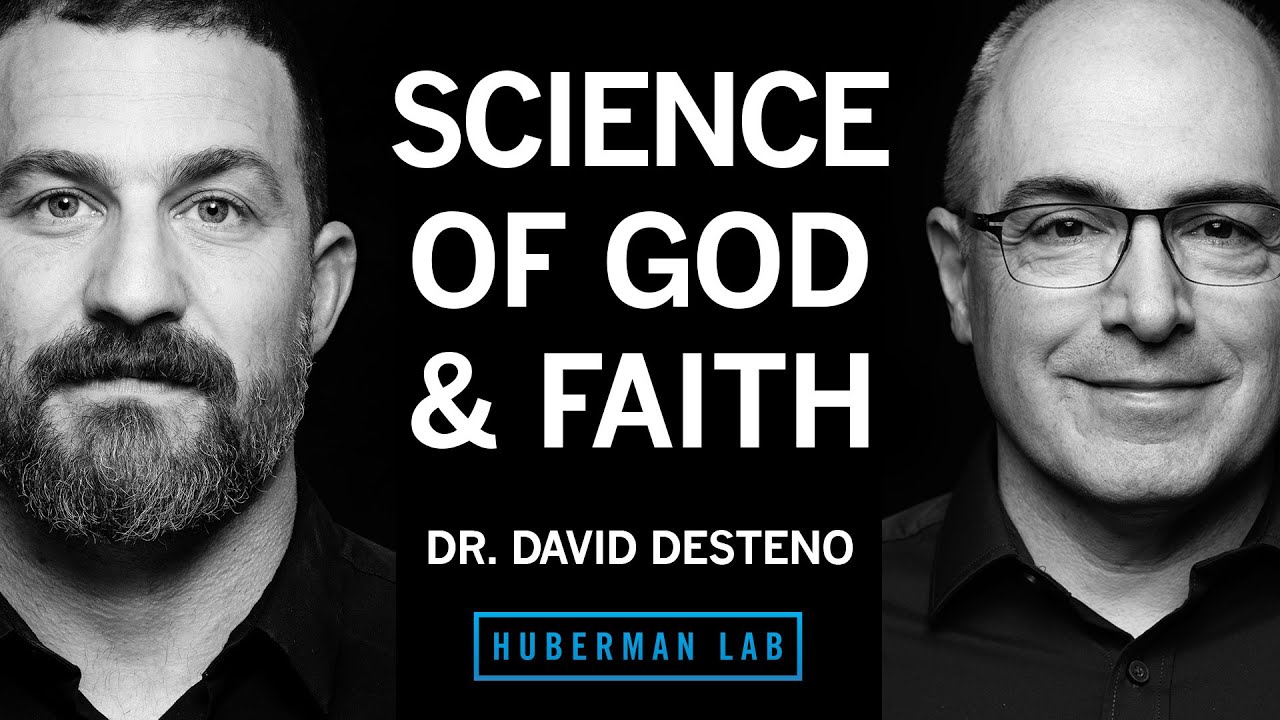
Dr. David DeSteno: Professor of psychology at Northeastern University and host of the podcast 'How God Works.' He studies the science of morality, emotion, and the health benefits of religious practice, and is the author of 'How God Works: The Science Behind the Benefits of Religion.'
What this episode covers
Andrew Huberman and psychologist David DeSteno explore why science and belief in God need not be at odds. DeSteno argues that whether God exists is a question science cannot answer, so he instead studies what religious practices actually do, and the data show that active religious engagement lowers all-cause mortality, reduces anxiety and depression, and increases meaning and connection. They unpack the mechanisms behind prayer, meditation, gratitude, grieving rituals, and motor synchrony, and how these function as 'spiritual technologies' that shape behavior and reduce stress. The conversation also covers good and evil, fear of death, addiction and 12-step surrender, cults versus new religions, Burning Man as a source of spiritual experience, and how religion can be used for both good and harm.
Recommended on this episode
The Secret Pulse of Time
Stefan Klein
“there's a wonderful book um that's not available in audio form called the secret pulse of time that that gets into how this uh expansion contraction works”— Andrew Huberman
The guest's own work
How God Works: The Science Behind the Benefits of Religion
David DeSteno
“to learn more about his books, including his most recent one entitled How God Works: The Science Behind the Benefits of Religion”— Andrew Huberman
Also referenced (named, not recommended)
Believe
Ross Douthat
“I'm thinking of of of Ross Dat's book, Believe. They're trying to make a case for that it's rational to believe in religion”— David DeSteno
Lumosity
Lumos Labs
“the control was an active control. They had done lumosity brain training for for a while.”— David DeSteno
My Big Fat Greek Wedding
Joel Zwick
“it wasn't like that movie my big fat Greek wedding but it wasn't dissimilar either to go over there”— Andrew Huberman
Big reveals from this episode
- DeSteno says any scientist who claims to know for sure that God doesn't exist shouldn't be listened to, because you can't run an experiment on God.
- Active religious engagement over 15-20 years cuts all-cause mortality by 30% and cancer/cardiovascular death by 25%.
- An eight-week meditation study tripled the rate of strangers giving up their seat to someone in pain, from about 15% to nearly 50%.
- In rigged coin-flip studies, about 85% of people lie to get the easier task when no one is watching.
- Having people simply 'count your blessings' for five minutes dropped cheating from roughly 25-30% down to about 2%.
- The people most anxious about death are not believers or firm atheists, but those who don't know whether there's an afterlife.
- Between 100 and 200 new religions form every year, but almost none stick.
- DeSteno admits that despite preaching the benefits of prayer, he rarely prays and is still working out his own beliefs.
Worth remembering
- Formal, repetitive prayer (rosary, sutras) slows respiration and lengthens exhalations, increasing vagal tone and lowering cortisol.
- Covering mirrors during Jewish Shiva works because looking in a mirror intensifies whatever emotion you're feeling, per 1970s-80s research.
- 'Motor synchrony' (moving in unison) makes strangers feel ~30% more willing to help each other, even when they can't explain why.
- Geneticist Eric Jarvis says evidence suggests song and dance evolved before spoken language.
- In Chinese ancestor worship, families burn paper 'ghost money' (even paper cell phones) to keep a relationship with the deceased alive.
- Roughly 25% of psychedelic trips are bad and about 8% are severe enough to need mental-health intervention, underscoring the need for a safe 'container.'
- In a study, cheating dropped dramatically when people played the game inside a temple versus a restaurant kitchen.
- Laura Carstensen's work shows that having young people contemplate death temporarily reorients their values toward relationships and service.
- Princeton neuroscientist Molly Crockett found Burning Man produces lasting, pro-social self-transcendent experiences for some attendees.
- DeSteno notes people are now floating the idea of churches built around an AI as an 'omniscient super intelligence.'