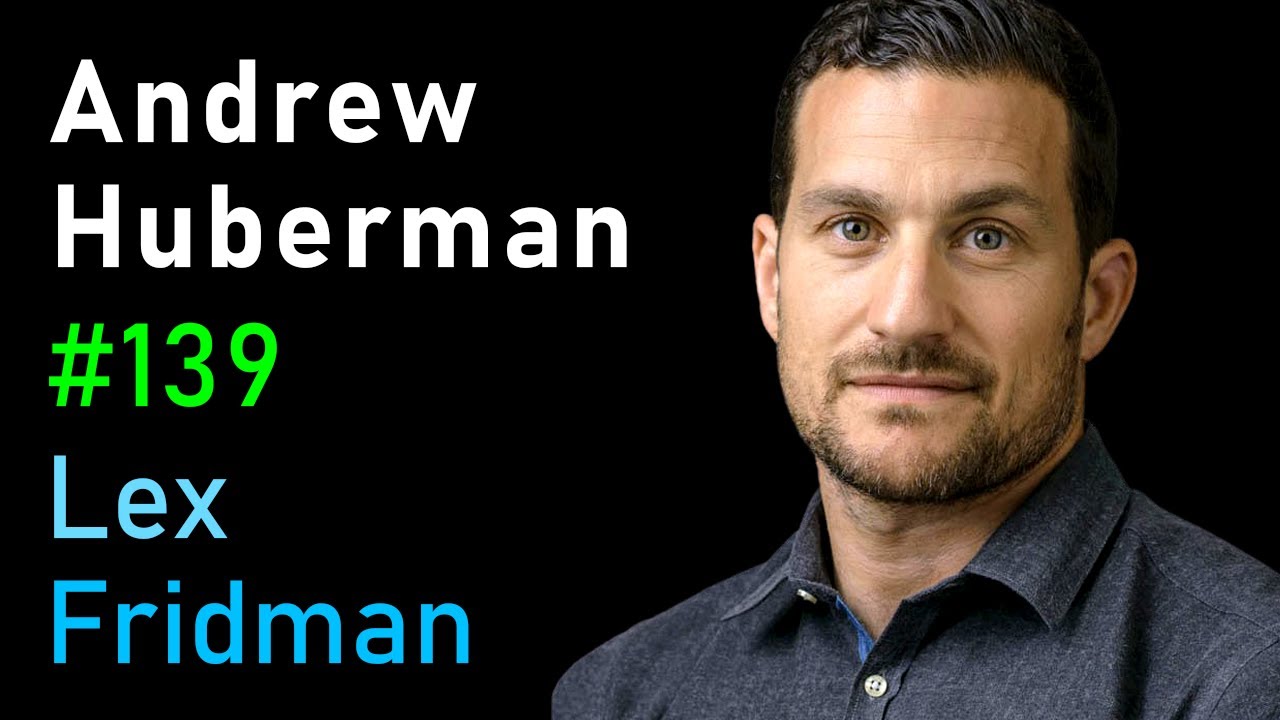
Andrew Huberman: Neuroscientist at Stanford studying how the brain changes through experience and how to repair damaged brain circuits. Runs the Huberman Lab and is known for public science education.
What this episode covers
Andrew Huberman explains how his lab uses VR to induce fear and stress, and what brain circuits govern the freeze, retreat, and advance responses. He develops a framework of 'limbic friction' and the matching of internal autonomic arousal to external space-time demands as the key to optimal performance. The conversation moves into how the visual system and subcortical structures work as concrete machines versus the abstraction-generating neocortex, with implications for neuralink and brain-machine interfaces. They explore psychedelics, sleep, creativity, consciousness, and David Goggins-style self-regulation, closing on the elastic nature of meaning across changing space-time mental states.
Recommended on this episode
Deep Work
Cal Newport
“this guy named Cal Newport wrote a book about deep work oh yeah I love that book yeah he's great”— Andrew Huberman
Man's Search for Meaning
Viktor Frankl
“Victor Franco man search for meaning I read that I reread that book uh quite often”— Lex Fridman
Also referenced (named, not recommended)
Free Solo
Jimmy Chin & Elizabeth Chai Vasarhelyi
“I like to point to that movie free solo which was wild because you know it's incredible movie but I think a lot of its popularity”— Andrew Huberman
How to Change Your Mind
Michael Pollan
“there was so much interest a few years ago with Michael pollen's book and and other things happening about psychedelics as a pathway to exploration”— Andrew Huberman
Winston Churchill's Nap
Jennifer Ackerman
“there's a a book um I think it's called Winston Churchills nap and it's about naps and and the transition between wake and sleep”— Andrew Huberman
Big reveals from this episode
- The maximum stress response is not freezing but advancing toward a threat, which is wired to dopamine reward circuits.
- Huberman dismisses 'flow' as not operationally defined and reframes peak performance as internal state matched to external space-time demands.
- He proposes inventing psychedelics with on/off switches so users could enter and exit altered states in minutes to extract insights.
- He argues neuralink should go subcortical, where stimulating an electrode can evoke an entire behavior or state, not just the cortex.
- Reactivating learned neurons all at once still produced the same behavior, suggesting the space-time firing code may be meaningless for some structures.
- Stimulating an 'up' neuron in area MT makes an animal perceive downward dots as moving up, proving perception is a neural abstraction detached from reality.
- Huberman bluntly says past consciousness researchers gleaned huge taxpayer resources 'essentially for nothing' because the technology wasn't there.
Worth remembering
- Fear of heights is universal in VR because the visual-vestibular system tricks the body into a full stress response on a flat lab floor.
- There are looming-detecting neurons in the retina, and swimming toward a great white shark confuses it because forward movement signals you may be a threat.
- Great mathematics tends to be done young because it relies on working memory, while biology careers run long because they rely on deep knowledge stores.
- In drowsy and sleep states, space and time become dislodged, which is why solutions often arrive after sleep and naps.
- Huberman coins 'limbic friction' for the prefrontal effort needed to override reflexive limbic pulls, in both overstimulated and drowsy states.
- The retina is a piece of your brain about as thick as a credit card, pushed out during the first trimester.
- Melanopsin ganglion cells act as photon counters that set your circadian clock and influence mood by season.
- Glial cells measure epinephrine during effort and send inhibitory signals that make you quit once a threshold is crossed, but dopamine can rescue endurance.
- Huberman's line on Goggins: neuroplasticity loves a non-negotiable contract, freeing brain energy for the actual effort.
- Meaning is elastic: the same situation feels enormous or trivial depending on how the brain contracts or dilates its space-time bubble.