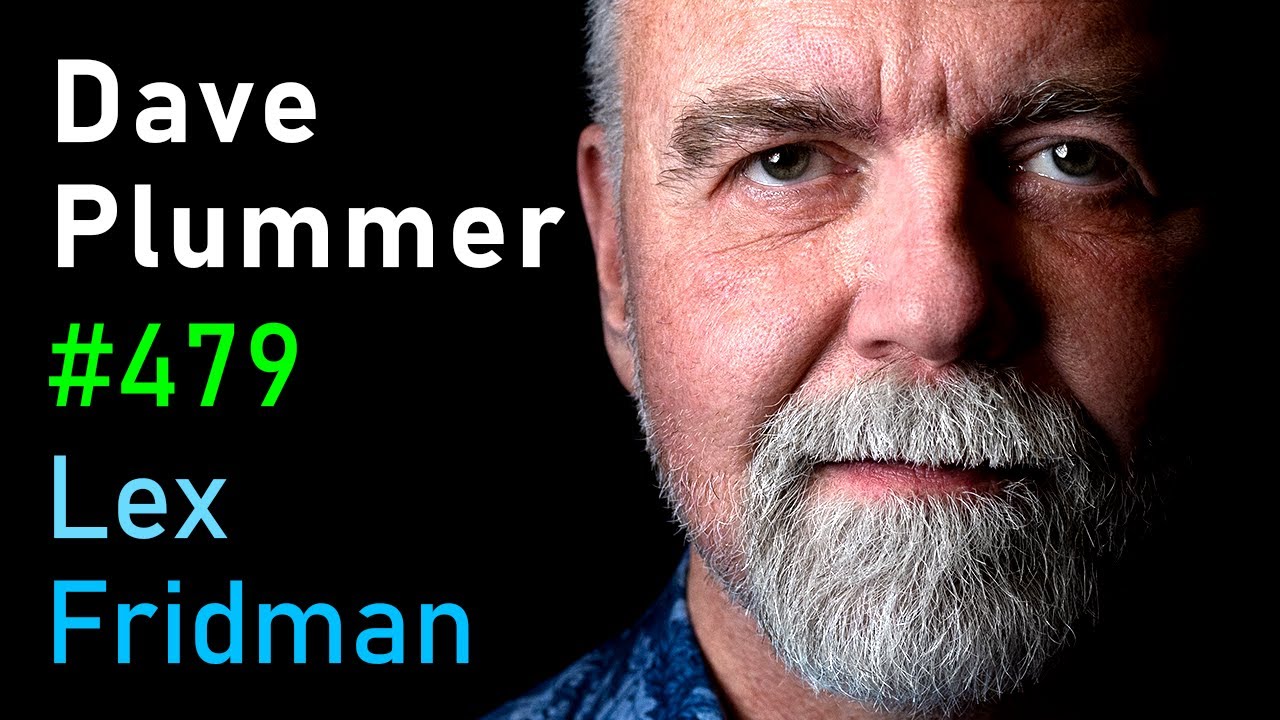
Dave Plummer: A retired old-school Microsoft software engineer who worked on MS-DOS, Windows 95, NT, and XP, creating the Windows Task Manager, ZIP folder support, and the port of Space Cadet Pinball. He now runs the YouTube channel Dave's Garage and wrote a book about life with autism.
What this episode covers
Dave Plummer walks Lex Fridman through his journey from a precocious kid learning on a TRS-80 and Commodore 64 to cold-emailing his way into a Microsoft internship from Saskatchewan. He shares detailed insider stories about porting Windows 95's shell to NT, building the Task Manager as a home side project, adding ZIP support, working under kernel architect Dave Cutler, and implementing Windows XP product activation. The conversation covers the realities of low-level debugging across multiple instruction sets, the craftsmanship-versus-scheduling debates behind Windows UI decisions, and Dave's later software-marketing business that drew a state Attorney General action. The second half is a candid discussion of autism: monotropism, masking, meltdowns, literalism, empathy, and how he reverse-engineers social interactions. He closes with current hobby projects (Tempest RL AI, PDP-11 restoration, GitHub Primes language benchmarks) and reflections on vibe coding and the future of programming.
Recommended on this episode
Hard Drive: Bill Gates and the Making of the Microsoft Empire
James Wallace and Jim Erickson
“I'm reading a book that I had bought called Microsoft, or Bill Gates, and the Making of Microsoft Hard Drive... And it's a great book.”— Dave Plummer
3D Pinball: Space Cadet
Cinematronics
“Why is that game so awesome? - I think it's a great design... the original game is a great design.”— Dave Plummer
The guest's own work
Secrets of the Autistic Millionaire
Dave Plummer
“he wrote a book on autism and about his life story, called Secrets of the Autistic Millionaire, where he gives really interesting insights”— Lex Fridman
Also referenced (named, not recommended)
Commodore 64
Commodore
“that was my first computer probably many years after it was released, but yeah, Commodore 64's incredible.”— Lex Fridman
Apple II
Apple
“Apple II. Would you say that's the greatest computer ever built? - Probably in retrospect.”— Lex Fridman
TRS-80 Model 1
Tandy RadioShack
“the first computer I ever used was a TRS-80 Model 1, Level 1, 4K machine, and I rode my bike”— Dave Plummer
Tempest
Atari
“I wanted to build an AI to play the game Tempest. That's the old Atari game, Tempest. And this is a game that I actually hold the world record on.”— Dave Plummer
Minesweeper
Microsoft
“there's just a generation of people that have gone to war in Minesweeper, right?”— Lex Fridman
PKZIP
Phil Katz / PKWARE
“a guy named Phil Katz came up with a command line program for MS-DOS called PKZIP, which was able to do compression”— Dave Plummer
Big reveals from this episode
- Dave's first program was a hand-coded machine-language clone of Galaga on the Commodore 64, which he accidentally destroyed by copying a blank floppy over his only data floppy.
- He got into Microsoft by going through his shareware registration cards, finding a few people with Microsoft email addresses, and cold-emailing them looking for an opportunity, which led to a phone interview and an MS-DOS summer job.
- A bug where Task Manager reported greater than 100% CPU usage turned out to be a kernel accounting issue; Dave put his real phone number into an assert to catch it, and that commented-out number still appears in leaked NT source code today.
- He wrote the original Windows Task Manager at home as a personal side project using registry performance keys, then brought it in-house and switched to internal NT APIs; the original was only about 87K.
- His ZIP folder support began as a home shareware product called Visual ZIP; Microsoft cold-called to acquire it without realizing the author already worked there.
- Microsoft slipped Windows XP product activation and brought it to Dave because of his reputation for fixing things fast, and he cranked it out in time for the XP ship.
- His side software-marketing business spent ~$10,000 in banner ads over a weekend by accident but generated ~$38,000 in sales; it later drew a Washington State AG action over nag-screen frequency and default disc-shipping charges.
- At his first intern summer, Dave interrupted his manager introducing him to Bill Gates to correct that a feature took three months, not four, illustrating how autistic literalism shaped his career interactions.
Worth remembering
- Dave ranks IBM's OS/360 as the most impactful operating system ever, above Windows 95, because COBOL programs from 1962 can still run on modern IBM mainframes.
- He notes that Dave Cutler, the architect of the NT kernel (the 'Linus of Windows'), is around 85 and still codes every day as a Microsoft Fellow.
- Debugging at Microsoft was done in raw assembly across four instruction sets (Intel, MIPS, Alpha, PowerPC) with no source-level debugging.
- The blue screen of death's white-on-blue color scheme came from author John Vert's MIPS firmware and Visual SlickEdit editor using the same colors, letting him code, boot, crash, and reboot in one scheme.
- Dave essentially reinvented Hamming code unknowingly to make Task Manager repaint only the individual dirty cells, enabling very fast, smooth resizing.
- Modern Space Cadet Pinball physics differ slightly from the Windows 95 version because Dave's port interpolates physics up to ~5,000 frames per second instead of ~30.
- The Windows Task Manager is reportedly used by around two billion people a month.
- Slot machines determine the win or loss via a random number generator first, then fabricate the reel animation to fit, rather than spinning reels and reading the result.
- In the 1970s-80s a Vegas slot-machine tech burned his own backdoored ROMs and invoked them on return service visits.
- In Dave's GitHub Primes benchmark comparing prime-sieve implementations across ~100 languages, Zig currently leads, with C running roughly 1.5x as long as Zig.