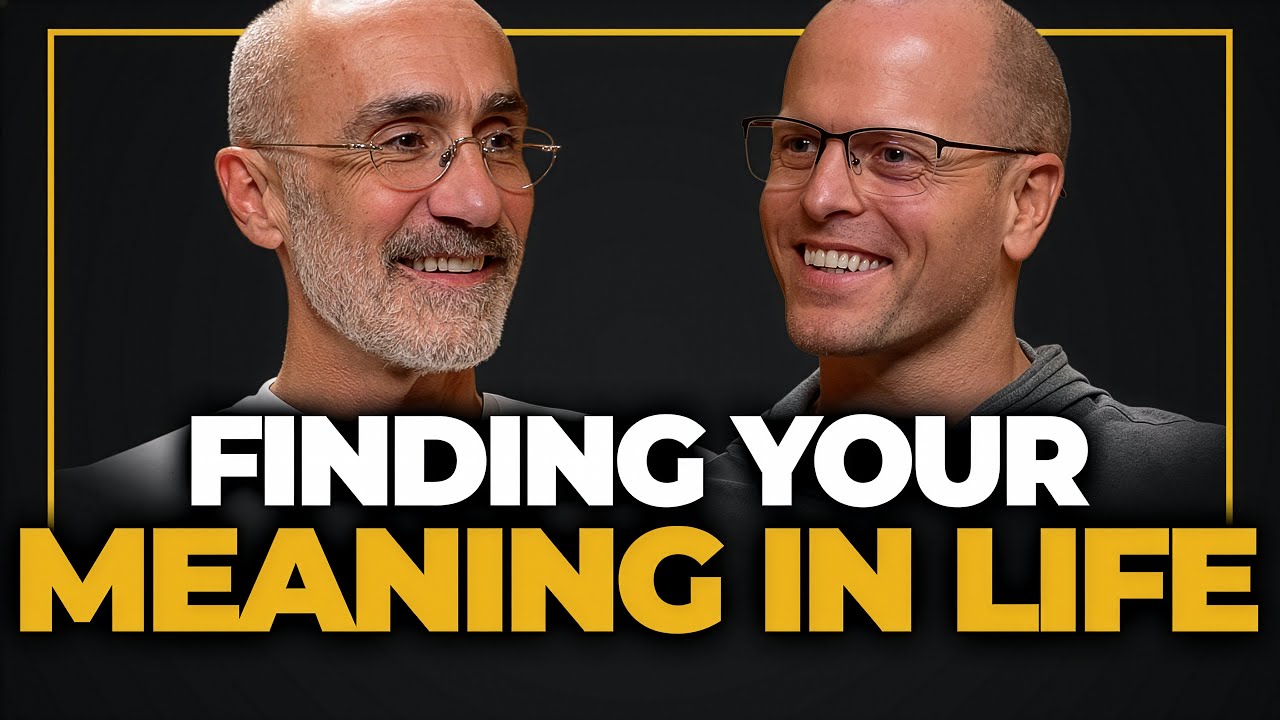
Arthur Brooks: Harvard professor, behavioral scientist, and bestselling author of 15 books on happiness, including 'Build the Life You Want' (with Oprah), 'From Strength to Strength,' and 'The Meaning of Your Life: Finding Purpose in an Age of Emptiness.'
What this episode covers
Tim Ferriss and Arthur Brooks open with a deep dive into Brooks's pre-dawn morning routine, covering the Vedic concept of Brahma Muhurta, his daily lifting and zone-two cardio, daily Catholic mass, high-dose creatine, delayed caffeine strategy, and high-protein nutrition, alongside Tim's own ketosis and intermittent-fasting protocols. They explore Brooks's four affect-profile framework (mad scientist, cheerleader, judge, poet) and the science of mood management. The conversation then turns to the meaning of life, which Brooks breaks into the macronutrients of coherence, purpose, and significance, plus the search-versus-presence journey. They discuss the modern psychogenic epidemic of depression and meaninglessness, transcendence, hemispheric lateralization, the value of suffering, pilgrimage, and protocols for sustaining love and marriage. Brooks closes with practical relationship neuroscience and the message that happiness is love.
Recommended on this episode
Morpheus heart-rate trainer
Morpheus
“the Morpheus device has been recommended to me by folks like Andy Galpin and others. that seems to be a pretty good device”— Tim Ferriss
Way (meditation app)
Henry Shukman
“I meditated for 10 minutes with an app, the Way app. Henry Shukman is my spirit animal, amazing mindfulness Zen-focused practice”— Tim Ferriss
Awe
Dacher Keltner
“he has a book called awe, A W E. It's a great book”— Arthur Brooks
Flow
Mihaly Csikszentmihalyi
“Mihaly Csikszentmihalyi, who wrote the great book Flow”— Arthur Brooks
Andy Goldsworthy: A Collaboration with Nature
Andy Goldsworthy
“This is Andy Goldsworthy, a collaboration with nature. Everybody should get this book, but check out some of the images in there”— Tim Ferriss
The guest's own work
Build the Life You Want
Arthur Brooks and Oprah Winfrey
“You have Build the Life You Want, co-authored with Oprah Winfrey”— Tim Ferriss
From Strength to Strength
Arthur Brooks
“From Strength to Strength, which was my first introduction to your books, which is an exceptional book”— Tim Ferriss
The Meaning of Your Life
Arthur Brooks
“And now, The Meaning of Your Life, Finding Purpose in an Age of Emptiness. Why write this book?”— Tim Ferriss
The 4-Hour Body
Tim Ferriss
“You wouldn't write The 4-Hour Body the same way today. I read that book. I really enjoyed it. I learned a lot from it”— Arthur Brooks
Also referenced (named, not recommended)
The Master and His Emissary
Iain McGilchrist
“Iain McGilchrist at Oxford. He wrote The Master and His Emissary back in 2010”— Arthur Brooks
Big reveals from this episode
- Brooks explains Brahma Muhurta, the Vedic 'creator's time' an hour and 36 minutes before dawn, and says modern behavioral science confirms getting up before dawn boosts productivity, focus, and happiness.
- Brooks lays out his four affect profiles based on positive and negative emotion intensity: mad scientists (high-high), cheerleaders (high positive, low negative), judges (low-low), and poets (low positive, high negative).
- Brooks defines meaning as having three macronutrients: coherence (why things happen), purpose (why I do what I do), and significance (why my life matters).
- Brooks shares the Marine leadership rule of getting to 80% knowledge then choosing and stopping, applying it to relationships: if you're in love, stop searching and get married.
- Brooks argues significance comes from love at the micro level (spouse, children, parents, friends, creator), not from macro-level pursuits like Instagram followers or activism.
- Brooks reframes religion as transcendence, the shift from the 'me self' to the 'I self' (William James), and says to feel significant you must make yourself less significant.
- Brooks introduces hemispheric lateralization via Iain McGilchrist: modern life traps us in the how/what left hemisphere and shuts the door on the why/meaning right hemisphere, causing the meaning crisis.
- Brooks presents the Buddhist formula suffering = pain x resistance, arguing people wrongly try to lower pain when they should lower resistance, and that eliminating suffering inadvertently eliminates meaning.
Worth remembering
- Brooks takes 15 to 20 grams of creatine monohydrate daily, far above the standard dose, citing benefits for muscle, sleep deprivation, and creativity.
- Brooks uses no caffeine to wake up but takes about 380 mg (a venti dark roast equivalent) two to three hours after waking to focus, letting adenosine clear first.
- Brooks identifies 120 beats per minute zone-two heart rate as the tempo of a Sousa march, a cue from his years as a French horn player.
- Both note the '30 grams of protein per sitting' absorption limit is an old wives' tale, and that older people may absorb protein better in a larger bolus.
- Brooks reports clinical depression among highly educated adults under 30 tripled while anxiety doubled, despite the number of therapists rising about fourfold, a psychogenic epidemic.
- Brooks references Mihaly Csikszentmihalyi's concept of flow as a transcendent 'self-forgetting' state, which is why he recommends working out without headphones.
- Tim notes Maslow's hierarchy pyramid was created by consultants; Maslow later revised it to put self-transcendence, not self-actualization, at the top.
- Brooks walked the Camino de Santiago twice (the last 8 days with his wife) and realized his mission during the pilgrimage rather than seeking it out.
- Brooks describes the oxytocin protocol for marriage: women have three times as much oxytocin as men, so eye contact and touch matter more for the partner.
- Brooks shares a 'break glass' relationship exercise: partners stand holding hands in an iron-cross position, staring silently into each other's eyes for 8 minutes.