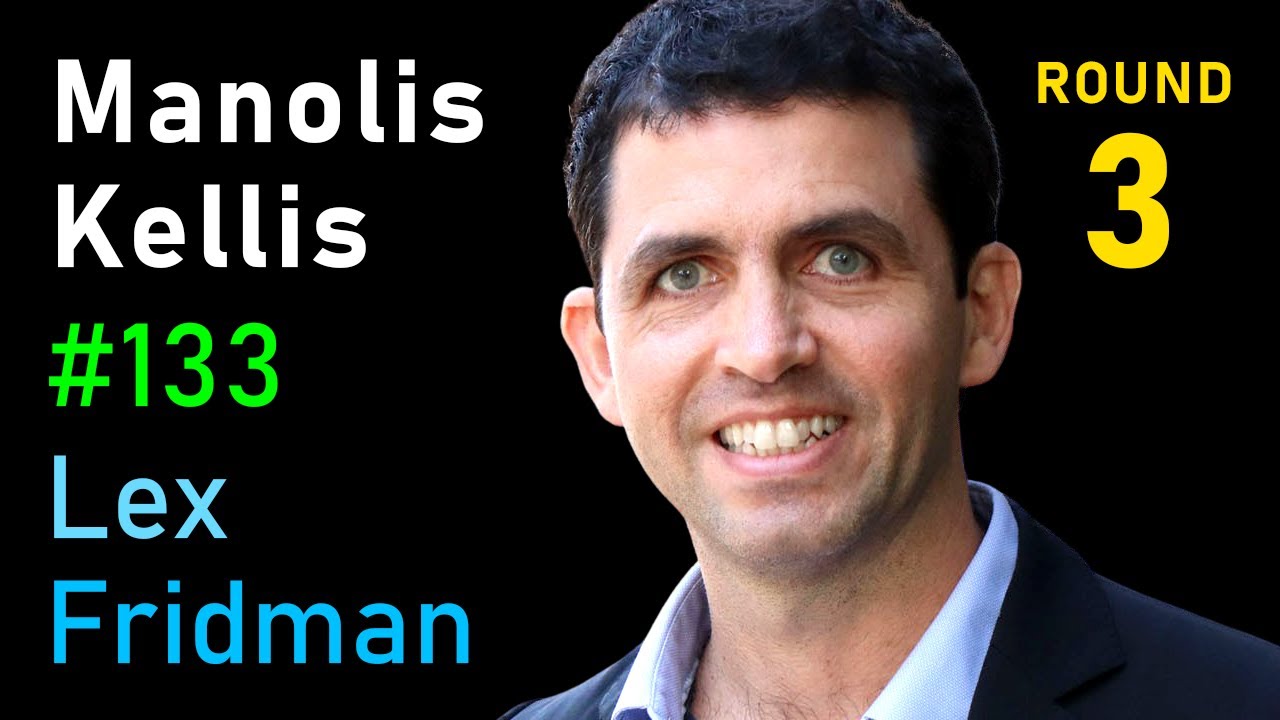
Manolis Kellis: Professor at MIT and head of the MIT Computational Biology Group. He studies the molecular basis of human disease by mapping the genome, epigenome, and gene-regulatory circuitry at single-cell resolution.
What this episode covers
Manolis Kellis walks Lex Fridman through how human genetics, rather than animal models, now drives the basic biology of disease. He explains that 93% of disease-associated variants fall outside genes, so understanding disease requires decoding the genome's long-range regulatory circuitry across tissues and cell types. Using his lab's six-step pipeline, he details how the strongest obesity locus (FTO) actually controls distant genes (IRX3/IRX5) governing fat-burning thermogenesis. He describes massively parallel technologies (MPRA, CRISPR perturbation, single-cell RNA/epigenome sequencing) that let researchers test thousands of hypotheses at once, and argues we are entering an era of systems medicine that will fundamentally alleviate disease.
No purchasable items were genuinely recommended in this episode.
Big reveals from this episode
- Alzheimer's is roughly 79% heritable, meaning genetics alone explains most of its incidence.
- His team found ZERO enrichment for Alzheimer's variants in brain neurons, astrocytes, or oligodendrocytes, pointing instead to immune microglia.
- The strongest obesity locus, FTO, does not implicate the FTO gene at all but controls IRX3 and IRX5 over a million nucleotides away.
- Kellis is a homozygous carrier of the rs1421085 risk allele, so he cannot turn on thermogenesis and is genetically predisposed to obesity.
- Editing one nucleotide out of 3.2 billion with CRISPR flipped cells between an obese and a lean phenotype like a switch.
- An immune complement pathway unexpectedly underlies both age-related macular degeneration and schizophrenia via synaptic pruning.
- Kellis predicts the next few years will bring the most dramatic manipulation of human biology in the history of humanity.
Worth remembering
- Every human carries about six million genetic variants, each a tiny natural perturbation experiment.
- Only 1.5% of the human genome codes for proteins; the other 98.5% does not.
- The number one killer is heart disease (650,000 Americans/year), then cancer (600,000), with accidents far behind.
- CRISPR originated as a bacterial immune system and was first studied by the yogurt industry to make cultures more virus-resistant.
- Mitochondria arose from an ancient engulfed organism via endosymbiosis and retain only 13 genes.
- About 42% of European chromosomes carry a fat-storage predisposition likely selected during ice-age food scarcity.
- Kellis's team generated 10 million brain cells in one year across a dozen disorders to map regulatory circuitry.
- In the famous human-versus-horse endurance race, the human outlasts the horse, showing our unique metabolic adaptation.