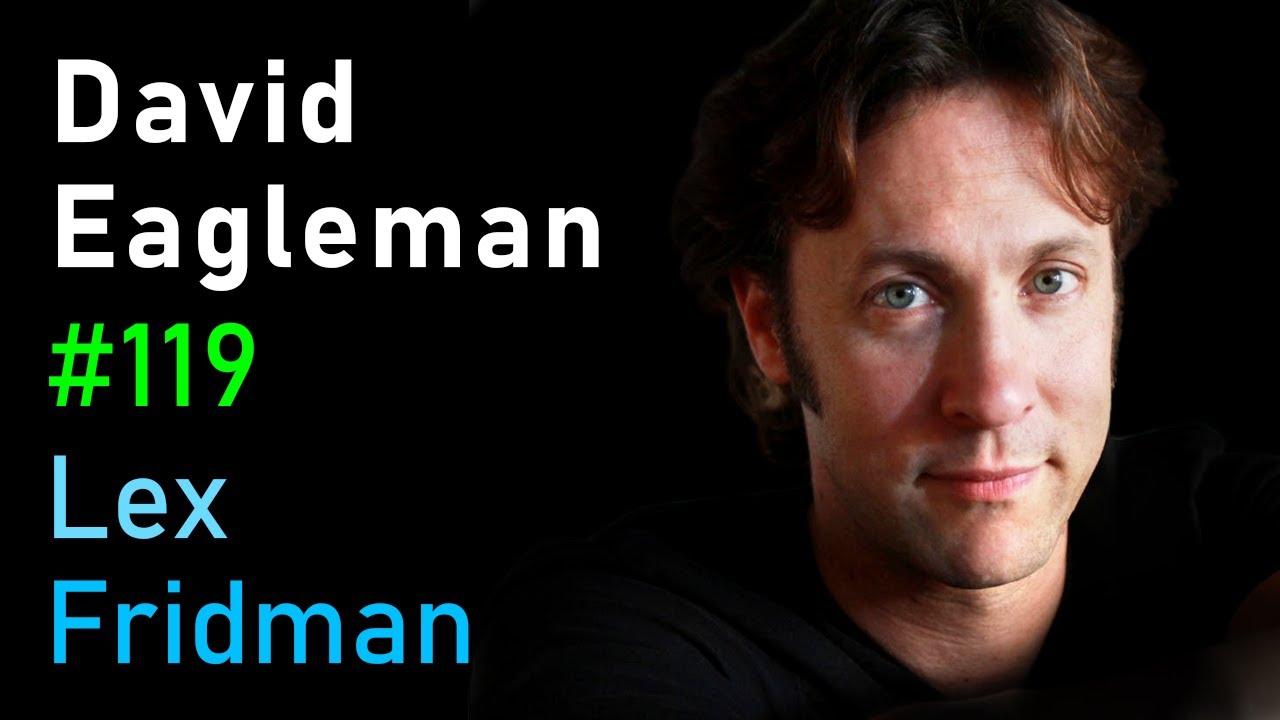
David Eagleman: Neuroscientist, Stanford professor, and bestselling science communicator known for popularizing brain research. He runs Neosensory, a company building sensory-substitution wearables, and authored Livewired and Incognito.
What this episode covers
Eagleman argues the brain is best understood not through the hardware/software metaphor but as 'livewear': a system that physically reconfigures itself throughout life. He explains that different brain regions harden at different rates depending on how stable their input data is, and that plasticity persists into old age, driven largely by relevance and motivation. The conversation ranges across brain-computer interfaces (where he is skeptical of invasive approaches), the 'potato head' theory that the brain can absorb data from any sensor, free will, in-group/out-group neuroscience, the limits of GPT-3, and his own company Neosensory, which feeds sound and other data streams to the brain through vibrations on the skin. He closes with book recommendations and advice to young people to stay adaptable.
Recommended on this episode
The Ascent of Money
Niall Ferguson
“i recommend ascent of money as a great book on this history debits and credits on ledgers started around 30 000 years ago”— Lex Fridman
Invisible Cities
Italo Calvino
“italo calvina i would actually recommend invisible cities i just i loved that book by italo calvino sorry it's a book of fiction”— guest
All the Light We Cannot See
Anthony Doerr
“anthony door wrote a book called all the light we cannot see which actually uh was inspired by incognito”— guest
The Snows of Kilimanjaro
Ernest Hemingway
“snows of kilimanjaro uh oh wow short stories that i love”— guest
Cosmos
Carl Sagan
“i grew up uh with cosmos both watching the pbs series and then reading the book and that influenced me a huge amount”— guest
The guest's own work
Livewired
David Eagleman
“it's called live wired by the way yeah the thing is we typically think about the brain in terms of the metaphors we already have”— guest
Incognito
David Eagleman
“i gave this the end of my book incognito so the whole book of incognito is about you know all the what's happening in the brain”— guest
Also referenced (named, not recommended)
Amazon Alexa
Amazon
“i just sent my mother and alexa and she you know figured out how to go on the settings and do the thing”— guest
The Martian
Ridley Scott
“that movie the martian with matt damon the um it was written in a book of course but the the movie poster shows matt damon all alone on the red planet”— guest
Google Home
“as soon as they're curious about something they ask alex or they ask google home they get the answer right there in the context of the curiosity”— guest
GPT-3
OpenAI
“so the gpt3 is this language model this neural network that's able to uh it has 175 billion parameters so it's very large”— Lex Fridman
The Denial of Death
Ernest Becker
“a philosopher named ernest becker he wrote a book called denial of death and there's a few psychologists sheldon solomon”— Lex Fridman
Big reveals from this episode
- Eagleman notes children under about seven can have an entire brain hemisphere removed (hemispherectomy) and still function nearly normally.
- He explains he chose 'livewired' over 'plasticity' because the brain never reaches an endpoint, it rewires constantly your whole life.
- He is openly skeptical that invasive brain-computer interfaces like Neuralink will become a mainstream consumer business.
- Using the Kalahari-bushman-and-radio analogy, he speculates free will might have a source outside the visible machinery of the brain.
- His lab's brain-scan study showed people empathize more with in-group hands being stabbed, even with arbitrary coin-toss tribes.
- He predicts GPT-3 will never do a really good job because it has no model of what it's like to be a human.
- He reveals he gave up his lab and spends 90% of his time running Neosensory, calling it the most important thing happening right now.
Worth remembering
- The visual cortex hardens quickly because visual data is stable, while motor and somatosensory cortex stay malleable because the body keeps changing.
- An alligator's brain is essentially the same now as 100,000 years ago, whereas humans drop into the world with a 'half-baked' brain to absorb culture.
- Hundreds of thousands of people already hear and see via cochlear and retinal implants that speak 'the dialect of silicon valley,' not biology.
- Some people with physical Alzheimer's damage show no symptoms while alive because constant cognitive challenge builds new neural roadways.
- Each neuron contains the entire human genome, and the brain has roughly half a quadrillion connections.
- The Mars rover Curiosity effectively died when a wheel got stuck, while a wolf simply gnaws off a trapped leg and relearns to walk.
- Neosensory's wristband lets deaf people 'hear' through skin vibrations, becoming a new qualia, for $399, far cheaper than a cochlear implant.
- Eagleman has tested sensory expansion, feeling infrared and ultraviolet, and once located a hidden night-vision camera by following the sensation on his wrist.