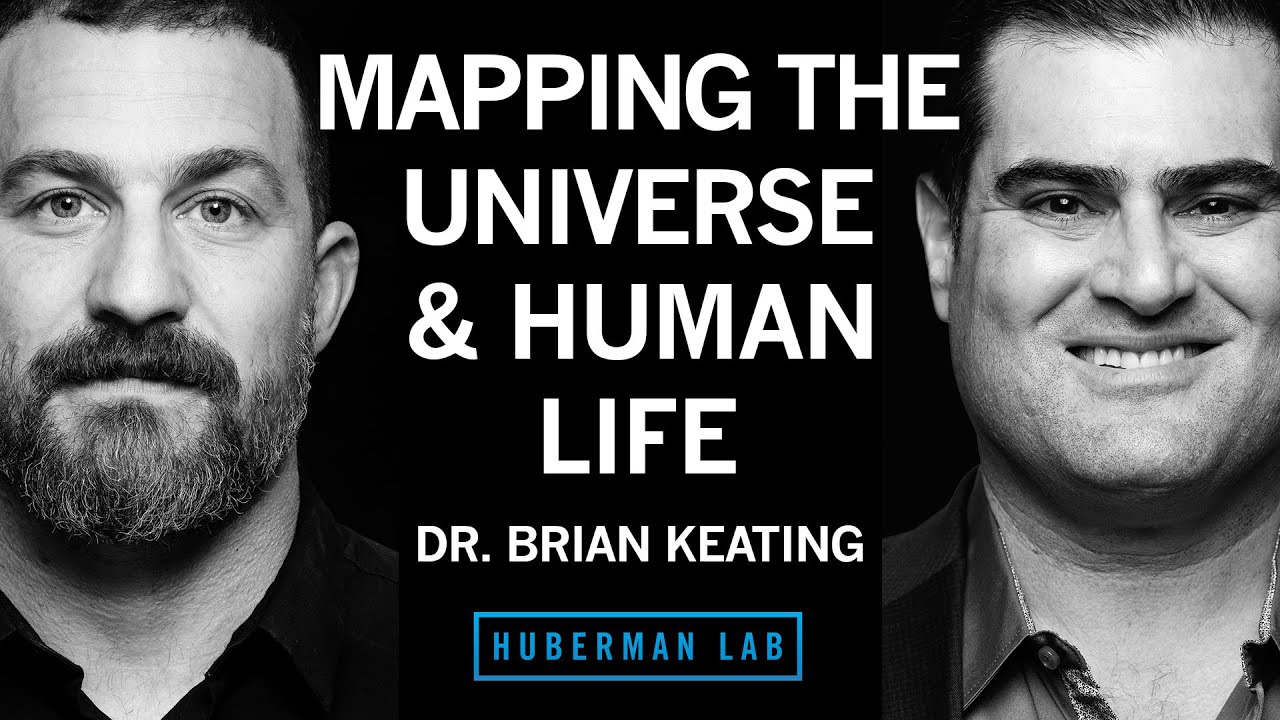
Dr. Brian Keating: Professor of cosmology at UC San Diego who built telescopes at the South Pole to study the cosmic microwave background. He led the BICEP experiment, made a headline 2014 'discovery' of the universe's origin that was later retracted, and wrote 'Losing the Nobel Prize.'
What this episode covers
Huberman and Keating trace humanity's oldest science, astronomy, from cave-painted star charts used to track seasons through Galileo's perfecting of the refracting telescope and the slow proof that Earth orbits the Sun. Keating explains why looking up connects us to deep time, debunks astrology, and ties optics to biology via the eye as a built-in telescope. He recounts the personal saga behind his South Pole BICEP experiment, the retracted Big Bang discovery (the signal was cosmic dust), and the suicide of his mentor Andrew Lange. They close on adaptive optics, the Moon illusion, the green flash, and the probability of extraterrestrial life, which Keating argues is surprisingly low.
Recommended on this episode
Longitude
Dava Sobel
“an important book for anyone to read who's interested in basically why we're still here um in my opinion is the book longitude”— Andrew Huberman
The Obstacle Is the Way
Ryan Holiday
“the barrier becomes the portal... shout out Ryan holid never yeah never met him but I like that book very much”— Brian Keating
The guest's own work
Losing the Nobel Prize
Brian Keating
“spoiler alert my first book is called losing the Nobel Prize because we had a retracted discovery that we made at Harvard”— Brian Keating
Into the Impossible (detecting gravitational waves / second book)
Brian Keating
“Barry barish he wrote the forward to my my second book um detecting gravitational waves the accelerating expansion of the universe”— Brian Keating
Protocols: An Operating Manual for the Human Body
Andrew Huberman
“I have a new book coming out it's my very first book it's entitled protocols an operating manual for the human body”— Andrew Huberman
Big reveals from this episode
- Keating flatly states there is no validity to astrology and it is statistically anti-correlated with reality.
- Reveals his father abandoned him at age seven and that besting his Nobel-less father drove his quest to win a Nobel Prize.
- Admits his BICEP discovery announced at Harvard in 2014 was retracted; his first book is titled 'Losing the Nobel Prize.'
- Becomes emotional recounting that his mentor Andrew Lange died by suicide at the peak of his career.
- Reveals the false 'origin spark' signal was actually cosmic dust, the humblest substance in the universe.
- Contrarian for a cosmologist: argues the probability of life elsewhere in the universe is very low.
- Claims Elon Musk's Starlink satellites interfere with his microwave astronomy and he personally asked Musk to switch them off over the South Pole.
Worth remembering
- 'Planet' comes from the Greek for wanderer; only five planets were visible to the ancients, and weekday names still encode them.
- Your zodiac sign is the constellation behind the Sun on your birthday, but precession means a 13th sign, Ophiuchus, is ignored.
- Eyeglass and telescope lenses share an origin in the Netherlands' fine glass; the Gutenberg Bible's fixed type was an early vision-acuity standard.
- For $50 to $75 you can buy a telescope and see the exact craters and four Galilean moons of Jupiter that Galileo saw.
- Keating's $1M South Pole telescope bested a $1B billion-dollar satellite experiment run by thousands of scientists.
- The Moon and Sun have the same apparent half-degree width, which is why Earth is the only planet with exact total solar eclipses.
- The Moon drifts about a fingernail-width (a few centimeters) farther from Earth each year, slowly ending total eclipses.
- Adaptive optics uses lasers to create artificial 'guide stars' and a mirror flexing 100 times a second to cancel atmospheric blur; it was once military-classified.
- A 1997 Antarctic meteorite from Mars (Allan Hills) claimed microbial life; the claim was never confirmed nor falsified.
- A hawk's visual acuity is about 120 cycles per degree, double the human 60, letting it spot a rodent's fur from a lamppost.