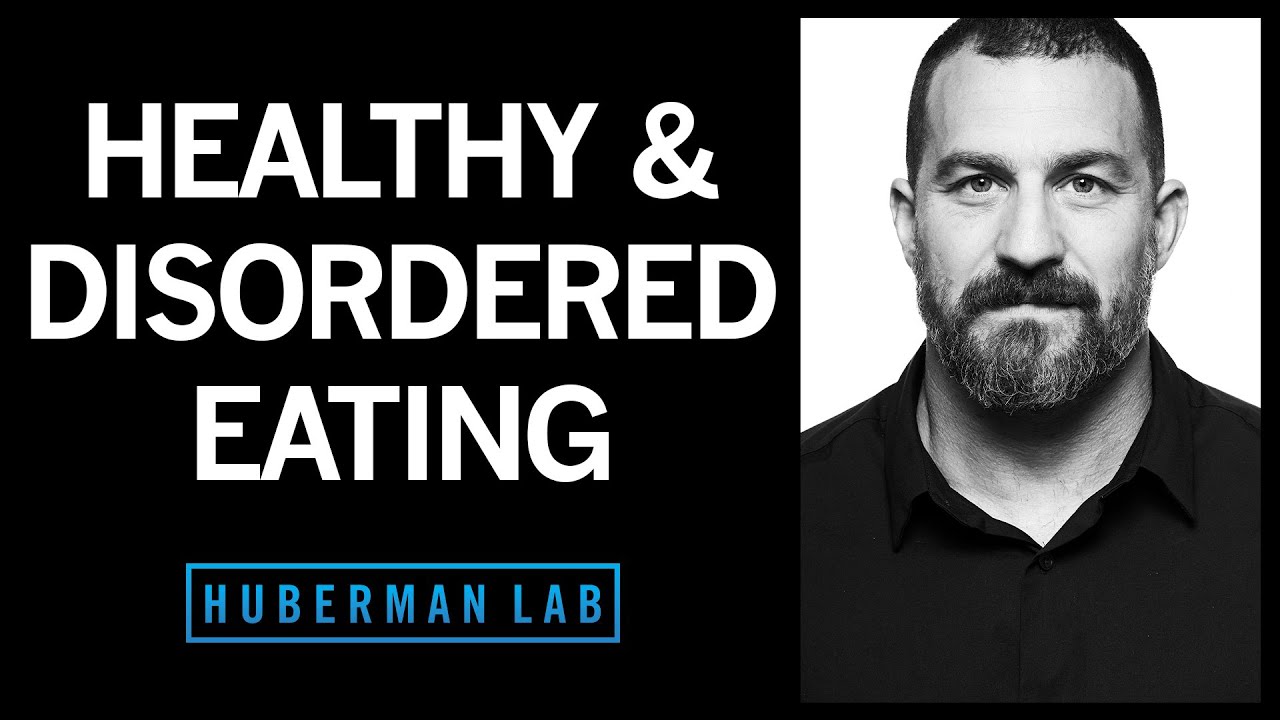
Andrew Huberman: Professor of Neurobiology and Ophthalmology at Stanford School of Medicine and host of the Huberman Lab Podcast, where he translates neuroscience into practical tools.
What this episode covers
In this solo episode, Andrew Huberman explores what healthy eating actually means and why nobody can truly define it, then dives into the clinical eating disorders anorexia, bulimia, and binge eating disorder. He frames behavior using a model of knowledge, action, and the intervening homeostatic and reward processes. He explains that anorexia is largely a habit-and-reward circuit problem (best treated by habit rewiring, CBT, and family-based models) while bulimia and binge eating disorder stem from impaired impulse and reward control. He covers the underlying biology of hunger and satiety, sponsor reads, and emerging treatments including deep brain stimulation and psychedelic clinical trials.
Also referenced (named, not recommended)
Prozac (fluoxetine)
Eli Lilly
“there are many categories of drugs that emphasize the serotonergic circuitry... Things like Prozac, Zoloft, Paxil, things of that variety.”— Andrew Huberman
Zoloft
Pfizer
“Things like Prozac, Zoloft, Paxil, things of that variety. Those drugs have been used to some degree of success.”— Andrew Huberman
Paxil
GlaxoSmithKline
“Things like Prozac, Zoloft, Paxil, things of that variety. Those drugs have been used to some degree of success.”— Andrew Huberman
Adderall
Teva
“some of those same drugs like Adderall, Vyvanse and things of that sort can also be used to treat bulimia and binge eating disorder.”— Andrew Huberman
Vyvanse
Takeda
“some of those same drugs like Adderall, Vyvanse and things of that sort can also be used to treat bulimia and binge eating disorder.”— Andrew Huberman
Wellbutrin (bupropion)
GlaxoSmithKline
“drugs like Wellbutrin, bupropion, which is an antidepressant, which mainly increases the amount of dopamine and norepinephrine and less serotonin, that can also be effective for certain types of binge-eating disorder”— Andrew Huberman
Big reveals from this episode
- Huberman flatly states nobody, no government or nutritionist, can define truly healthy eating; we only have measurable proxies.
- A Cell Reports study shows protein eaten early in the day (5-10am) builds more muscle than the same protein eaten later, driven by the circadian BMAL clock gene.
- Anorexia is the most dangerous psychiatric disorder of all, deadlier than depression, with very high untreated mortality.
- Anorexia rates have not risen over centuries, undercutting the idea that social media imagery causes it and pointing to a strong biological basis.
- In anorexics the reward circuitry (dorsal lateral striatum) is flipped so they feel rewarded for avoiding food, making restriction a habit, not self-punishment.
- Anorexics who eat almost nothing often have cosmically high cholesterol, a wrinkle in the dietary-cholesterol hypothesis.
- Dr. Casey Halpern uses FDA-approved deep brain stimulation targeting nucleus accumbens Delta oscillations to treat binge eating disorder.
- Legal clinical trials at Johns Hopkins are exploring MDMA and psilocybin for eating disorders, though Huberman urges waiting for the data.
Worth remembering
- Stomach fullness signals satiety mechanically via baroreceptors, independent of actual nutrient content.
- AgRP neurons drive the urge to eat; killing them makes animals refuse food, while overactivity makes them eat to bursting.
- Body fat secretes leptin to suppress appetite, and low leptin is why anorexics stop having periods.
- Dr. Halpern frames our wiring as evolved to eat as often, as much, and as fast as possible because food was once scarce.
- Anorexics show 'weak central coherence,' spotting a hidden face in a field of coffee beans faster than non-anorexics.
- A Caltech rooftop study found people walk near-identical robotic trajectories from their cars every day, illustrating habits.
- VR studies in Jeremy Bailenson's Stanford lab show anorexics severely distort self-avatars, revealing a real perceptual defect.
- Deaths from eating disorders are not far off the number of deaths from automobile accidents in some countries.
- Bulimia's hallmark is a lack of inhibitory control, often paired with other impulsive behaviors like alcohol or promiscuity.
- Every cell, from hair to retina to toe, runs the BMAL clock gene that times protein synthesis across 24 hours.