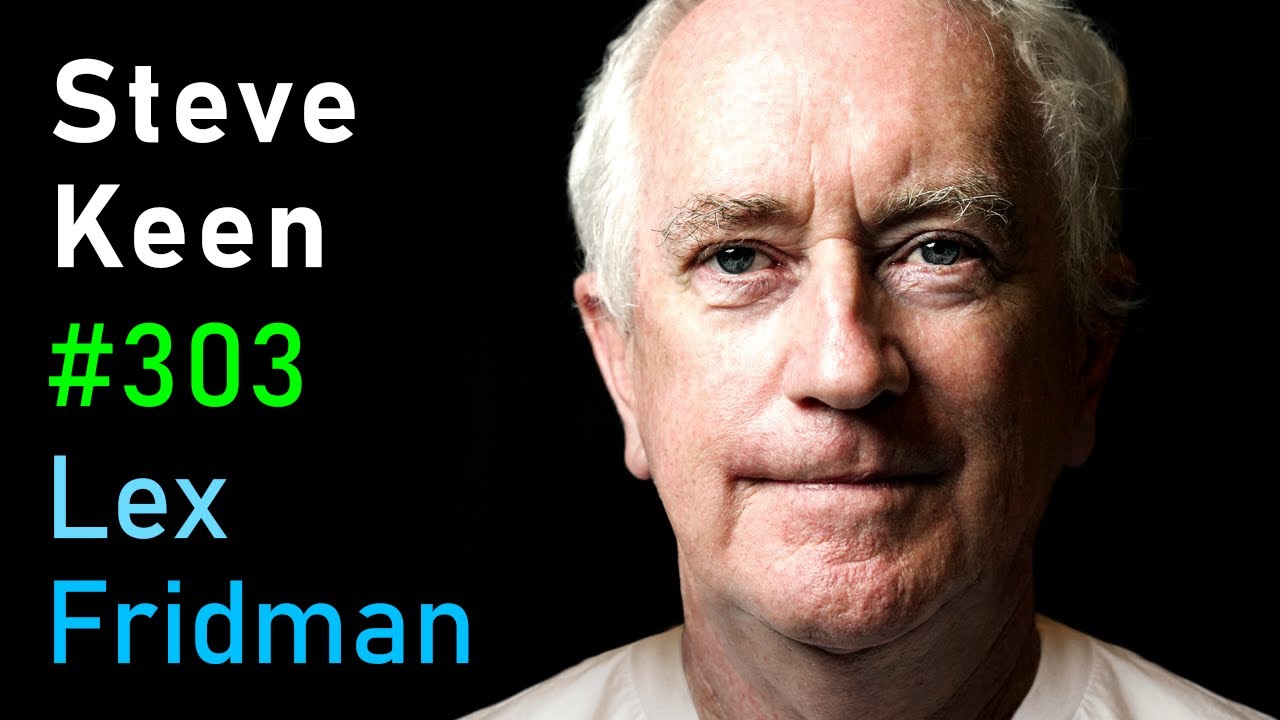
Steve Keen: An Australian heterodox economist and longtime critic of mainstream neoclassical economics, known for predicting the 2008 crisis. He is a scholar of Karl Marx, author of 'Debunking Economics' and 'The New Economics: A Manifesto,' and creator of the open-source system-dynamics modeling software Minsky.
What this episode covers
Keen walks Lex through the history of economic thought, from the physiocrats and Adam Smith to Marx, the neoclassicals, Schumpeter, Keynes, and Hyman Minsky. He argues mainstream economics uses the wrong mathematics (difference instead of differential equations), wrongly assumes equilibrium, and ignores money, credit, and private debt. A large portion explores Marx's labor theory of value, where Keen claims Marx contradicted his own theory in the Grundrisse by admitting machines (like labor) can be a source of surplus. The conversation then turns to why socialism failed (resource-constrained vs. demand-constrained economies), China's hybrid model, and finally to climate change, which Keen argues economists model so badly it threatens civilization. It closes on AI, consciousness, love, death, and advice to avoid economics degrees.
Recommended on this episode
Marx in Contradiction
Roslyn Wallach Bologh
“this beautiful book called Marx in contradiction you want to find a great explanation for Marxist philosophy”— Steve Keen
Earth Abides
George R. Stewart
“there's a wonderful science fiction book called the Earth abides about a world in which humans get wiped out”— Steve Keen
Economix: How Our Economy Works (and Doesn't Work)
Michael Goodwin
“there's a little book Econ Comics taking the con out of Economics um so they should start with that”— Steve Keen
The Denial of Death
Ernest Becker
“I find the idea is of Ernest Becker with denial of death really powerful which is that humans will not only have emotions”— Steve Keen
Mathematica
Wolfram Research
“I mean I first did that in Mathematica uh back in 1992 ... mathematics is another amazing piece of software”— Steve Keen
Mathcad
PTC
“I prefer like a program called mathcad which is what I'm using for all my when I do my mathematics on the computer”— Steve Keen
Scent of a Woman
Martin Brest
“it's like that Scent of a Woman one of my favorite films where alucino gives advice to a cat”— Steve Keen
The guest's own work
The New Economics: A Manifesto
Steve Keen
“he has written several books I recommend including the new economics and Manifesto and debunking economics”— Lex Fridman
Debunking Economics
Steve Keen
“he has written several books I recommend including the new economics and Manifesto and debunking economics”— Lex Fridman
Also referenced (named, not recommended)
A Brief History of Doom
Richard Vague
“which Richard vague covers beautifully in the uh brief history of Doom”— Steve Keen
Capital (Das Kapital)
Karl Marx
“we bunch of about 20 or 30 of us reading our way through marks Capal like what which volume one volume one capital”— Steve Keen
Grundrisse
Karl Marx
“it occurs in a footnote on page 267 to 268 of the penguin edition of the griesa”— Steve Keen
The Wealth of Nations
Adam Smith
“reading a cardboard cutout version of uh of the wealth of of The Wealth of Nations it's uh I find his worth trivial”— Steve Keen
Mao's Last Dancer
Bruce Beresford
“there's actually a classic book and movie as well we called M's last answer ... a young man explaining his progression from being a dancer in the cultural revolution”— Steve Keen
The Matrix
The Wachowskis
“if you're a fan of the Matrix movies at all ... what what's agent Smith says when he's got uh Morpheus in his possession”— Steve Keen
Avatar
James Cameron
“I'll use another movie The Avatar type respect for the cycle of life we need to have that as part of our innate nature”— Steve Keen
The Great Escape
John Sturges
“we stare in all its glory in a not in 42 BMW yeah okay it was exactly the same as Steve McQueen and Great Escape”— Steve Keen
Monty Python's Life of Brian
Monty Python
“that uh Mon Mon Life of Brian was lived out live ah look at the bright side of life”— Steve Keen
Big reveals from this episode
- Keen says his own discipline of economics has 'probably helped bring about the feasible termination of human civilization.'
- Argues Marx contradicted himself in a Grundrisse footnote by admitting machines, like labor, can be a source of surplus value, undermining his case for revolution.
- Claims we have already 'gone through the wall' with capitalism ecologically and haven't realized we smashed our skulls.
- Cites economist Richard Tol's claim that losing the Gulf Stream would raise global GDP by 1.1%, calling it the worst work he's read in 50 years.
- Recounts using his Minsky model in a 2005 court case, then checking the data and realizing 'holy shit we're in for a financial crisis.'
- Argues a government deficit is 'a feature not a bug' of a well-functioning fiat-money economy and that surpluses caused the Great Depression.
- Advises young people: 'don't do an economics degree' and study system dynamics instead.
- Admits he has battled depression for years since reading neoclassical economists' work on climate change.
Worth remembering
- The physiocrats, an extinct 18th-century French school, saw the economy as a circulation system and believed all wealth came from the soil (really the Sun), calling manufacturing 'sterile.'
- Modern Monetary Theory is essentially double-entry bookkeeping; money is fundamentally the liabilities of the banking sector, created when banks lend.
- An emperor's solid-gold, gem-encrusted back scratcher in Beijing's Forbidden City illustrates how feudal goods are valued by utility while capitalist commodities are valued by exchange value.
- Soviet shortage economies froze innovation: Keen's example is a Russian-made motorbike sold cheaply that turned out to be an unchanged copy of a 1942 BMW.
- An OECD model: losing the Gulf Stream amid a 2C rise could cut Earth's wheat-suitable surface from 20% to 7%, a 'catastrophic' food collapse.
- Alan Ginsberg's summary of thermodynamics: 'you can't win, you can't break even, you can't leave the game.'
- US credit swung from +16% of GDP in 2006-07 to -5% in 2008-09, a 20% turnaround in aggregate demand correlating strongly with unemployment.
- During the Depression, the Austrian town of Worgl issued depreciating 'stamp' money that drove unemployment to zero until the central bank sued and shut it down.
- US margin debt rose from 0.5% of GDP in 1920 to 133% in 1929, then collapsed, helping cause the 1929 crash.
- Keen says healthy private debt is roughly 30-70% of GDP; the US sits around 170%.