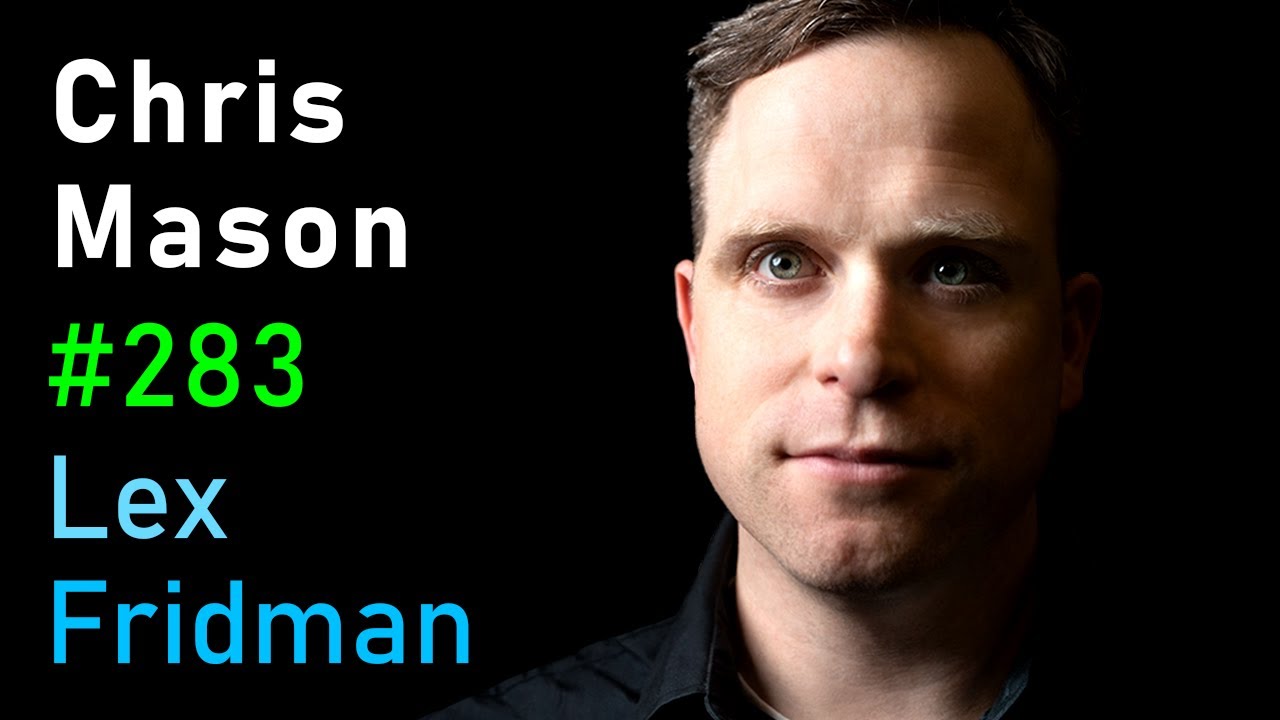
Chris Mason: Professor of genomics, physiology and biophysics at Cornell who runs molecular experiments on astronauts in space, including NASA's famous twin study. Author of 'The Next 500 Years: Engineering Life to Reach New Worlds.'
What this episode covers
Chris Mason argues that humans are uniquely 'extinction-aware' and therefore carry a moral duty to safeguard all life by becoming a multi-planetary species. He details findings from the NASA twin study and other astronaut research showing how the body damages and repairs itself in space, including the surprising lengthening of telomeres. The conversation ranges across editing human cells to resist radiation, growing food and even making vitamin C in our own bodies, colonizing Mars and its lava tubes, and eventually launching multi-generation ships toward exoplanets. Mason also explores extreme-microbiome organisms, new species evolving on the space station, the ethics of AI duty, identity and cloning, and what makes life worth protecting.
Recommended on this episode
The Precipice
Toby Ord
“ever since really the first nuclear test when they uh tony orb has a great book about this called the precipice where the precipice for humanity”— guest
Reasons and Persons
Derek Parfit
“derek parfitt wrote this great book called reasons and persons about how you really define an individual is not just your own thoughts”— guest
The guest's own work
The Next 500 Years: Engineering Life to Reach New Worlds
Chris Mason
“he also wrote an epic book titled the next 500 years engineering life to reach new worlds that boldly looks at what it takes to colonize space”— Lex Fridman
The Age of Prediction
Chris Mason
“i think called the age of prediction so the next book that's coming is all the ways where machine learning tools predictive algorithms have fundamentally changed our life”— guest
Also referenced (named, not recommended)
Contact
Carl Sagan
“like what carl sagan wrote about in contact doing prime numbers and sending those out to indicate intelligence”— guest
The Andromeda Strain
Michael Crichton
“or michael creighton wrote a book the andromeda strain about this very idea and we could but it hopefully won't”— guest
The Big Lebowski
Coen Brothers
“they're called nihilist donnie that's a shout out for big lebowski they're like nothing matters”— guest
Mars trilogy
Kim Stanley Robinson
“kim stanley robinson wrote a lot about this in his books the new martian religion that was created so i think this idea has been discussed”— guest
Velcro
Velcro
“it would be it would need a lot of velcro i think is my only real answer there”— guest
Netflix
Netflix
“and also you'd still get up updates from netflix if you're on the way towards another star you can still get downloads”— guest
2001: A Space Odyssey
Stanley Kubrick
“for people who haven't seen 2001 space odyssey held 9000 is very kind of um focused on the mission cares a lot about the mission”— guest
Amazon Alexa
Amazon
“that's why they talked about kids have to be polite to alexa um because they find if they're you know if kids are rude to ai systems”— guest
Trading Places
John Landis
“there's even movies like trading spaces about this with eddie murphy or like these are people who can swap bodies”— guest
IBM Watson
IBM
“watson when notoriously was made by ibm to try and replace doctors i actually love ibm so i was in the room when we got a tour of watson”— guest
Counter-Strike
Valve
“in grad school i'd sometimes play like counter-strike or half-life like 12 hours straight now like what was i did”— guest
Half-Life
Valve
“in grad school i'd sometimes play like counter-strike or half-life like 12 hours straight now like what was i did”— guest
Diablo
Blizzard Entertainment
“the amount of hours i spent playing like diablo and like video like is insane i'm sure it adds up to like weeks maybe months”— guest
Final Fantasy
Square Enix
“some of the games like final fantasy things or things we actually had to solve problems and think and they were some degree of strategy”— guest
Big reveals from this episode
- Scott Kelly's telomeres got LONGER in space, the opposite of what was expected, and this has now held across 59 astronauts studied.
- Returning to Earth's gravity after a year was far harder on the body than being in space; Kelly's stress markers spiked to levels never seen before.
- NASA's official stance is that there has never been sex in space, though Mason suspects humans are 'very predictable' about it.
- Becoming an astronaut is no longer years of impossible training and selection; for commercial flights it is 'frankly just a question of funds.'
- Mason reframes a multi-generation starship as no different from Earth: 'earth is still a spaceship traveling out of space.'
- Bacteria and fungi on the ISS have mutated so much they are now literally new species, one named after a Cornell donor.
- Mason says he would take a one-way trip to Mars later in life and consider dying there an honor.
- There is no scientific collaboration between the US and China in space; NASA grants are congressionally mandated to forbid working with anyone in China.
Worth remembering
- Astronauts absorb cosmic radiation equivalent to three or four chest X-rays every single day in space.
- Humans still carry the broken 'GULO' pseudogene for making our own vitamin C, lost 10-20 million years ago, which could in theory be reactivated.
- Mars lava tubes could shelter habitats from radiation, and a JPL helicopter mission is being planned to explore one.
- Sending anything to space costs about $10,000 per kilogram, and hardware must survive destructive, fire, and vibration testing.
- Oral herpes commonly reactivates during spaceflight as the immune system is perturbed in microgravity.
- Lake Hillier in Australia is a bubblegum-pink salt lake colored by halophilic algae and bacteria that die below ~10-15% salinity.
- 'Chloro-humans': embedding chloroplasts in skin could let people photosynthesize, but you'd need about two tennis courts of skin for a day's energy.
- AI already out-diagnoses pathologists on some cancers; '10 slides to 10 pathologists' can yield '11 different diagnoses.'
- Earth scores a perfect 1.0 on the Earth Similarity Index; Mars sits around 0.7, far from ideal but relatively close.
- Mars soil contains perchlorates that are toxic to plants, but water exists nearly everywhere just a few feet under the surface.