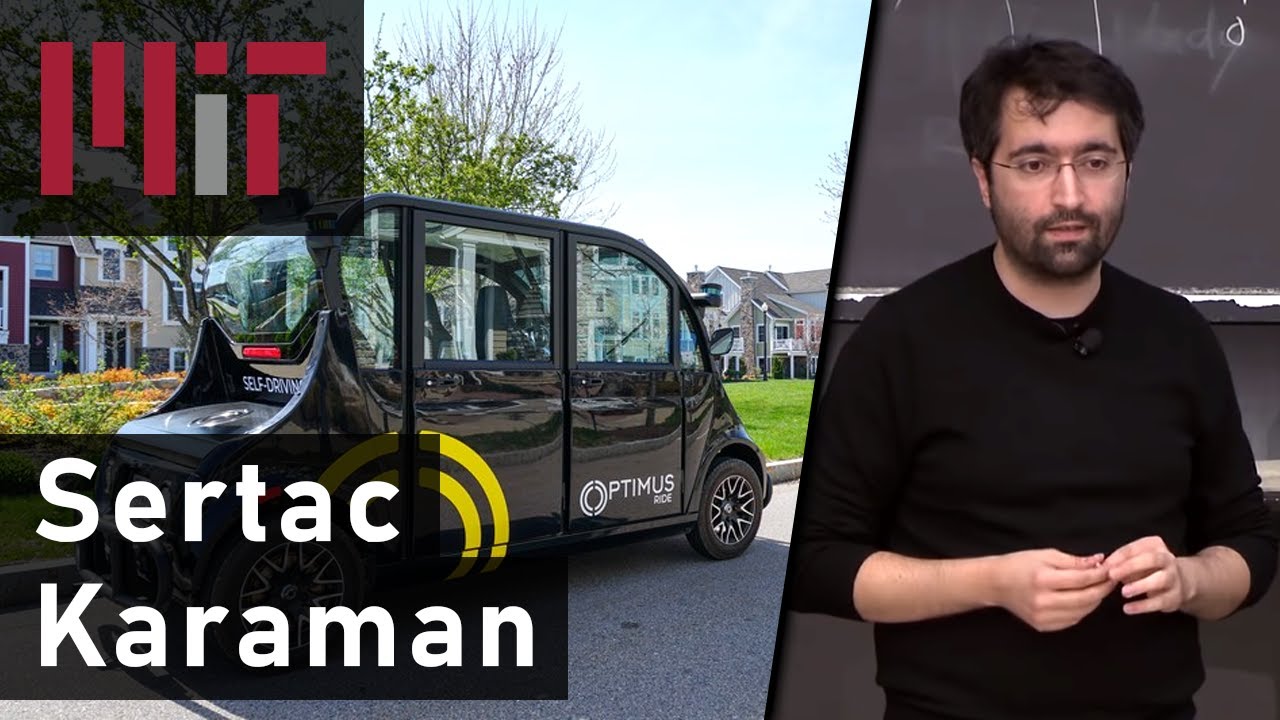
Sertac Karaman: MIT aero-astro professor who builds and studies autonomous vehicles on land and air, inventor of the RRT* motion-planning algorithm
What this episode covers
Sertac Karaman gives a lecture in Lex Fridman's MIT self-driving cars class tracing the past, present, and future of motion planning. He walks through his graduate work on the DARPA Urban Challenge, the autonomous forklift, and his discovery that the widely used RRT algorithm fails to converge to optimal solutions, leading to his RRT* algorithm. He describes the sensor-heavy MIT vehicle, a famous low-speed collision with Cornell's robot car, and how the race seeded companies like Google's self-driving program and Cruise. He closes with thoughts on how autonomous, shared, electric vehicles could radically lower transportation costs and reshape cities, plus the legal and societal hurdles ahead.
Also referenced (named, not recommended)
Kinesis keyboard
Kinesis
“for the nerds out there he still programs he programs on a Kinesis keyboard uses Emacs which is how you know he's legit”— Lex Fridman
Velodyne 3D laser scanner
Velodyne
“so other teams thought this sensor is made by a company called Melodyne it came pretty much just in time for the urban challenge”— guest
NVIDIA DGX-1
NVIDIA
“the deep learning computers that you would use normally you have access to things like DG x1 and so on that we use”— guest
Land Rover LR3
Land Rover
“we took a Land Rover lr3 line one of the sponsors but also it was nice that the vehicle was pretty big”— guest
Big reveals from this episode
- Karaman proved the classic RRT motion-planning algorithm fails to converge to optimal solutions because early trajectories constrain the search space.
- He developed RRT*, which adds little computation but guarantees asymptotic optimality, becoming his 2011 doctoral thesis.
- The Cornell car got stuck because its collision checker thought an obstacle was on top of the car and it stopped refreshing its map, causing a collision with MIT's vehicle.
- MIT's strategy was 'if it fits on the vehicle, put it on the vehicle,' resulting in 5 cameras, 16 radars, 12 planar and 1 3D laser scanner.
- The Google self-driving car was essentially a spinoff of the DARPA Urban Challenge, using a very similar laser-scanner-oriented sensor package.
- Karaman predicts a camera-only car navigating city streets is plausible within ten years but unlikely as soon as next year.
- Karaman is part of a new autonomous-vehicle company called Optimus that raised just over five million dollars in seed funding.
Worth remembering
- A six-dimensional drone controller written out fully would require about 2.5 petabytes, but compression brings it down to roughly two megabytes.
- The MIT vehicle needed a 40-CPU, 40GB-RAM computer plus an internal generator and a rooftop air conditioner to handle the heat.
- The MIT team had eight full-time graduate students plus support from Draper Laboratory and Olin College.
- Drones in Karaman's group carry GPUs and teraflop computers and use 200 Hertz cameras for fast perception.
- A modern BMW carries about 25 times the weight and 10 times the size of its passengers, and US cities average about two parking spots per car.
- A traffic jam in China once lasted nine days and stretched a hundred miles long.
- Karaman envisions shared, autonomous, electric transport letting you go anywhere in Boston for 99 cents, or 50 cents if shared.
- 89 teams entered the 2007 DARPA Urban Challenge; only six finished, with CMU winning the $2 million prize and MIT placing fourth.