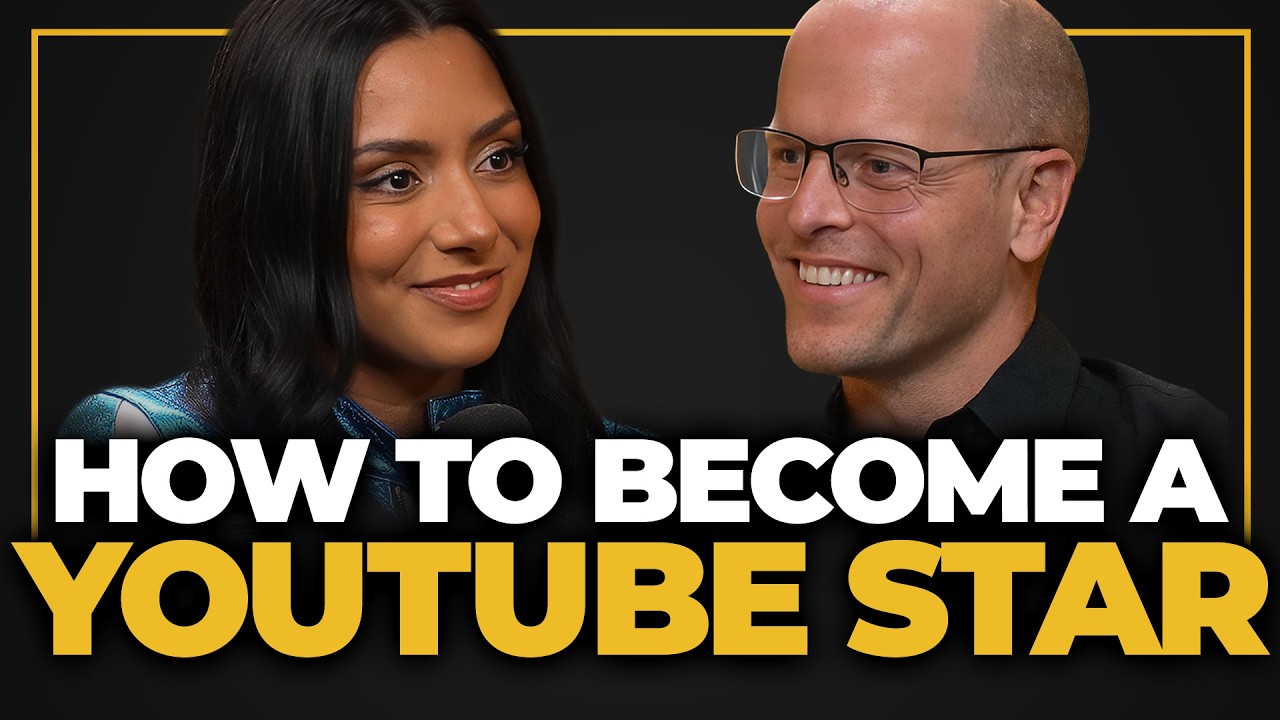
Michelle Khare: YouTube creator and host of Challenge Accepted, where she attempts the world's toughest stunts and professions. 6M+ followers, 1B+ views, Time 100 honoree, and the first creator to petition onto the prime-time Emmy ballot. Former BuzzFeed producer, Dartmouth grad.
What this episode covers
Tim Ferriss interviews Michelle Khare, the creator behind Challenge Accepted, a show where she trains for and attempts extreme stunts and professions like Houdini's water torture cell, FBI/Secret Service collaborations, and recreating Tom Cruise's Mission Impossible plane stunt. They trace her path from a movie-loving childhood in Shreveport, Louisiana, through a rejected Google internship, BuzzFeed, and a year of deliberate preparation before quitting her job, anchored by Tim's own fear-setting exercise. The conversation goes deep on practical playbooks: the anatomy of a great cold email, assembling a 'Formula 1 team' (coach, mentor, cheerleader), why doing the hard thing creates a competitive moat, and how to avoid scope creep and burnout. Khare shares her management frameworks (Radical Candor, Six Thinking Hats, areas-of-responsibility charts) and her storytelling syllabus (Survivor, Save the Cat). The episode closes with wishlist collaborations, favorite documentaries, and the challenges she would and wouldn't do again.
Recommended on this episode
The 4-Hour Work Week
Tim Ferriss
“But reading the 4-hour work week changed my life. This is the original copy I have from 2016.”— Michelle Khare
The Year of Living Biblically
A.J. Jacobs
“AJ Jacobs would be a great example for people who don't know. The year of living biblically I think is an amazing amazing book.”— Tim Ferriss
McMillions
HBO
“It's called McMillions. Oh, Tim, you're going to love it. Riveting documentary series.”— Michelle Khare
Survivor
CBS
“I'm going to make everyone watch Survivor and every week we're going to discuss it. First of all, because it's the best ever.”— Michelle Khare
Save the Cat
Blake Snyder
“we are going to study Snyder's Beats and we're going to study the save the cat of it all. Those two books are so good”— Michelle Khare
Levels of the Game
John McPhee
“If you want to read something short, Levels of the Game is incredible. Just a phenomenal writer”— Tim Ferriss
Radical Candor
Kim Scott
“Radical Candor by Kim Scott. Kim Scott is just phenomenal. I thought Radical Candor was really instrumental to me”— Tim Ferriss
Six Thinking Hats
Edward de Bono
“The Six Thinking Hats by Edward de Bono, this book, believe it or not, was incredibly helpful to me in my first few years”— Tim Ferriss
The Great CEO Within
Matt Mochary
“a giant spreadsheet called the Areas of Responsibility Chart, which I learned from a book called The Great CEO Within”— Michelle Khare
Originals
Adam Grant
“And then I've given Adam Grant's Originals to a few people, too.”— Michelle Khare
Big reveals from this episode
- Khare's once-a-month 'passion projects' (cold-DMing stunt doubles to train for a week) consistently outperformed the videos she expected to do well, so the team stripped away everything else to focus only on Challenge Accepted, the true inflection point of the channel.
- After completing a Google internship, she did NOT get the full-time job, a back-against-the-wall moment that pushed her toward BuzzFeed and ultimately her own creative risk; she says without the BuzzFeed job first she would not have succeeded 'period.'
- Khare brought a 10-year-old copy of The 4-Hour Workweek and an email dated March 18, 2016, exactly 10 years before the recording, containing her original handwritten fear-setting exercise that launched her whole career.
- She took action immediately but took a full year to quit her job: she 'practiced poverty' by moving into a shared studio, cutting memberships, and making videos nights/weekends to prove she cared, then quit with two months of videos backlogged and only three months of savings.
- Her stunt coordinator Steve Brown, who works on Avatar films, Logan, and Marvel projects, she met by chance at a kebab shop counter in LA in 2016; he now does all the stunt coordination on her channel ('kebab friendship').
- To collaborate with the FBI, she cold-called the FBI's 1-800 crime-tip line, got routed to 'the Hollywood guy' (the agent who repped the McMillions documentary), who agreed because he was retiring in a couple months and figured 'let's try it out.'
- Her single biggest physical regret is episode one of the Tim Ferriss Experiment-style parkour shoot: she tore multiple heads of the quadricep in both legs and continued filming for 12 more consecutive weeks, Tim reveals he is still dealing with injuries from that same parkour episode 12-13 years later.
- Her full-time team is intentionally tight at seven people (herself, a chief creative officer, head of production, three editors, an assistant) operating as a 'slinky' that balloons to 50+ for a big shoot, with each core member acting as a department head.
Worth remembering
- Khare's editorial calendar runs 12 to 15 months out from idea to upload, and she releases only 8 to 10 episodes per year.
- In a single day for the NASA episode she went up in a fighter jet in California (and threw up), then drove three hours back to LA for a ballet lesson.
- One defensive strategy: do something so crazy no one else would attempt it, like running seven marathons on all seven continents in one week, or calling the FAA 300 times for permission to hang off a military plane.
- Her 'Formula 1 team' framework for every challenge is three people: a coach (best in the world at the skill), a mentor (someone who recently did the thing), and a cheerleader (detached from the outcome).
- Cold-email formula: subject line shows value to the reader; body is three two-sentence blocks (who you are + ask, the vision/details, the call to action); include your cell phone explicitly with 'text me anytime.'
- She uses an 'Areas of Responsibility' chart from the book The Great CEO Within listing hundreds of company actions from 'decides if brand deal is worth taking' down to 'takes out the trash.'
- For the Houdini water-torture-cell challenge she trained her breath-hold to 3:30 (matching Houdini's best time; most Navy SEALs are around 2-3 minutes) and her team engineered their own glass torture cell from scratch.
- For the Mission Impossible plane stunt she wore custom scleral contact lenses (made by a specialized optometrist) inserted by a dedicated on-set lens technician, because a tiny pebble at multi-hundred-mph winds could blind her.
- Chess was a challenge she would pay NOT to do again: she trained ~10 months total to hit her target ELO rating, including studying the London system.
- In the seven-marathons week, the sleeper-hardest leg was marathon six in Colombia, started around 3 a.m. due to a flight delay, racing the sunrise in ~100% humidity; people have historically been hospitalized for heat exposure there.