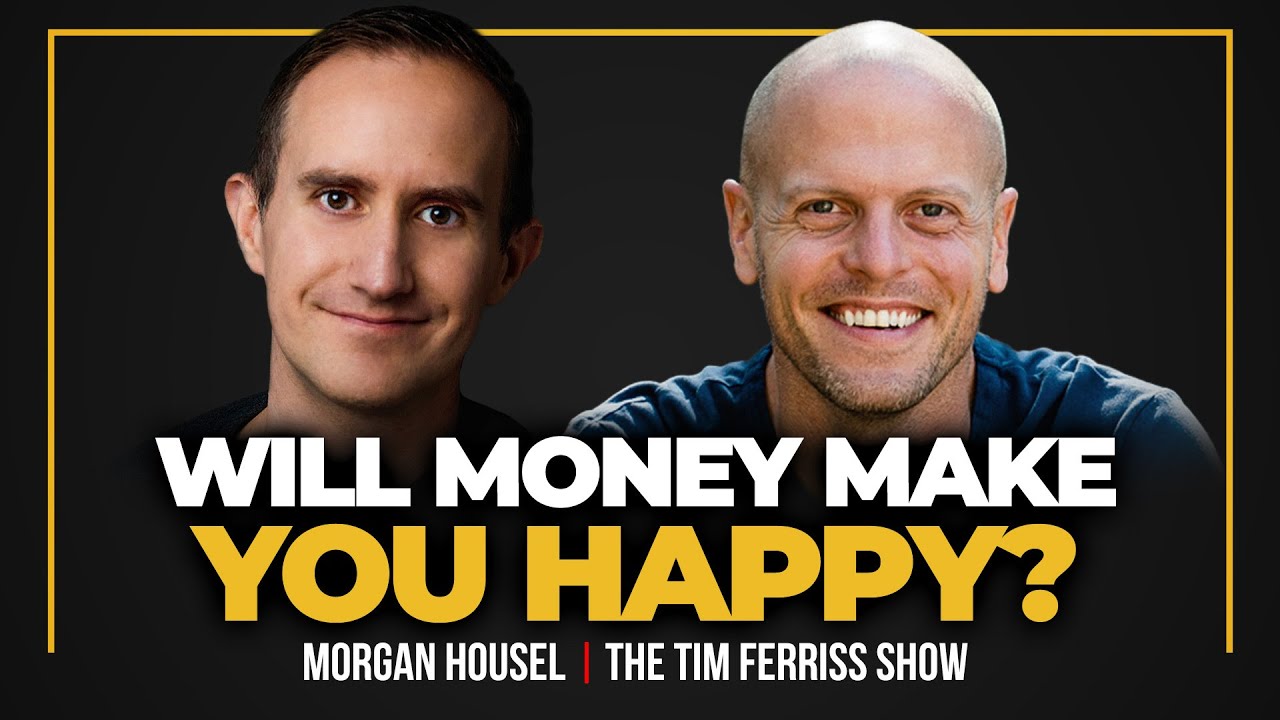
Morgan Housel: Partner at Collaborative Fund and author of The Psychology of Money (3M+ copies, 53 languages) and Same as Ever; two-time Best in Business Award winner and New York Times Sidney Award recipient.
What this episode covers
Tim Ferriss welcomes back Morgan Housel to discuss his book Same as Ever and his philosophy of focusing on what never changes rather than trying to predict the future. They explore money's relationship to happiness versus contentment, why wealth amplifies personality, and the concept of 'social debt' that comes with every dollar earned. Housel shares the harrowing personal story of losing two friends in a 2001 avalanche and how it shaped his views on risk and life's fragility. The conversation ranges across raising children who aren't spoiled, marriage and luck, the power of incentives, the future of text versus audio, and Housel's selfish 'audience of one' approach to writing.
Recommended on this episode
The Great Depression: A Diary
Benjamin Roth
“one of my favorite books is a book called The Great Depression: A Diary, and it's written by a lawyer named Benjamin Roth”— Morgan Housel
Die with Zero
Bill Perkins
“I love the idea from the book Die with Zero... It's such a good book. It's a wonderful book everyone should read.”— Morgan Housel
The Year of Living Biblically
A.J. Jacobs
“A.J. Jacobs, who's an amazing writer. He wrote The Year of Living Biblically. He's written many books that I think are very, very smart.”— Tim Ferriss
I Think You're Fat
A.J. Jacobs
“I recommend people check out also an Esquire piece he wrote called I Think You're Fat, which is an experiment in radical honesty”— Tim Ferriss
The Triangle Fire
“great books that you've read lately, Triangle Fire, Empty Mansions, The Strange Last Voyage of Donald Crowhurst”— Tim Ferriss
Empty Mansions
Bill Dedman
“great books that you've read lately, Triangle Fire, Empty Mansions, The Strange Last Voyage of Donald Crowhurst”— Tim Ferriss
The Strange Last Voyage of Donald Crowhurst
Nicholas Tomalin and Ron Hall
“great books that you've read lately, Triangle Fire, Empty Mansions, The Strange Last Voyage of Donald Crowhurst”— Tim Ferriss
Working: Researching, Interviewing, Writing
Robert Caro
“one that is a little cryptic, Robert Caro, if I'm getting the pronunciation right, Working”— Tim Ferriss
No Ordinary Time
Doris Kearns Goodwin
“I'm pretty sure I've read Doris Kearns' No Ordinary Time three times, which is, I think it's 710 pages. It's a very meaty book.”— Morgan Housel
The Tao of Charlie Munger
David Clark
“This book, it's called The Tao of Charlie Munger... if you're an investing fan or a Charlie Munger fan, you should reread this book once a year”— Morgan Housel
The guest's own work
The Psychology of Money
Morgan Housel
“His book, The Psychology of Money, which we really dug into in depth last time, has sold more than three million copies”— Tim Ferriss
Same as Ever: A Guide to What Never Changes
Morgan Housel
“Morgan's new book is Same as Ever: A Guide to What Never Changes”— Tim Ferriss
The 4-Hour Workweek
Tim Ferriss
“if you had to go back to before, when you wrote The 4-Hour Workweek, you would not change your mind”— Morgan Housel
The Tim Ferriss Show
Tim Ferriss
“This is Tim Ferriss. Welcome to another episode of The Tim Ferriss Show.”— Tim Ferriss
Tools of Titans
Tim Ferriss
“that book and probably Tools of Titans are my two bestselling books still to this day”— Tim Ferriss
Also referenced (named, not recommended)
Finding the One Decision That Removes 100 Decisions
Tim Ferriss
“there's a blog post that I wrote some time ago, which was Finding the One Decision That Removes 100 Decisions”— Tim Ferriss
Letters from a Stoic (Moral Letters to Lucilius)
Seneca the Younger
“this is true for Letters from a Stoic or the Moral Letters to Lucilius as well from Seneca the Younger”— Tim Ferriss
Snickers
Mars
“Jim, do you know what the bestselling candy bar was in 1962? And Jim said, No. And Warren said, Snickers.”— Morgan Housel
Respect and Admiration
Morgan Housel
“I read three in prepping for this conversation, Respect and Admiration, Rich and Anonymous, and then Expectations Debt”— Tim Ferriss
Rich and Anonymous
Morgan Housel
“Respect and Admiration, Rich and Anonymous, and then Expectations Debt. How did you decide to write Rich and Anonymous?”— Tim Ferriss
Expectations Debt
Morgan Housel
“Respect and Admiration, Rich and Anonymous, and then Expectations Debt”— Tim Ferriss
Walter Isaacson's Elon Musk biography
Walter Isaacson
“the new biography of Elon Musk, Walter Isaacson is interviewing Musk's first wife, whose name is Justine”— Morgan Housel
Will Smith biography (Will)
Will Smith
“There's a really great quote in Will Smith's biography where he says, when Will Smith was poor and depressed”— Morgan Housel
Honda Civic
Honda
“Nobody cares because he's so funny. He doesn't need to show off his six-pack. If he drove a Honda Civic, nobody would care.”— Morgan Housel
11 Reasons Not to Become Famous
Tim Ferriss
“Yeah, 11 Reasons Not to Become Famous. And you were very open and forthcoming about what it's done to your own life.”— Tim Ferriss
The Snowball: Warren Buffett and the Business of Life
Alice Schroeder
“If you read the biography, The Snowball, which I reread recently, it's a biography of Warren Buffett”— Morgan Housel
MrBeast (YouTube channel)
Jimmy Donaldson
“growing up with MrBeast, which I think is reasonably wholesome content for young people to watch. It's not that bad.”— Morgan Housel
The Power Broker
Robert Caro
“I believe that is the author of The Power Broker”— Tim Ferriss
What We Knew: Terror, Mass Murder, and Everyday Life in Nazi Germany
Eric A. Johnson and Karl-Heinz Reuband
“it's a book called What We Knew, and it's a book that interviews German civilians who were around during Nazi Germany”— Morgan Housel
Big reveals from this episode
- Housel recounts the Buffett 'Snickers' story: during the 2009 recession Buffett dismissed fears the country would never recover by noting Snickers was the bestselling candy bar in 1962 and still is today, illustrating his strategy of betting on things that stay the same forever.
- Housel admits to giving 'the worst writing advice you could give someone': he is a first-draft-and-publish writer who refuses to leave a sentence until every word is perfect, so by the time he reaches the end of a piece it is essentially done.
- He introduces the concept of 'social debt': with every dollar earned comes obligation to others, and for athletes or stars there may be $4 of social debt per dollar earned, making 'rich and anonymous' the ideal life position.
- On raising unspoiled kids, Housel concludes the only real answer nobody wants to hear is to give them less money, because money is only valuable when you have to work hard for it.
- Housel tells the story of the 2001 Squaw Valley avalanche that killed his friends Brendan Allen and Bryan Richmond after he made a thoughtless snap decision not to join their second run, which he calls the most important decision of his life.
- He cites that the top 10 richest people have roughly 14 cumulative divorces and references Elon Musk breaking down in tears over time lost with his children, arguing you cannot have extreme success without its downsides.
- Housel reveals the audiobook of Psychology of Money outsells the physical book two-to-one, and his four-month-old podcast already has a larger audience than the blog he has run for 16 years.
- He states that all his writing, including both books, is 'selfish writing' for an audience of one, himself, because knowing your audience slips into pandering, the worst form of writing.
Worth remembering
- Housel calls Benjamin Roth's The Great Depression: A Diary 'the best economics book ever written'; a 1932 entry noting the Depression mirrored 1920, 1878 and 1865 is exactly what happened again in 2008.
- Housel spent time with a family worth $8 billion who are completely anonymous, not on any Forbes list, no interviews, donating money anonymously, and found their children remarkably well-balanced.
- In a 1960s/70s documentary, J. Paul Getty, then the world's richest man in a castle, was asked who he envied and answered 'people who are happier than me.'
- Housel notes Donald Trump in early 1980s YouTube interviews appears as a calm, measured, reasonable person, unrecognizable from later, and quotes Getty: 'Nobody would be the same if they could afford to be different.'
- During the Battle of Long Island, the wind changing direction one night let George Washington escape the British; David McCullough told Charlie Rose there would be no United States otherwise.
- In Doris Kearns Goodwin's No Ordinary Time, FDR held a daily 6 p.m. gathering with friends where politics were forbidden, and Eleanor responded to D-Day uncertainty: 'To be 60 and still rebel against uncertainty is a bit ridiculous.'
- Robert Caro's biographies take 10 to 30 years; for Lyndon Johnson he moved to rural Texas and went through roughly 8,000 boxes of material under his motto 'Turn Every Page.'
- The 1911 Triangle Shirtwaist Factory fire killed about 200 young women, with locked fire escapes; witness Frances Perkins became FDR's Secretary of Labor and said 'Without the Triangle Fire, there would've been no New Deal.'
- The Strange Last Voyage of Donald Crowhurst chronicles a 1968 amateur sailor who faked a round-the-world voyage via fraudulent radio signals, then took his own life when discovery loomed.
- Housel recommends The Tao of Charlie Munger and rates Munger nine out of ten on wisdom but ten out of ten on succinctness; Munger himself called his 'shut up and let me tell you' trait one of his worst.