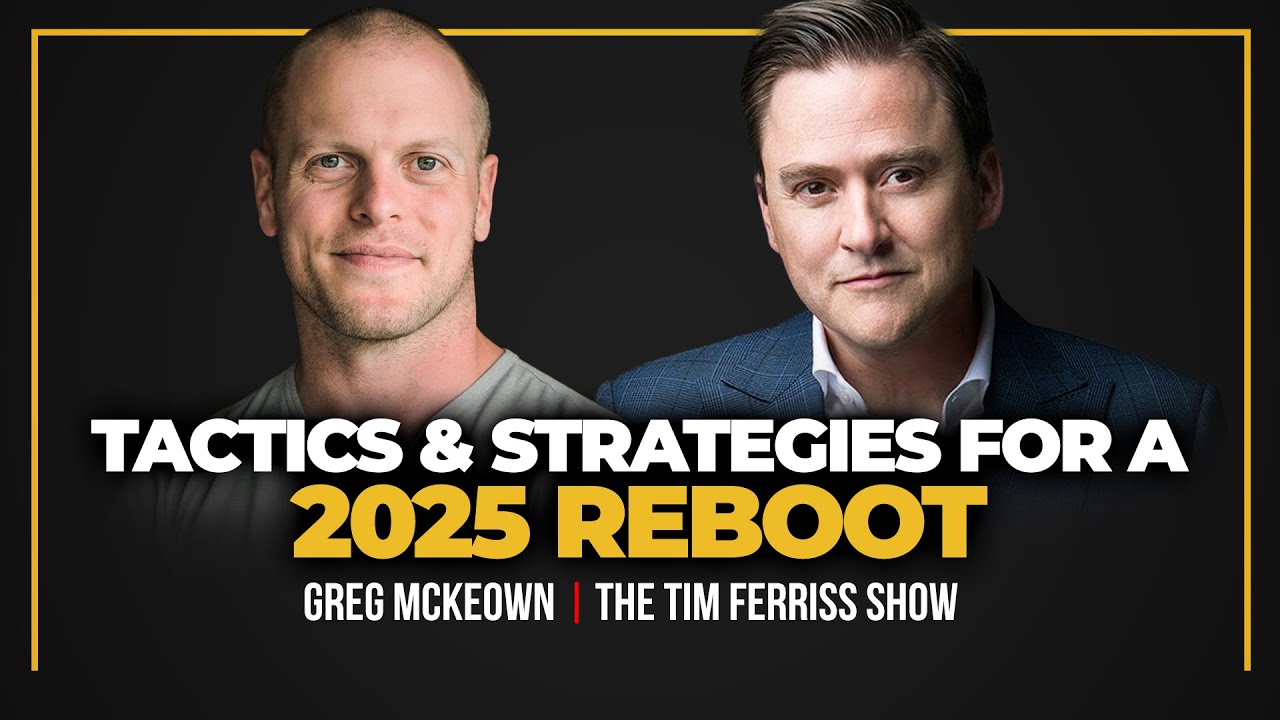
Greg McKeown: Author of Essentialism and Effortless, speaker who has taught these ideas to 400+ organizations worldwide; currently pursuing a doctorate at the University of Cambridge.
What this episode covers
Tim Ferriss and Greg McKeown begin with an unplanned detour on how to center yourself when life destabilizes you, prompted by personal hardship on both sides. McKeown distinguishes essentialism (focus, the right thing to do) from effortless (simplification, doing it the right way), then walks through concrete tools: temporal landmarks, the personal quarterly offsite, premortems, defining 'done,' the power half hour, and the 1-2-3 method. The back half turns toward meaning, where McKeown shares the impending loss of his best friend of 35 years and his daughter Eve's neurological illness as the ground for 'radical gratitude.' The conversation closes on post-traumatic growth, Rogerian deep listening, and McKeown's plan to teach a listening course.
Recommended on this episode
Essentialism: The Disciplined Pursuit of Less
Greg McKeown
“first of all you I'll recommend both books to everybody essentially m is one of my most highlighted Kindle books that I have”— Tim Ferriss
Effortless: Make It Easier to Do What Matters Most
Greg McKeown
“I'll recommend both books to everybody essentially m is one of my most highlighted Kindle books that I have effortless is similar”— Tim Ferriss
The Collapse of Complex Societies
Joseph Tainter
“it's a brilliant book written about this by Joseph tainer called the the collapse of complex Societies in which he says”— Greg McKeown
The guest's own work
Tools of Titans
Tim Ferriss
“someone was just raving to me last night about tools of titans this is the groom who just was married oh amazing”— Greg McKeown
Essentialism Planner
Greg McKeown
“I think I have something now that special and it works and it's so helpful to me I think I'm ready to actually get into contract and do it”— Greg McKeown
Also referenced (named, not recommended)
Man's Search for Meaning
Viktor Frankl
“Victor Frankle in his in his creation of logo therapy out of the Nazi Germany concentration camps he crafts his story and man search for meaning”— Greg McKeown
Ridiculousness
MTV
“his first big show was Robin big and then before that he was famous as a skateboarder lots of people listening to this know already who Rob Dear deck is”— Greg McKeown
Big reveals from this episode
- McKeown introduces 'instinctive elaboration', when given a prompt your mind cannot help but think about it, and uses it by raging into a 'what / so what / now what' download, even recording audio and uploading it to ChatGPT for a reframe.
- He suggests prompting ChatGPT to respond as psychotherapist Carl Rogers, the most influential figure in psychotherapy per two surveys of psychologists, to get empathic restating rather than premature advice.
- Essentialism in one word is Focus and Effortless in one word is simplification; essentialism is figuring out the right thing to do (explore, eliminate, execute) and effortless is doing it the right way.
- McKeown's 'law of inverse prioritization': the most important thing in our lives at any given time is the least likely thing to get done, because its high stakes create performance anxiety and vulnerability.
- Using Michael Phelps and coach Bob Bowman, he explains building a strategic narrative (where you've been, are now, want to go, what could stop you) and routinizing everything as a premortem, including mentally rehearsing swimming with goggles full of water.
- Defining 'done' is framed as a natural law, if you don't know what done looks like you cannot be done, feeding the 1-2-3 method: one most important thing, two essential-and-urgent things, three maintenance items equals done for the day.
- Radical gratitude defined as expressing thanks for things you are NOT thankful for; McKeown forces himself to say he is grateful his dying best friend is ill 'because' it compels him to live doubly.
- Post-traumatic growth, not just resilience or collapse, is presented as the under-referenced outcome where people move to a higher level after trauma, 'beauty for ashes' as a tangible, not merely poetic, reality.
Worth remembering
- The 'screaming onto the page' technique moves a person from confusion to clarity to creation, and from prisoner to observer to creator.
- Two surveys of psychologists (around 1980 and around 2000) both named Carl Rogers the most influential figure in psychotherapy, ahead of Freud.
- 'Temporal landmarks' / the Fresh Start effect: any date (birthdays, anniversaries, quarter-starts, a child's birthday) can serve as a fresh start, so you want as many as possible per year.
- McKeown has kept a journal for nearly 14 years without missing a day by setting an upper bound of five sentences and a lower bound of one.
- Joseph Tainter's 'The Collapse of Complex Societies' argues societies grow fragile by solving problems with added complexity, with no mechanism to reduce it other than failure.
- Phelps arrived two hours before every race, never lay down on the massage table, controlled his music, mounted the blocks from the left, and dried the block, all routines built from previously identified problems.
- For ten years before Beijing, Phelps mentally rehearsed the perfect race in slow motion every morning and night, including contingencies like goggles filling with water, which actually happened, and he still won.
- Phelps won eight gold medals in Beijing; the framing was that seven would make him 'the first man on the moon' and eight 'the first man on Mars.'
- Rob Dyrdek (Ridiculousness, Rob & Big) maintains a roughly 50-page living document called 'the rhythm of experience' that his whole team can access, turning every lesson into a permanent system.
- The term 'sonder' describes the realization that every stranger's life is as complex and emotionally challenging as your own.