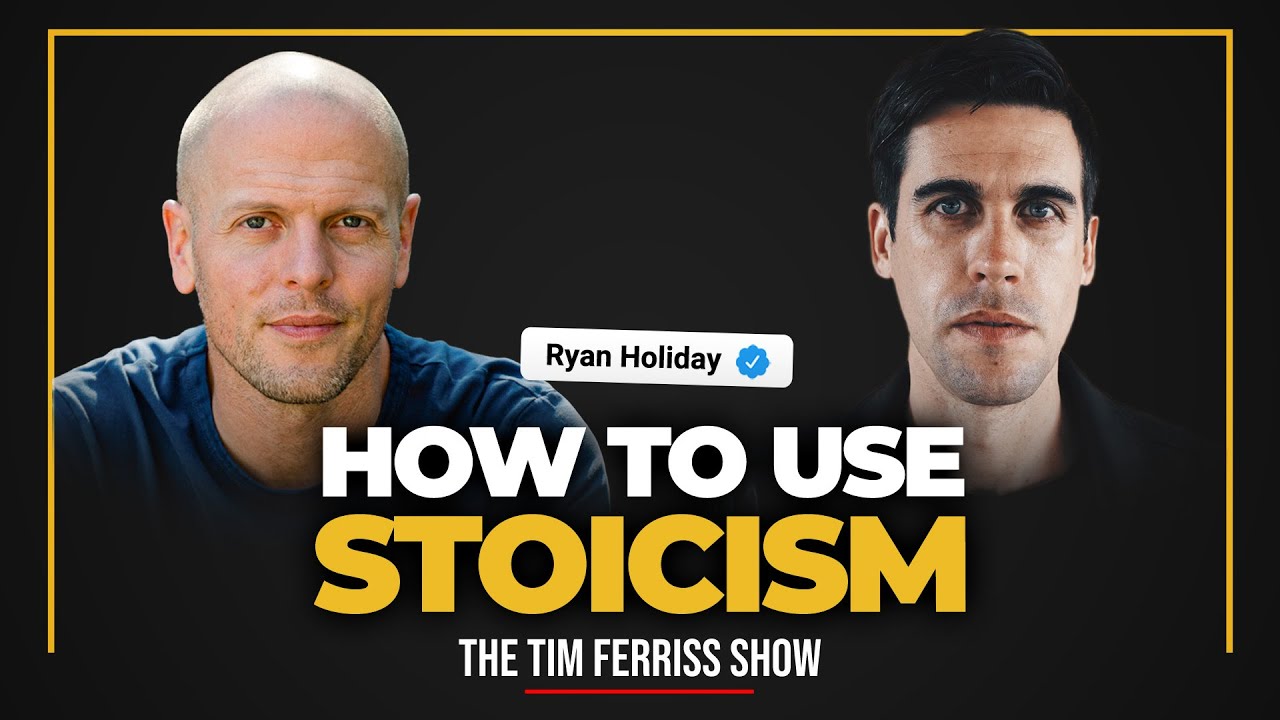
Ryan Holiday: Author of bestselling books on Stoicism including The Obstacle Is the Way and the Daily Stoic. A former marketing director at American Apparel turned writer who popularizes ancient Stoic philosophy for modern audiences.
What this episode covers
Recorded on April 1, 2020 at the onset of the COVID-19 pandemic, Tim Ferriss and Ryan Holiday discuss how ancient Stoic ideas help navigate fear, anger, loss aversion, and uncertainty. They explore premeditatio malorum and fear-setting, processing regret over financial decisions, and why anger is usually counterproductive. A central theme is Robert Greene's 'alive time versus dead time' framing and treating the quarantine as a sacred pause rather than mere survival. They close with practical guidance on civic duty and how individuals can help locally during crisis.
Recommended on this episode
The Black Swan
Nassim Nicholas Taleb
“The Black Swan or Fooled by Randomness specifically I think helped to explain what we are contending with... I think that is that is worth reading.”— Ryan Holiday
Fooled by Randomness
Nassim Nicholas Taleb
“The Black Swan or Fooled by Randomness specifically I think helped to explain what we are contending with... I think that is that is worth reading.”— Ryan Holiday
The 48 Laws of Power
Robert Greene
“Then The 48 Laws of Power do a great job of explaining that... Those are three fantastic uh books for the for the quiver.”— Ryan Holiday
Mastery
Robert Greene
“if you take Mastery and The 48 Laws of Power combined, those can act as a possible road map for the abilities you want to develop... Those are three fantastic uh books”— Ryan Holiday
The guest's own work
The Obstacle Is the Way
Ryan Holiday
“this is my Marcus Aurelius statue. I bought this when I was writing The Obstacle Is the Way.”— Ryan Holiday
Also referenced (named, not recommended)
Meditations
Marcus Aurelius
“And then I have Meditations right here. then and then Meditations right.”— Ryan Holiday
Antifragile
Nassim Nicholas Taleb
“And then Anti-Fragile? Anti-Fragile, but The Black Swan or Fooled by Randomness specifically I think helped to explain what we are contending with”— Ryan Holiday
Letters from a Stoic (Moral Letters to Lucilius)
Seneca
“this definitely hearkens back to certainly some of the moral letters to Lucilius, if you want to cite some of the sources.”— Tim Ferriss
Cato, a Tragedy
Joseph Addison
“George Washington... had the troops perform... a play about It was Cato, right? Yeah. It's Cato to boost morale and continue the fight.”— Ryan Holiday
Big reveals from this episode
- Tim describes selling a portion of his Uber stock around $40/share in early 2020 but choosing to hold the rest, after an experienced investor told him to commit to a 5-year hold and prepare for the price to drop to $15-$20.
- Roughly two and a half weeks after Tim mentally prepared for $15/share, Uber actually hit about $14/share.
- Ryan recounts campaigning for the cancellation of South by Southwest, being attacked as an alarmist, but standing firm because he felt the data were on his side.
- Ryan reframes the central question from 'how can I survive?' to 'how could I most profit and benefit from the next 3 to 6 months?' to avoid placing a ceiling on visible options.
- Ryan introduces Robert Greene's dichotomy of 'alive time or dead time' as the key framework for using any block of time you cannot control.
- Ryan points out Tim's bookshelf holds a 'trifecta' for understanding the crisis: The Black Swan (or Fooled by Randomness), The 48 Laws of Power, and Mastery, plus Meditations.
- Ryan reveals that his Epicurean tendencies (tending the garden, drinking wine) are only possible because Stoicism provides the safety net beneath him, rooted in childhood trauma and lifelong hyper-vigilance.
- Ryan and Tim agree the crisis can foster community where it had broken down, with Ryan noting more contact with neighbors in a few weeks than in years.
Worth remembering
- Ryan unwrapped a bust of Seneca that had been sitting in storage in bubble wrap and placed it in a room he and his girlfriend use in the mornings.
- Ryan's Marcus Aurelius statue dates from 1840 and has survived cholera, smallpox, polio, the Spanish flu, and the 1950s flu epidemics.
- Bill Ackman at Pershing reportedly made around $2.6 billion from short positions during the crisis.
- Ryan cites Krista Tippett's idea (from the On Being podcast) that anger is fear shown publicly.
- Both Dean Martin and Mike Tyson would vomit from nerves before performances/fights; Tyson's trainer Cus D'Amato said the hero and the coward feel the same fear, but it's what the hero does that differs.
- The episode was recorded on April 1, 2020, when New York City was described as the global epicenter, the 'Hubei of the US,' with 85 refrigerated trailers brought in as temporary mortuaries.
- Marcus Aurelius ruled for 15 years during the Antonine Plague, forgave most debts owed to the empire, and sold imperial palace treasures on the palace lawn to revive the economy.
- At Valley Forge, George Washington had his troops perform the play Cato to boost morale and sustain the fight.
- Ryan recounts that Robert Greene first told him about alive time versus dead time when Ryan had a year left owed to American Apparel before leaving to become a writer.
- Ryan notes Malcolm X gave himself a college education while imprisoned, and Isaac Newton and Shakespeare did some of their greatest work during plague quarantines.