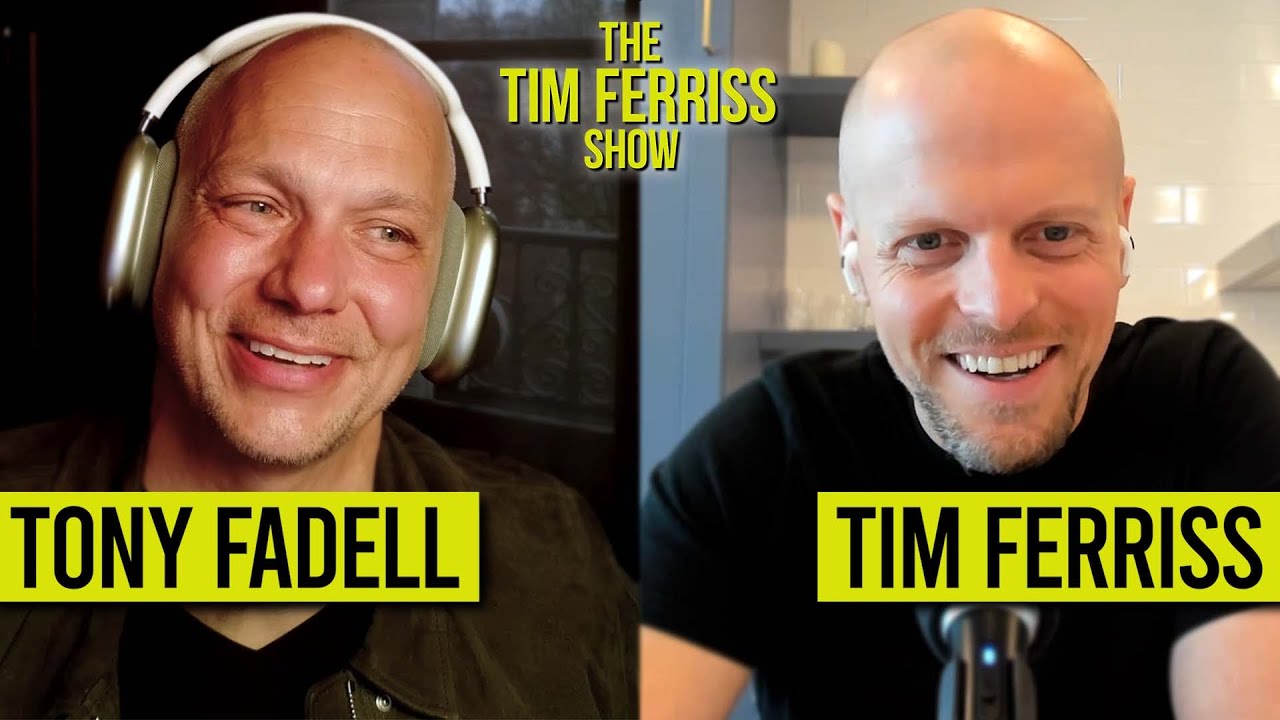
Tony Fadell: Inventor of the iPod and Nest thermostat, former Apple SVP, founder of investment firm Future Shape, and author of the book Build: An Unorthodox Guide to Making Things Worth Making.
What this episode covers
Tony Fadell returns to talk with Tim Ferriss about his book Build, framed as a 'mentor in a box' distilled from years of advising startup founders. He shares hard-won lessons on working sustainably (including how Steve Jobs really took vacations), running small teams via task-sharing versus task-separation, and the craft of storytelling as a tool to define a product rather than just sell it. The bulk of the conversation turns to his investing thesis at Future Shape, a small family-funded firm of about nine 'mentors with money' focused on disruptive deep-tech for the planet, society, and health. He details specific bets on more efficient electric motors, next-generation electrical switches, home-compostable plastics, the hydrogen and biomass economies, and carbon removal. He closes on cultivating optimism, fixing your media diet, and treating the 'sick planet' like an ailing family member worth fighting for.
Recommended on this episode
Of Wolves and Men
Barry Lopez
“I was reading a book called Of Wolves and Men by Barry Lopez. It's one of my favorite non-fiction books.”— Tim Ferriss
Speed & Scale: An Action Plan for Solving Our Climate Crisis Now
John Doerr
“this is a great great place to start, which gives a great overview. Speed and Scale. That's John Doerr's latest compilation. I think that's a really great one.”— Tony Fadell
The Hundred-Year Marathon
Michael Pillsbury
“I've been reading books like the 100-year marathon. That's by Michael Pillsbury. Those are two really great books that people should read.”— Tony Fadell
Principles for Dealing with the Changing World Order
Ray Dalio
“I'm also been really fascinated by the changing world order by Ray Dalio. these books do a great job of illuminating those things.”— Tony Fadell
The guest's own work
Build: An Unorthodox Guide to Making Things Worth Making
Tony Fadell
“So, you have this new book Build subtitle an unorthodox guide to making things worth making which is incredibly well put together.”— Tim Ferriss
Also referenced (named, not recommended)
TurnTide
Turntide Technologies
“So, one company that we invested in is TurnTide. And we've been there well before they before they were named TurnTide.”— Tony Fadell
Menlo Micro
Menlo Microsystems
“Another company that we're in is called MenloMicro. MenloMicro's all about the distribution of electricity from place to place.”— Tony Fadell
Redwood Materials
“Some people are looking at it now, battery recyclers are getting into the act, like Redwood Materials, those kinds of things.”— Tony Fadell
Stripe
“I've looked very closely at what Stripe has done, which I think is really innovative and inspiring.”— Tim Ferriss
Climeworks
“And we see Climeworks and we see other people trying to put up these big factories, so to speak, to suck in air and take out CO2.”— Tony Fadell
Charm Industrial
“I want to say that one, you know, Charm Industrial would fall into the second category, I believe, and I've been quite impressed by them.”— Tim Ferriss
Carboculture
“So, there's another one called Carboculture. They're also doing the biochar. So, Carboculture is there. And they're doing it en masse.”— Tony Fadell
Remora Carbon
“I heard of one recently and I can't speak to the company. I haven't done any diligence on this at all, but great name. It's called Remora Carbon.”— Tim Ferriss
My Climate Journey
“There's also things like My Climate Journey. Talks about people who are in the industry and trying to solve things.”— Tony Fadell
Skype
Microsoft
“we we go between WhatsApp and we go between of all things Skype. We started on Skype years ago before all of this other stuff. And it works.”— Tony Fadell
Meta
“So, interestingly enough, we go between WhatsApp and we go between of all things Skype.”— Tony Fadell
Big reveals from this episode
- Steve Jobs never truly disconnected on vacation; after the first 48-72 hours he would call (not email) up to five or six times a day to brainstorm new product directions, acquisitions, and technologies.
- Fadell worked 80-110 hour weeks early on because he thought he had to prove himself through hours, and only later learned he had undiagnosed ADD/ADHD during his General Magic years.
- His framework for small teams: 'task sharing/time sharing' (two people who self-manage as one) versus 'task separation' (each owns specific buckets), with the key insight that he rotates tasks every half year so people don't get locked in a rut.
- The core storytelling lesson: a story doesn't exist to sell your product, it exists to help you define it; he wrote the press release for Build before writing a single page.
- Steve Jobs' seemingly effortless, note-free iPhone launch was the result of refining the story daily with his team for a long time, using it as the 'true north' for product decisions.
- Fadell openly addresses being called an 'asshole': the chapter took seven or eight rewrites, and he distinguishes passionate pushing in service of the mission from ego-driven, degrading behavior, which should never be allowed.
- Fadell's reframe on inflation: it isn't being done to us; we created decades of artificial deflation by offshoring labor and pushing externalities (climate, healthcare) onto others, and now we're finally paying the true price.
- All profits Fadell earns from the book go to a climate fund he runs, and he is matching that money five times over to invest in climate solutions.
Worth remembering
- Future Shape calls itself 'mentors with money'; roughly 70-80% of its portfolio is expected to fail or push, with the other 20-25% potentially being dramatic wins.
- About 60% of all energy created in the world today is lost to inefficiencies before it ever does useful work.
- Portfolio company TurnTide makes a next-generation electric motor that is 10-15% more efficient and eliminates rare-earth magnets.
- MenloMicro uses tiny MEMS silicon switches to replace electromagnetic relays essentially unchanged since the 1800s; over 20 billion relays are sold per year.
- In India, 8% of all the country's electricity is consumed by ceiling fans, and a single inexpensive wall switch from MenloMicro could cut that to 4%.
- Biochar locks plant carbon into a stable form that stays in the ground for thousands of years while also producing energy, which Fadell calls a win-win for carbon sequestration.
- Remora Carbon builds carbon-capture scrubbing technology that piggybacks on semi-trailer trucks, named after the remora fish that rides on sharks.
- Future Shape was a fully virtual team well before COVID, and uses WhatsApp and, of all things, Skype for its group chats to keep the channel uncluttered.
- Non-lithium batteries (sulfur-, sodium-, and iron-based) are coming, letting technology be matched to locally abundant resources and reducing geopolitical supply-chain risk.
- Fadell recommends Speed and Scale by John Doerr, The 100-Year Marathon by Michael Pillsbury, and Ray Dalio's The Changing World Order for understanding climate and geopolitics.